As the Philippines prepares to assume the Asean chairmanship in 2026, key officials from the Marcos administration have called for the need to position the country to champion stronger regional cooperation on blended finance to drive sustainable development.
Speaking at Eco-Business’ Unlocking capital for sustainability Philippines forum in Metro Manila last week, central bank representative Ellen Joyce Suficiencia said that the country will be pushing for more regional initiatives on climate and energy finance as it builds on Malaysia’s current chairmanship and leads the regional bloc next year.
In the opening plenary, Suficiencia, who is director of the Bangko Sentral ng Pilipinas’ (BSP) sustainability office, said that the central bank is working to bolster partnerships on blended finance among the Asean nations.
“[We hope] to bridge the public and private sectors with non-governmental organisations and philanthropists, giving them a platform to share and hopefully co-invest in adaptation and resilience,” said Suficiencia.
She added that in leading Asean next year, the Philippines aims to develop a regional initiative to scale blended finance and promote more investments in forward-looking adaptation projects in Southeast Asia.
“[We hope] to champion a framework that sets out what each actor [in the Asean group of countries] can do to promote blended finance and sharpen the focus of how to unlock climate finance through de-risking mechanisms,” Suficiencia explained.
Across Southeast Asia, there has been the emergence of blended finance facilities dedicated to investments in the region in recent years. But Asean officials and regulator have also previously flagged that the majority of blended finance transactions have been focused on renewables; annual blended finance volumes across Asean countries have also largely remained flat over the past five years.

The Philippines could push to accelerate sustainable bond issuances in the region, partly by lowering issuance costs through blended finance, suggested Rachel Esther Gumtang-Remalante, director of corporate governance and finance at the Securities and Exchange Commission (second from right). The SEC representative was speaking on a panel at the Unlocking capital for sustainability Philippines forum moderated by Eco-Business founder and CEO Jessica Cheam (first from right). Image: Eco-Business
At the same plenary, Rachel Esther Gumtang-Remalante of the Securities and Exchange Commission added that the Philippines could push to double sustainable bond issuances in the region, partly by lowering issuance costs through blended finance.
Blended finance – which combines public and philanthropic funds to catalyse larger private investments – is seen as increasingly vital as Western aid to Southeast Asia wanes.
Traditional official development assistance (ODA) has fallen sharply: the United States, European Union, United Kingdom, France and Germany have all slashed their aid budgets since 2023, with global aid projected to decline another 9 to 17 per cent this 2025. The Lowy Institute estimates Southeast Asia could lose more than US$2 billion in development finance by 2026.
For the Philippines, this shift also coincides with a changing development profile. In her keynote address, Dr Noralene Uy of the Department of Environment and Natural Resources (DENR) noted that by 2026, the country expects to graduate to upper middle-income status, which will mean less access to concessional loans and grants, albeit with greater creditworthiness.
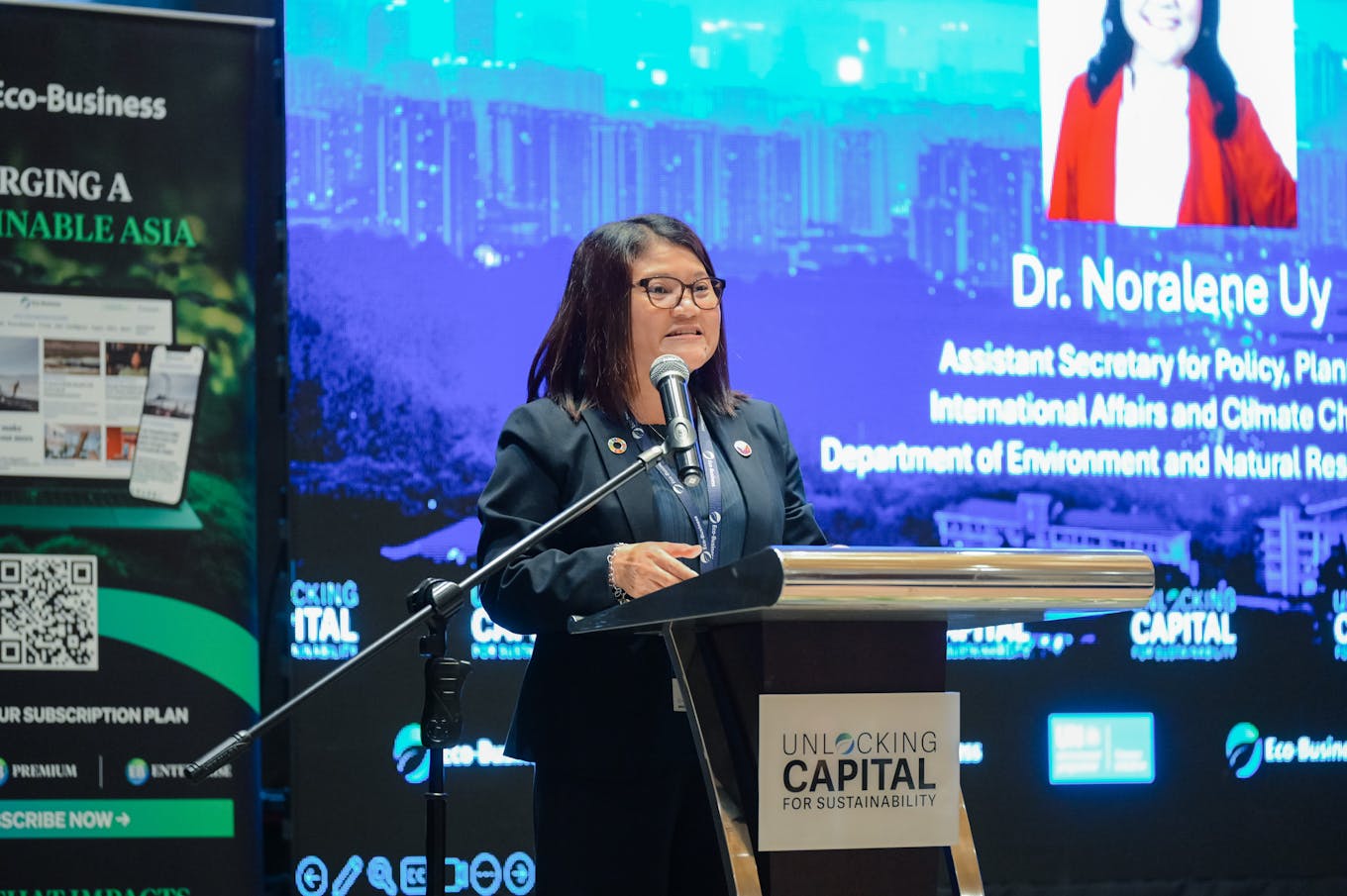
By 2026, the Philippines expects to attain upper middle-income status, reducing its access to concessional loans but boosting its creditworthiness. “Unlocking finance is a starting point and would be the key enabler for accelerated climate action,” said DENR assistant secretary Dr Noralene Uy. Image: Eco-Business
“Unlocking finance is a starting point and would be the key enabler for accelerated climate action,” said the DENR assistant secretary for policy, planning, international affairs and climate change, noting that the Philippines will also be leading the development of the Post-2025 Asean Strategic Plan on Environment and the Asean Blue Economy Implementation Plan.
Uy further stressed that advancing sustainable growth will require “innovative and integrated actions from all stakeholders” through an “all-of-society approach”.
Angelo Kairos dela Cruz, executive director of the Institute for Climate and Sustainable Cities, said cross-border initiatives such as the Asean Power Grid could allow the Philippines to export offshore wind energy. Pilot projects such as floating solar power between Singapore and Indonesia, and the Lao PDR–Thailand–Malaysia–Singapore Power Interconnection, already demonstrate that regional energy trade is feasible with political alignment.
The stakes are high. Southeast Asia will need at least US$7 billion in concessional finance between 2026 and 2030 to stay on track for net-zero targets, according to the International Energy Agency.
Without decisive action, climate impacts could cut the Philippines’ GDP by 7.6 per cent by 2030 and as much as 13.6 per cent by 2040. “For the Philippines, this signals both opportunity and urgency,” said Climate Change Commission commissioner Rachel Anne Herrera, pointing to rising risks from typhoons, floods, and droughts.
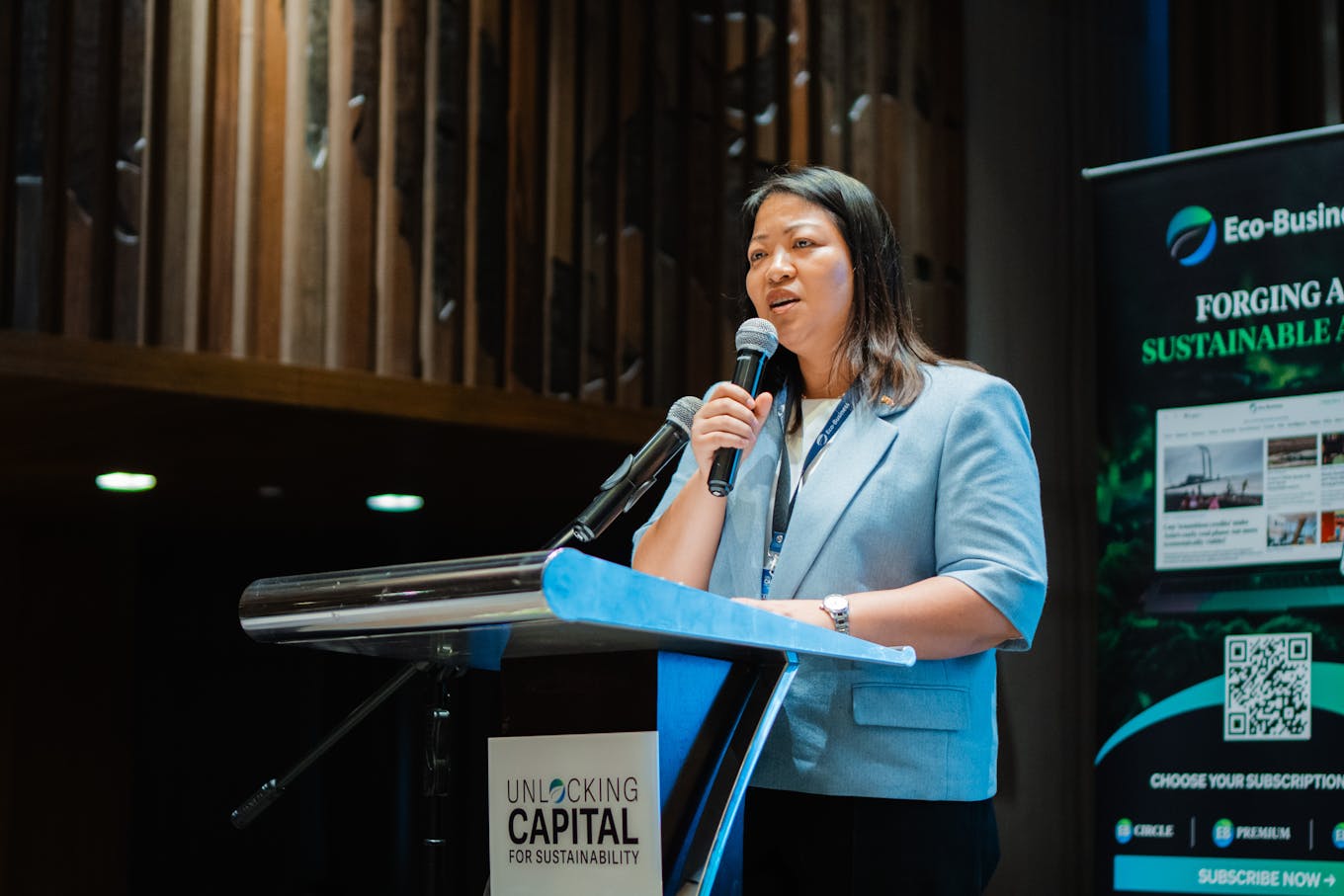
Climate impacts could slash the Philippines’ gross domestic product by up to 13.6 per cent by 2040 if interventions stall. For the country, this moment signals both “opportunity and urgency,” said Climate Change Commission commissioner Rachel Anne Herrera. Image: Eco-Business
Private capital could help fill the gap. Analysts estimate US$4.5 trillion in global private financing is waiting for investable opportunities, while Asean has already recorded 107 blended finance deals worth over US$20.7 billion, with renewable energy taking the largest share. Indonesia, the Philippines, and Vietnam have led the region in deal activity.
In a speech commemorating the 58th founding year of the Southeast Asian cooperation last month, President Ferdinand Marcos, Jr pledged that the Philippines’ chairmanship will “build on Asean’s achievements in responding to the region’s evolving priorities and in facing emerging challenges.”
In her closing keynote, Herrera concluded that this moment could define the region’s trajectory. “The Philippines knows the [climate] crisis well. But we also know resilience. We know bayanihan. We know the power of coming together,” she said. Bayanihan is Tagalog for a spirit of communal unity.
“The window for opportunity is fast closing. Let us not waste it,” she urged.
Follow our coverage on Eco-Business’ flagship sustainable finance and business forum Unlocking capital for sustainability here.