
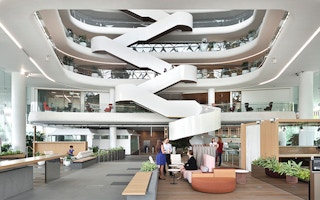



Working in a sustainable building is good for people’s health and well-being, according to a growing body of research on the impacts of green buildings on occupants’ health and productivity.
The green buildings concept was initially about reducing the environmental impact of buildings by improving factors such as energy efficiency and waste management. But as health and wellness move up the list of priorities for employees around the world, building developers are moving beyond environmental goals to provide amenities that promote health and foster productivity.
In Singapore, the Green Mark for Healthier Workplaces scheme was launched to promote employee health alongside environmental sustainability in the office. Similarly, the Well Building Standard, administered by the United States-based International Well Building Institute (IWBI), rates buildings according to how wellness has been integrated into the built environment.
More employers are also realising the benefits of employee health for their businesses and are working to integrate features and programmes into the work environment that can boost job satisfaction and innovation. According to Emma McMahon, director of sustainability at CBRE, a commercial real estate services company, businesses find there is significant risk mitigation and reduction in absenteeism when employees are more engaged and motivated by a healthy work environment.
“About 90 per cent of a company’s operational costs are locked up in its people,” said McMahon, who sat on a panel titled ‘Healthy Places for Senses’ at the International Green Building Conference (IGBC) in Singapore. “There’s huge potential to unlock the benefits around health and well-being that can be driven from costs associated with salary and benefits.”
Building the business case for healthy workplaces
According to Neo Yi Lin, deputy director at the workplace health and outreach division at the Health Promotion Board (HPB), more companies are realising these benefits and recognising the business value of putting health at the centre of workplace design. She said: “People in these spaces found work more enjoyable and there was more tenant engagement and greater awareness of the developer’s brand. In a very competitive market, you cannot be competing on rent alone.”
Recent studies have shown that green buildings provide optimised environments that are beneficial for human health, through features such as natural lighting and better air quality. A 2017 study by researchers from Harvard University, Syracuse University and SUNY Upstate Medical University on the Impact of Green Buildings on Cognitive Function found that participants in green office environments were more productive than those in conventional buildings. Those working in well ventilated environments were also the ones with the highest levels of cognitive function.
According to McMahon, growing interest in the impact of green buildings on occupant health reflect a cultural shift in the work place. She said: “We used to sit in cubicles and smoking was largely allowed in the office. The workplace of the past looked very different.”
These days, the industry is witnessing greater innovation and creativity to make buildings better places for people. At the building conference, experts shared several ways health and wellness have been integrated into the workplace.
1. Greening the office with biophilic features
As the world rapidly urbanises city dwellers are increasingly cut off from nature, with office employees spending close to 90 per cent of their time indoors. To counter the stresses of the urban, built environment, biophilic design aims to bring nature into the workplace. This includes introducing living plants, natural daylight, green walls, timber exteriors and patterns and colours that evoke nature.
Growing research reveals that biophilia has distinct physiological and psychological impacts on humans. Integrating elements that tap into this connection between man and nature has been found to reduce stress and improve productivity as well as creativity in the workplace.
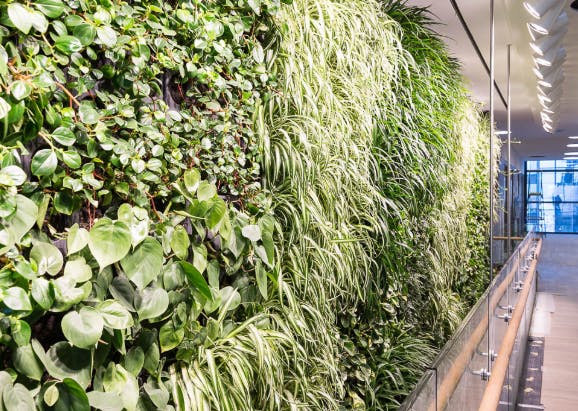
A “breathing wall” designed by Australian greening company Junglefy improves the indoor air quality of buildings. Image: Junglefy
2. Providing healthier diet options
Companies are offering healthier food and drink alternatives by stocking their fridges with non-carbonated drinks and putting healthy snacks such as fruit and nuts in the pantry. A few have even introduced smoothie blenders to cut dependency on coffee. Better nutritional options in the workplace have the greatest positive impact on employees. When compared to other factors such as natural space, good lighting and physical exercise, diet is perceived to result in the highest increase in productivity—52 per cent, according to research by CBRE.
McMahon attributes this to how diet has a direct, sensorial impact on people. She said: “We can physically feel what we’re putting in our bodies. We know how we feel afterwards.”
According to Neo, studies by HPB reveal that more employees in Singapore suffer from obesity or are overweight compared to those who were unemployed. There is also a higher tendency in the working population to suffer from diseases such as cancer, and develop obesity later on in life. She said that the board is currently working with canteen operators—whose main customers are office workers—to make healthier options more affordable.
3. Encouraging physical activity
Green buildings have created conducive environments for health by providing more opportunities for exercise and physical activity. Exercise facilities and equipment are now available in certain offices, while bike racks have been made more accessible to office workers to encourage a more active lifestyle.
Global pharmaceutical company GlaxoSmithKline (GSK) promotes exercise in its Asia headquarters in Singapore with wide staircases across the six levels of the building, and visual cues to encourage climbing instead of using the lift. Singaporean interior construction company Facility Link, which has earned Green Mark Platinum status, the highest qualification for green buildings in Singapore, encourages its employees to exercise by conducting fitness classes during lunchtime. Speaking at IGBC, general manager Jason Chok said that the company was actively trying to get its employees to partake in joint workout sessions and participate in running races together.
4. Allowing time and space to ‘detox’
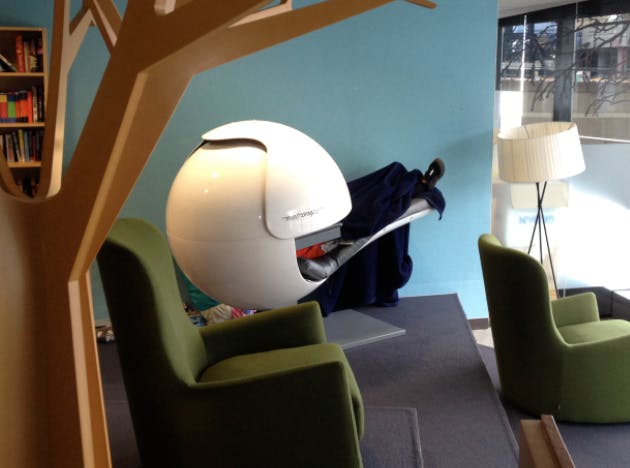
An occupied sleep pod in Google’s offices in Sydney. Image: Mumbrella
Just as employers encourage healthy living, they are also trying to reduce work-related stress and improve employees’ mental health by providing space to relax. Vacant rooms have been converted into spaces to do yoga, pilates and even house massage chairs and sleeping pods for employees to rest.
According to McMahon, sleeping pods are high in demand among millenials, who are driving these changes in the new workplace. Recent trends confirm that both multinationals and small to medium enterprises are introducing such facilities for their employees to recharge and take respite from their hectic schedules.
5. Cultivating an open workplace
Co-working spaces not only cut cost for businesses, they promote employee well-being and motivate people to go to work. Functioning as a shared ecosystem of talent and services, the co-working space provides opportunities for socialisation and knowledge transfer. The open workplace concept encourages people to move, collaborate and network, improving engagement and boosting their mental health.
“We work in more collaborative spaces, with a lot more focus on activity-based working,” said McMahon of CBRE. She cited the availability of shared resources in these spaces, such as large tables that can be converted to play ping pong, that both work to encourage exercise and social engagement.