
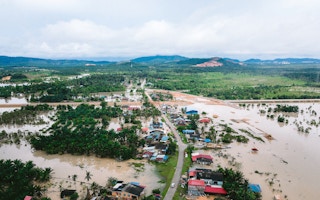

Malaysia’s total flood-related losses declined to US$161.2 million (RM636.9 million) in 2025 from US$236.3 million (RM933.4 million) the year before, although damages to public assets and infrastructure rose year-on-year, based on the latest report by the Department of Statistics Malaysia (DOSM).
To continue reading, subscribe to Eco‑Business.
Access all our exclusive content and archive — with a 7-day free trial. Then just US$5/month. Cancel anytime.
- Exclusive access to training across business and policy topics
- Direct access to industry leaders at Eco-Business events
- A seat among the decision makers shaping the region's sustainable development
In a special report titled Impact of Floods in Malaysia 2025, DOSM said total losses were equivalent to 0.03 per cent of nominal gross domestic product (GDP), down from 0.05 per cent in 2024.
Flooding is a growing economic concern for Malaysia after widespread floods in 2021 caused over RM6 billion (US$1.5 billion) in damage and led to insurers raising premiums and tightening underwriting.
Yesterday, heavy rains led to flooding across multiple main highways in capital Kuala Lumpur. A mud flood occured on a slope of Kiara Hill, which had been deforested for the construction of a new government office and for which a stop-work order has been issued.
DOSM’s assessment covered floods that occurred between January and December 2025 across all affected states. Losses included damage to living quarters, vehicles, business premises and industrial facilities, as well as agricultural losses and damage to public assets and infrastructure.
Public assets and infrastructure recorded the largest losses at US$96.3 million (RM380.2 million), up from US$76.8 million (RM303.4 million) in 2024, whereas losses to living quarters fell to US$46.5 million (RM183.8 million) from US$94.2 million (RM372.2 million) previously.
Agricultural losses also declined to US$13.3 million (RM52.6 million) from US$46.9 million (RM185.2 million) in 2024. Business premises recorded US$3.4 million (RM13.4 million) in losses, down from US$13.7 million (RM54.1 million).
Meanwhile, vehicle damage totalled US$1.7 million (RM6.8 million) compared to US$4.4 million (RM17.3 million) in 2024. The manufacturing sector recorded approximately US$19,200 (RM76,000) in losses compared with US$303,800 (RM1.2 million) the year prior.

Share of total flood losses by type of damage in Malaysia, 2024 and 2025. Image: Department of Statistics Malaysia
Although the overall flood losses for Malaysia declined in 2025, most states along Peninsular Malaysia’s west coast and Sabah and Sarawak in East Malaysia experienced higher losses than the previous year.
Still, it was the east coast states that continued to record the highest overall flood losses, with Terengganu losing US$22.6 million (RM89.2 million), followed closely by Kelantan at US$22.4 million (RM88.5 million). Johor recorded losses of US$18.3 million (RM72.1 million) while Sarawak, Sabah and Selangor posted substantial losses at US$15.5 million (RM61.2 million), US$14.8 million (RM58.4 million) and US$13.4 million (RM52.9 million) respectively.
Terengganu and Kelantan are among the states most frequently affected during Malaysia’s northeast monsoon season, which typically brings prolonged heavy rainfall from November to March. Their location along the east coast of Peninsular Malaysia, combined with low-lying river basins and coastal plains, makes them particularly vulnerable to riverine flooding and overflow when intense monsoon rains coincide with high tides.
The DOSM stated that case studies conducted in selected areas of the East Coast showed that more than half (51.2 per cent) of flood victims adopted proactive measures by maintaining reserves of daily necessities to ensure their survival during emergency situations.
Of the victims, 5.5 per cent had insurance coverage as a form of financial protection against potential damage or losses. However, 22.5 per cent made no prior preparations, increasing their vulnerability during and after flood events.
The World Bank has warned that as climate change intensifies storms and rain fall, Malaysia will continue to see rising economic costs from flooding unless it integrates climate projections into national budget planning.

Comparison of flood losses across Malaysian states in 2024 and 2025. Image: Siva Selan/Eco-Business
The data also showed that housing damage is largely concentrated in East Malaysia. Sarawak recorded the highest losses to living quarters at US$8.3 million (RM32.6 million), a sharp increase from US$557,000 (RM2.2 million) in 2024. Sabah followed with US$7.0 million (RM27.7 million) from US$4.4 million (RM17.3 million), while Johor recorded US$6.6 million (RM26.2 million).
For business premises, Sarawak recorded the highest losses at US$0.7 million (RM2.7 million), followed by Johor at US$532,000 (RM2.1 million) and Sabah at US$456,000 (RM1.8 million). Sabah also registered the highest vehicle damage nationwide at US$329,000 (RM1.3 million).
Johor was the most affected state in the agriculture sector in 2025, with losses of US$3.3 million (RM13.0 million), followed by Selangor at US$2.4 million (RM9.6 million) and Kedah at US$1.3 million (RM5.0 million).
DOSM concluded that the findings underscore the need to strengthen preparedness, enhance financial protection and build household resilience to mitigate the impact of future floods.