
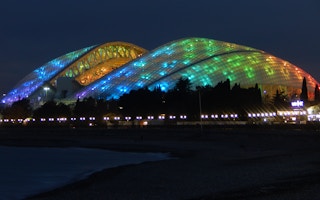

Football is packing stadiums to the brim each passing year, but with it comes an ugly environmental footprint.
To continue reading, subscribe to Eco‑Business.
Access all our exclusive content and archive — with a 7-day free trial. Then just US$5/month. Cancel anytime.
- Exclusive access to training across business and policy topics
- Direct access to industry leaders at Eco-Business events
- A seat among the decision makers shaping the region's sustainable development
From generating millions of tonnes of solid wastes to fans consuming truckloads of sausages that inflate the game’s carbon footprint, how can the beautiful game live up to its environmental responsibility?
American power tool company McCulloch reports that football’s sustainability game can be won where it is played. The company rounded up 12 of the world’s most sustainable football stadiums, including one built entirely from wood, and another that is naturally cooled by water.
Amsterdam ArenA, Amsterdam, The Netherlands
Home of the AJAX football club, the Amsterdam ArenA is the world’s first stadium with 100 per cent of seats made from sugarcane. It is also among the world’s first carbon-neutral stadiums and uses 4,200 solar panels and 11 strategically placed wind turbines to power its operations. The stadium is also cooled by water from a nearby lake.
Signal Iduna Park, Dortmund, Germany
Dortmund’s football club has partnered with renewable energy provider Lichtblick to power all of the stadium’s facilities—from training pitches to headquarters—with clean energy.
Forest Green Rovers, Nailsworth, England
Given that three-quarters of a stadium’s carbon footprint across its lifetime comes from the materials it is made from, the Forest Green Rovers Football Club decided to build its stadium only with wood, which is less carbon intensive compared to steel or cement.

An illustration of the Forest Green Rovers Stadium. Image: McCulloch
Olympic Stadium, London, England
The London Stadium’s sustainability achievement came after the 2012 Summer Olympics and Paralympic Games, when the stadium was demolished. In its place, the Environment Agency, working with the Olympic Delivery Authority (ODA) and the London Development Agency planted some 300,000 wetland plants and 2,000 native plants, built cycleways and footpaths, and turned 44 hectares of land into reedbeds, wet woodlands, grasslands, and ponds to attract wildlife. There are plans to build 6,800 new homes where the stadium used to be, and the Olympic Village has been repurposed as a new neighbourhood with 1,500 homes.
The Metlife Stadium, New York, US
The Big Apple’s 82,000-seat stadium was built using over 40,000 tonnes of recycled steel, with chairs made partially of reclaimed metals and recycled plastics. A solar ring on its roof powers the arena’s LED lights.

An illustration of the MetLife Stadium. Image: McCulloch
Estadio Mineirão, Belo Horizonte, Brazil
As one of the venues of the 2014 Fifa World Cup, the 62,000-seat Estadio Mineirão became the first Brazilian stadium to be fitted with a solar-powered roof in 2012. The stadium now powers nearly 1,000 homes every year with its 6,000 solar panels.
Morro da Mineira, Rio de Janeiro, Brazil
Opened by Brazilian football legend Pele, Morro da Mineira is the world’s first football pitch to convert the players’ movements into energy. Through the use of 200 kinetic tiles, the stadium produces enough electricity to power the six LED floodlights in a nearby favela so children can safely play football into the evening.

An illustration of the Morro da Mineira Stadium. Image: McCulloch
Metricon Stadium, Carrara, Australia
The Metricon Stadium on the Gold Coast has 574 solar panels that deliver up to 275,000 kWh of electricity to the national grid every year.
Estadio Alejandro Morera Soto, Alajuela, Costa Rica
Deportiva Alajuelense is Costa Rica’s first football club to power its stadium with solar panels in 2015, generating up to 400,000 kWh annually and saving the club an estimated $148,000 in electricity bills each year.
New Antalya Stadium, Antalya, Turkey
Antalya’s stadium became Turkey’s first solar-powered stadium in 2015, with solar panels covering up to 75 per cent of its roof and generating energy enough to replace the electricity used from the grid on match days.
Khalifa International Stadium, Doha, Qatar
Qatar will be the first Arab country to host a World Cup in 2022. Ahead of that, Khalifa International Stadium has installed a district cooling system—saving up to 40 per cent of energy compared to conventional cooling— and is the world’s first open-air air-conditioned stadium. It was awarded a four-star rating by the Global Sustainability Assessment System for this system, which consists of an energy centre located one kilometre away that pumps chilled water to the venue to keep temperatures down.
National Stadium, Kaohsiung, Taiwan
Completed in 2009, Taiwan’s famed dragon-shaped stadium is 100 per cent solar-powered, with the help of 8,844 solar panels that cover 14, 255 square metres. The stadium also replanted the trees that had been removed during construction . Other green credentials include rainwater harvesting and flood prevention technologies.
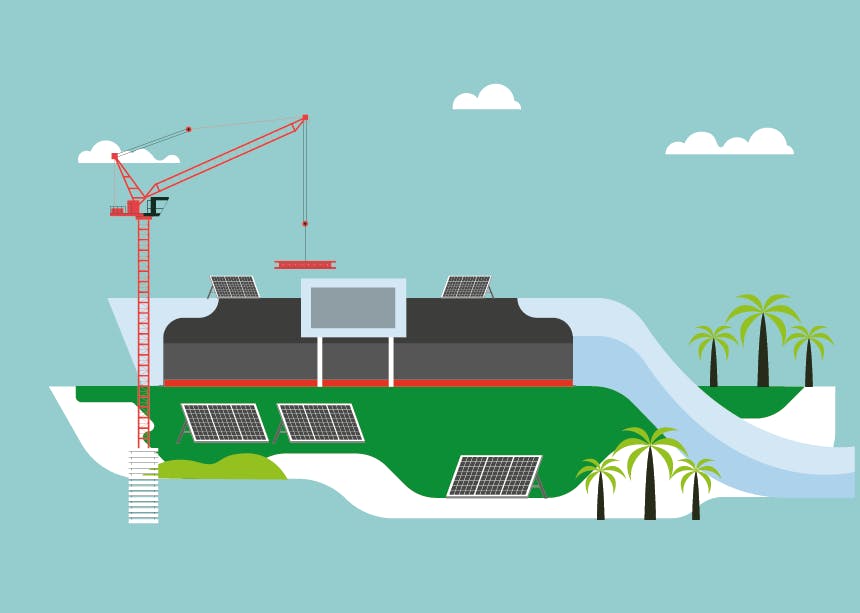
An illustration of the Kaohsiung National Stadium. Image: McCulloch