
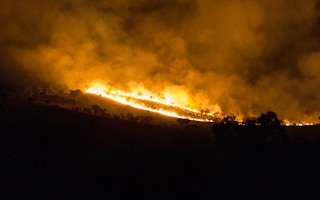
Australia’s insurance industry has escalated its response to the ongoing Victorian bushfires, declaring an insurance catastrophe as claims surge and analysts warn the fires reflect deepening climate-driven risks facing the country.
Industry body the Insurance Council of Australia (ICA) said the catastrophe declaration applies to bushfires that have burned across 18 local government areas since 7 January. Insurers have so far received 2,369 claims spanning residential properties, commercial assets and motor vehicles, with early estimates suggesting about 30 per cent of property claims are total losses – which means that the cost of repairing a property would be greater than the cost of rebuilding it.
The declaration follows an earlier “significant event” classification by the ICA and is intended to fast-track support for affected policyholders. Under the catastrophe status, insurers will prioritise claims, deploy disaster response specialists when conditions allow, and coordinate through an industry taskforce to address emerging issues.
“These bushfires have been devastating for many communities across Victoria, and insurers’ priority is getting help to people as quickly as possible,” said ICA deputy chief executive Kylie Macfarlane. She urged affected residents and businesses to lodge claims even if they have not yet returned to their properties or assessed the full extent of damage.
The escalating insurance response comes amid what analytics firm Moody’s has described as one of Australia’s most dangerous fire seasons since the catastrophic Black Summer bushfires of 2019–20. According to Moody’s analysis, prolonged heat and dry conditions returned to southeastern Australia in early January, following extreme weather late last year, underscoring the persistent and compounding nature of climate risk.
In Victoria alone, more than 400,000 hectares of bushland and farmland have burned – more than five times the size of Singapore. As of mid-January, around 30 fires were active across the state, including major blazes at Longwood, Walwa and Ravenswood. A State of Disaster has been declared for the same 18 local council areas covered by the ICA’s catastrophe declaration after temperatures exceeded 40°C and wind gusts reached up to 100 kilometres per hour.
Moody’s noted that hundreds of structures have already been destroyed or damaged, farmland has been heavily impacted and around 20,000 livestock killed, while power outages have affected thousands of homes and businesses. Fire danger ratings have reached extreme and catastrophic levels, with spillover risks also evident in parts of New South Wales.
Severe storms have followed the fires. On 15 January, parts of Victoria’s southwest coast recorded 166 millimetres of rainfall in a single day, triggering flash floods along sections of the Great Ocean Road that had only recently been closed due to bushfire threats. While further rain may help suppress fires, Moody’s warned it could also bring new hazards such as landslides and flooding.
“What makes 2026 stand out is not that fires are burning, but how multiple large fires, aligned with extreme conditions, have crossed into areas with significant property exposure,” said Iuliia Shustikova, product manager at Moody’s. Homes and businesses have been directly in the path of fire fronts, amplifying both humanitarian and economic losses.
Comparisons have been made with the Black Summer bushfires of six years ago. Those fires burned more than 10 million hectares in New South Wales and 1.5 million hectares in Victoria, destroying thousands of homes. While it is too early to estimate the full insured cost of the current event, Moody’s said the lesson for insurers lies less in total scale than in how compound drivers – heat, drought, wind and simultaneous ignitions – can rapidly overwhelm suppression capacity.
Moody’s also pointed to international parallels, including a January 2025 firestorm in Los Angeles that devastated urban neighbourhoods outside the traditional wildfire season. The slow recovery there, with fewer than 10 per cent of homes rebuilt a year later, highlighted the long tail of insurance exposure through additional living expenses and business interruption claims.





