
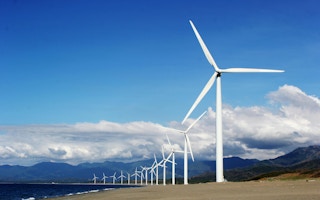

As countries ramp up investment in domestic renewable energy, China maintains its position as the world’s leading player in the global wind industry in 2025, accounting for 73 per cent of total installations.
To continue reading, subscribe to Eco‑Business.
Access all our exclusive content and archive — with a 7-day free trial. Then just US$5/month. Cancel anytime.
- Exclusive access to training across business and policy topics
- Direct access to industry leaders at Eco-Business events
- A seat among the decision makers shaping the region's sustainable development
The latest data from the Global Wind Energy Council (GWEC), a member-based organisation that represents the wind energy sector, shows that global wind power installations reached a record high of 165 gigawatts (GW) last year, up by 40 per cent from 2024.
Of that total, China alone accounted for 120.5 GW of newly added capacity, marking one of the largest single-year expansions by any country. More than 110 GW came from onshore wind, which accounts for the 73 per cent share in global onshore installations, the GWEC said in a press statement.
With the newly added capacity, China’s cumulative wind capacity has reached 640.5 GW, out of a global total of 1,299 GW in 2025. The figures underscore Beijing’s key role in shaping the direction and pace of the global wind energy transition.
The expansion aligns with China’s long-term climate targets of peaking emissions before 2030 and achieving carbon neutrality by 2060. In 2025 alone, more than 124 GW of future wind projects were approved under the country’s market-oriented pricing mechanism, a third higher than the previous year, signalling continued pipeline growth.
China also led offshore wind development, installing 6.6 GW of new offshore capacity. Globally, offshore wind installations reached 9.3 GW in 2025, bringing the total offshore capacity to 92.3 GW, closer to reaching the 100 GW milestone.
Commenting on this trend, Ben Backwell, chief executive of GWEC, said the steep increase in installations sets a new benchmark for the industry which is responding to higher demand of for homegrown, affordable and resilient renewable energy.
“At a time when skyrocketing oil and gas prices and supply shocks are once again causing disruption to economies around the world, the wind sector has demonstrated its ability to scale at speed. Accelerated growth led by Asia is enabling the rapid transition of fast-growing energy markets to electro-state economies, and showing that, where wind is built at scale, it can successfully compete with all alternatives, from coal to nuclear,” he said.
Asia dominates global growth
The 2026 Global Wind Report also showed that Asia-Pacific accounted for 131.8 GW of new installations in 2025, or 80 per cent of global additions, reinforcing the region’s central role in the energy transition.
Beyond China, India recorded its strongest year on record, with installations rising 86 per cent from 3.4 GW in 2024 to 6.3 GW in 2025. Having pledged to scale non-fossil fuel capacity to 500 GW by 2030 at the COP26 climate talks in 2021, India ranked third globally for new wind additions last year, behind the United States and ahead of Germany.
China and India added more than 126 GW combined in 2025, reflecting how Asian economies are scaling up wind power to meet rising electricity demand while strengthening energy security amid volatile fossil fuel markets.
Installations outside Asia also increased last year. Europe added 19.1 GW, its second-highest annual total, pushing the cumulative capacity past the 300 GW threshold. The United States installed nearly 7 GW of new onshore wind, marking a rebound after four consecutive years of declining growth.
Overall, China, the United States, India, Germany and Brazil were the top five markets, accounting for the majority of global wind additions in 2025.
Girish Tanti, vice chairman of Suzlon Group and vice chair of GWEC, said the growth seen in the five major markets reflects a strong convergence of policy alignment, scale and investment and reinforces their leadership in shaping the future of the sector.
“With this sustained momentum, we are firmly on track to potentially surpass wind’s global potential of 2 TW by 2030,” he said.
GWEC projects that 969 GW of new wind capacity will be added globally between 2026 and 2030, averaging 194 GW annually. Although China is expected to drive around 63 per cent of installations in 2026, growth is forecast to broaden into Southeast Asia, Central Asia, and the Middle East towards the end of the decade.
However, Blackwell cautioned that bureaucratic delays and grid constraints could continue to hamper deployment in several markets, and current growth rates remain insufficient to meet the global goal of tripling renewable energy capacity by 2030.
He said that by acting decisively to address these bottlenecks, policymakers could unlock a vast pipeline of ready-to-invest projects.
Last month, GWEC published a Wind Action Plan to Break the Cycle of Energy Crises outlining emergency policy measures for governments to accelerate wind deployment and strengthen energy resilience. The plan calls on countries to fast-track permitting, address grid bottlenecks and mobilise finance to expand electrification and scale up supply chains.