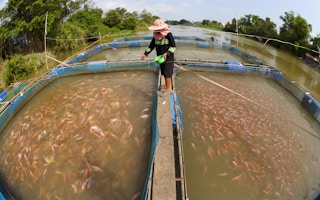
The creation of a global partnership to help ensure that the world’s fish supplies can keep pace with booming demand has received a green light from FAO’s Sub-Committee on Aquaculture.
Over 50 countries endorsed the Global Aquaculture Advancement Partnership (GAAP) programme, which will bring together governments, UN agencies, non-governmental organizations and the private sector to find sustainable solutions to meeting the need for fish products.
Aquaculture already supplies nearly 50 percent – or nearly 63 million tonnes – of fish consumed globally, and with production from wild fish stocks levelling off, it will fall to fish farmers to supply the estimated 50 million additional tonnes required to feed the rising world population by 2030.
But while aquaculture is one of the fastest expanding food sectors in the world with a current growth rate of around 6.1 percent a year, recent trends predict a gradual decline which might see the sector fall short of bridging the gap between projected supply and demand.
“This is an alarming situation and urgent concerted efforts to build a strong private-public partnership are imperative to maintain the current rate of growth of aquaculture over the coming years,” said Árni M. Mathiesen, FAO Assistant Director-General for Fisheries and Aquaculture.
The partnership will be tasked with overcoming obstacles to the expansion of the sector, which include the increasing scarcity of land and water for the development of inland fisheries and the need to step up aquaculture activities in the world’s seas and oceans.
This in turn will require strict governance to safeguard aquatic animal health and conserve biodiversity.
“GAAP will also help tap the huge potential of aquaculture to help reduce poverty, unemployment and socio-economic inequalities through proper planning and development,” Mathiesen said, recalling that around 80 percent of fish farmers are small-scale.
Some 55 million people are directly employed by the fisheries and aquaculture sector, of whom 85 percent live in Asia.
The initiative will now go for approval to the Committee on Fisheries when it meets at FAO headquarters in Rome in June 2014.
Certification benchmarking
A tool to help countries assess whether public and private aquaculture certification schemes are in line with FAO’s global guidelines for certification has also received a nod from the sub-committee, which is the only global intergovernmental forum discussing aquaculture development.
Covering animal health, food safety, the environment and worker welfare issues, the FAO aquaculture guidelines were approved in 2011 after four years of consultation among governments, producers, processors and traders.
“It is overwhelmingly positive that consumers want to see a label on a product showing that it is sustainably produced. The challenge is to ensure certification provides adequate incentives to small producers and eventually contributes to overall sustainability of the sector,” said FAO Senior Aquaculture Officer Rohana Subasinghe.
“Many schemes claim they are within the FAO guidelines, but this new evaluation framework will allow them to self-assess whether that’s true,” he said.
The evaluation framework will also now pass to the Committee on Fisheries for approval in June next year.
Coordinated efforts in aquaculture needed to meet global demand
Most popular
-
![A pile of e-waste]()
News / Waste Management
Malaysia arrests top environment officials amid probes on e-waste irregularities
The arrests come as the Malaysian Anti-Corruption Commission conducts broader investigations into alleged abuse of power and corruption … -
![Palm oil forest carbon]()
News / Food & Agriculture
GHG Protocol launches first global standard for reporting agricultural land-use emissions
Palm oil players welcomed the new standard, which also covers traceability requirements for Scope 3 emissions. However, it … -
![Vinamra Srivastava speaking at an event in Singapore.]()
News / Corporate Responsibility
CapitaLand Investment sustainability chief Vinamra Srivastava moves on after 10 years
The former management consultant has been replaced by a renewable energy finance specialist at the real estate giant. -
![Beijing_National_Stadium_BRI]()
News / Policy & Finance
The Belt and Road boomed in 2025
China's engagement in overseas renewables grew once again, though not as much as in oil and gas. -
![Malaysia subsea power grid construction]() While overland cables are just as important, the geographic flexibility offered by subsea cables will have a catalytic …
While overland cables are just as important, the geographic flexibility offered by subsea cables will have a catalytic … -
![Frank Phuan co-founded Sunseap in 2011]()
Podcasts / Energy
Cross-border clean energy projects are hard – but the returns are worth the pain: Sunseap co-founder Frank Phuan
As Southeast Asia eyes regional power trading to accelerate decarbonisation, veteran solar entrepreneur Frank Phuan unpacks the political, …