The United Nations’ highest court has said that countries have an obligation to curb emissions from fossil fuel production and can be held responsible for the resulting harms.
To continue reading, subscribe to Eco‑Business.
There's something for everyone. We offer a range of subscription plans.
- Access our stories and receive our Insights Weekly newsletter with the free EB Member plan.
- Unlock unlimited access to our content and archive with EB Circle.
- Publish your content with EB Premium.
In a groundbreaking advisory opinion delivered at the Peace Palace in The Hague on Wednesday, the International Court of Justice (ICJ) said states must take “appropriate action to protect the climate system from greenhouse gas emissions, including through fossil fuel production, fossil fuel consumption, the granting of fossil fuel exploration licenses or the provision of fossil fuel subsidies.”
“A state may be responsible where it has failed to exercise due diligence by not taking the necessary and legislative measures to limit the quantity of emissions caused by private actors under its jurisdiction,” said Iwasawa Yuji, ICJ president, as he led the two-hour reading of the opinion.
The legal guidance was welcomed by environmentalists who lauded it for not just being a “turning point in international law”, but a “point of no return on the path toward climate justice and accountability”.
“The ICJ court rejected attempts by the biggest polluters to hide behind the Paris Agreement and claim that mere compliance with procedural obligations was enough. The court said [polluters] must do more,” said Nikki Reisch, climate and energy programme director of Swiss-based nonprofit Center for International Environmental Law (CIEL).
In a series of hearings in December, the United States, along with other top polluters, told the ICJ court that it should rely on the Paris Agreement, a non-binding pact of more than 190 countries to commit efforts to limit global warming to 1.5 degrees Celsius, and not establish further obligations than the ones negotiated by states.
However, the treaty has failed to curb global greenhouse gas emissions, with a UN report warning that current climate policies will result in global warming of more than 3°C above pre-industrial levels by 2100.
Greenpeace senior campaigner Virginia Benosa-Llorin said ICJ’s ruling marks the start of a “new era of climate accountability on a global scale”, and could compel major polluters to cut emissions while healing harms with climate reparations.
The court also left open the possibility that countries could sue each other for damages from historical emissions. “While climate change is caused by cumulative greenhouse gas emissions, it is scientifically possible to determine each state’s total contribution to global emissions,” the court said.
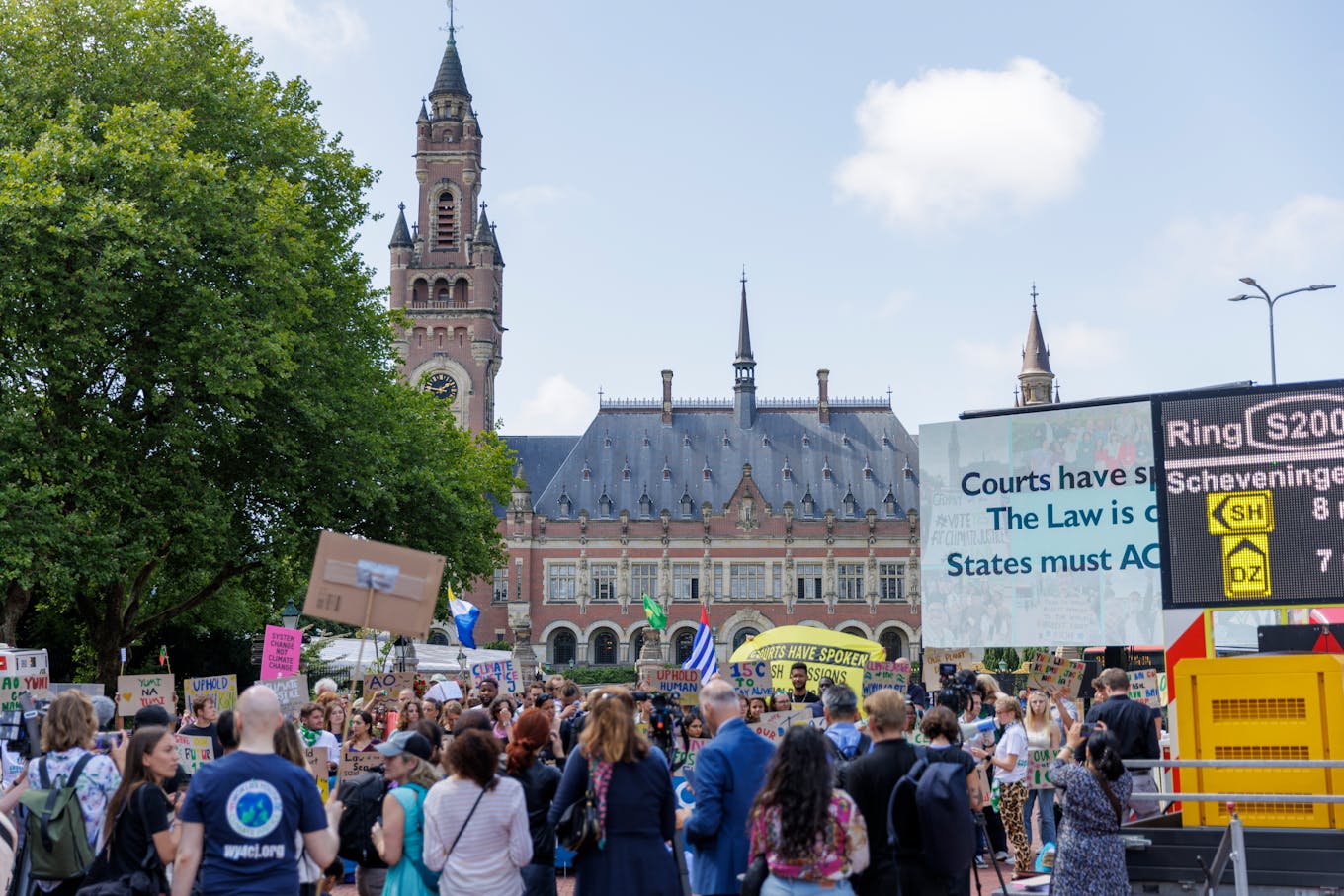
Campaigners stage a rally outside the Peace Palace as the advisory opinion was announced on 23 July at The Hague, The Netherlands. Image: Oxfam
‘The most far-reaching legal statement ever made’
Iwasawa, who presided the panel of 15 judges, added that a “clean, healthy and sustainable environment” is a human right that paves the way for other legal actions, including states returning to the ICJ to hold each other to account as well as domestic lawsuits.
He also affirmed that countries that signed the 2015 Paris Agreement must ensure their nationally determined contributions (NDCs), their individual national climate plans, are “progressive” and reflect the “highest possible ambition,” in line with the treaty’s aim to limit global temperature rise to 1.5 degrees Celsius.
The court also recognised that sea level rise does not compromise a state’s maritime boundaries and such countries would continue to legally exist even if its territory is wholly or partially submerged by sea level rise due to global warming.
The advisory opinion was the culmination of years of campaigning by a group of students from Pacific nations and a coalition of small island states and vulnerable countries fearing they could be submerged under rising sea waters.
The process was formally launched through a resolution of the United Nations General Assembly, which, influenced by Vanuatu’s advocacy, referred the matter to the ICJ, seeking to clarify legal responsibilities of nation-states in relation to climate change.
Former United Nations climate chief Christiana Figueres called the ruling the “most far-reaching legal statement ever made” on countries’ responsibility to protect the rights of current and future generations to a clean, healthy, and sustainable environment.
“It is the clearest legal affirmation to date that cooperation among states to address climate change is not optional,” Figueres said.
While the ICJ’s ruling is not binding, Iwasawa said that countries themselves have an obligation to take binding measures to comply to climate treaties. Rich nations have a legal obligation to take the lead in combating climate change, due to their greater historical responsibility for emissions, he added.

Cynthia Houniuhi of Solomon Islands, president of the Pacific Islands Students Fighting Climate Change (PISFCC) and Raki Ap of West Papua hold up the Vanuatu flag to celebrate the outcome of the advisory opinion on 23 July. South Pacific island nations led by Vanuatu went through years of campaigning to clarify the legal responsibilities of nation-states in relation to climate change. Image: Oxfam
While the decision was stronger than expected, international treaties protecting foreign investments can make it harder for governments to honour their duty to regulate fossil fuel production and consumption in their jurisdictions, said an environmental lawyer.
“International treaties protecting foreign investments can make governments pay hefty damages if climate action causes investors to lose money,” said Lorenzo Cotula, principal researcher in law and sustainable development at Amsterdam-based think tank International Institute for Environment and Development (IIED).
He cited how “investor-state dispute settlements”, which allow foreign investors to sue host states if they believe they violated their rights, have allowed fossil fuel businesses to collect up to US$80 billion by claiming their investments could be disrupted by government policy. But the advisory opinion can provide a basis for reform, he added.
CIEL’s Reisch added: “The opinion will reinforce the arguments that states can bring to defend against big polluters seeking to make it prohibitive to regulate. Paying polluters cannot be the cost of climate action.”