Cambodia’s government on Friday approved a hydropower dam and solar energy plant projects in a bid to ease the strain on the country’s electricity grid, which has been unable to meet supply demand, leading to nationwide outages over the past several weeks.
In a statement, the Council of Ministers said SPHP (Cambodia) Co. Ltd. had been approved to invest in an 80-megawatt hydropower dam in Pursat province, while Cambodian firm SchneiTec Co. Ltd. was given permission to build three 60-megawatt solar energy plans in Pursat, Kampong Chhnang and Kampong Speu provinces.
The US$231 million hydropower dam will be built as part of a 39-year concession, while the solar energy plants will each cost US $58 million and be built as part of 20-year concessions, the statement said.
Council of Ministers spokesman Phay Siphan told a press briefing that the power projects would benefit Cambodia “technically, economically and socially.”
“Cambodia will have local sources of energy and reusable fuel consumption—clean and at affordable prices,” he said.
“The projects will also employ thousands of people during the construction phase and as a result of ecotourism,” he added, without elaborating.
Phay Siphan said that the government expects the plants to generate US$292 million annually.
While the projects will help to ease Cambodia’s power shortages in the future, they will do little to alleviate widespread blackouts over the past several weeks that the government has attributed to high temperatures affecting the ability of dams to generate power and high levels of public consumption.
Officials said recently that the grid is around 400 megawatts short of what is needed to supply the country during the dry season.
The power cuts are expected to last through May and have caused some to question whether they are being orchestrated by the government to drum up public support for proceeding with the controversial Stung Cheay Areng hydropower dam in Koh Kong province, despite environmental concerns that shelved the project in 2015.
Cambodia’s Prime Minister Hun Sen on Tuesday told officials to “cut off electricity” to the homes of those who claim the government is behind the outages, adding, “Let them light torches.”
Alejandro Gonzalez-Davidson, founder of local environmental watchdog Mother Nature, told RFA’s Khmer Service he is concerned that construction of the dam announced Friday will destroy the forest in Pursat “like they have in Koh Kong and Stung Treng” provinces, because the government will use the project as an excuse to log the area.
He called on officials to provide details of the proposed dam, noting that past projects have lacked transparency.
Meanwhile, Hun Sen announced Friday that the government has canceled plans to lease a Turkish floating power plant that would have produced an additional 200 megawatts of electricity for Cambodia, saying the vessel would not arrive in time to alleviate the nation’s power shortages.
The Khmer Times quoted Ty Norin, secretary of state at the Ministry of Mines and Energy, as saying that Thailand and Laos will “sell us more power” instead.
Ty Norin said Cambodia will increase imports of electricity from Thailand to 200 megawatts from 120 megawatts, while Laos will deliver 50 megawatts instead of 40 megawatts.
“So, in total, we get 90 megawatts more,” he said.
Cambodia currently imports 170 megawatts from Vietnam.
Cambodia’s Mines and Energy Ministry has said that Cambodia produced 2,650 megawatts of energy in 2018—50 percent of which came from hydroelectric dams.
Copyright © 1998-2019, RFA. Used with the permission of Radio Free Asia, 2025 M St. NW, Suite 300, Washington DC 20036.
Cambodia announces hydropower, solar projects amid widespread electricity shortages
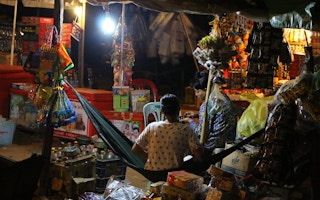
Power cuts in the country have caused speculation that they have been orchestrated by the government to proceed with a controversial hydropower dam in Koh Kong province, despite environmental concerns that shelved the project in 2015.
Terpopuler
-
![CDL's microforest at City Square Mall]()
Berita / Perkotaan
Singapore real estate firm eyes growth for microforests to combat urban heat
CDL has doubled the size of a microforest planted at a shopping mall, and is aiming to plant … -
![A man shelters from the midday heat on the path at Robertson Quay, Singapore]()
Berita / Karbon & Iklim
Singapore logs hottest, wettest months ever in 2025, as Earth’s climate balance slips
Heat stress readings shattered records in Singapore, reflecting the world's hottest decade on record according to the World … -
![A solar technician in Thailand]()
Berita / Energi
Asean could meet new power needs with solar at US$67 billion, as gas prices surge: study
Solar offers the region a cheaper path to meet new power demand by cutting costs by half compared … -
![An attendant puts up the price of fuel]()
Berita / Energi
Philippines declares ‘national energy emergency’ amid Iran war as it boosts coal output
Philippine president Ferdinand Marcos, Jr made the declaration to empower officials to crack down on fuel hoarding and … -
![An installation in Singapore's FairPrice supermarket chain]()
Berita / Pangan & Agrikultur
Methane is a blind spot in Asian supermarkets’ climate strategies, study finds
Retailers in China, Japan, South Korea and Singapore were assessed on efforts to curb methane from meat, dairy … -
![A photo of Lai Ching-te]()
Berita / Kebijakan & Keuangan
Taiwan’s Lai says nuclear restarts can align with green energy push
Policy shift comes as renewables lag targets and power demand rises, sparking political backlash.