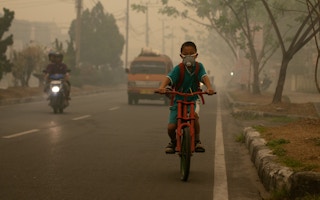


Southeast Asia knows the cycle: forests and land burn, smoke spreads, and once the skies clear, the same question remains: what has changed to prevent the same land from burning again?
From the devastating fires of 1997–1998 to the crises of 2015, 2019 and now 2026, the costs of recurring fires have been immense.
Nusantara Atlas, a satellite-based forest and fire monitoring platform, estimated that 2.88 million hectares burned across Indonesia between January and October 2026. Centre for Research on Energy and Clean Air (CREA) reported that nearly 58 million people faced unhealthy or worse air quality at September’s peak, while Center of Economic and Law Studies (CELIOS) estimated economic losses of IDR 340.4 trillion (US$18.65 billion), excluding health costs.
Concession management deserves particular scrutiny.
Pantau Gambut’s analysis found that around 70 per cent of the 1.46 million hectares of peatland burned between 2015 and 2019 lay within company concessions. More recently, the Indonesian Forum for the Environment, WALHI reported that around 74 per cent of the hotspots it detected across Kalimantan between 1 January and 27 July 2026 were within concessions.
These findings raise a serious question that companies cannot answer with a no-burning pledge alone: have they managed their concessions to prevent fires? Corporate accountability begins with how they manage peatland water levels, maintain fire-prevention systems and respond to known risks. It extends beyond identifying who lit the first flame.
Peatlands are naturally waterlogged. To grow crops such as oil palm and acacia, companies build drainage channels to lower the water table. But this dries the peat’s organic material, making it highly combustible. Once ignited, fires can spread underground, becoming difficult to extinguish and producing persistent smoke. How companies manage peatland water levels therefore has a direct bearing on fire risk.
Holding a concession does not exempt a company from protecting peatlands within its boundaries. Indonesia’s peatland regulations prohibit drainage channels that cause peat to dry out and impose stricter safeguards on peatlands designated for protection. These obligations apply before any fire starts.
Forest and plantation concession holders must also have trained firefighting teams, working equipment, early-warning systems and adequate water supplies.
Authorities do not have to wait for a fire to enforce these obligations. Routine inspections should identify breaches of peatland protections and gaps in firefighting readiness and require companies to address them before fires occur.
Responsibility extends beyond starting the fire
A company’s responsibility for its concession does not begin and end with whether it started a fire. Concession holders must prevent fires and control their spread within the land they manage. Outside ignition does not erase those duties.
Under Indonesian environmental law, companies can be held liable for harm caused by activities that pose a serious environmental threat, even without proof of negligence or intent. Draining peat, for example, increases fire risks and can qualify for this form of liability, known as strict liability. Plaintiffs must still show that they suffered harm and that the activity caused it.
Companies also cannot simply blame natural disasters or other people for causing the fire. The Indonesian Supreme Court Regulation No. 1/2023 sets strict conditions for relying on either defence.
To rely on a natural disaster, the defendant must show that it was extraordinary in scale, unprecedented and unforeseeable using the best available science. The defendant must not have contributed to the disaster or the resulting harm.
Invoking El Niño or dry weather is therefore insufficient. By April 2026, Indonesia’s Meteorology, Climatology and Geophysics Agency (BMKG), Indonesia’s meteorological agency, had warned of potentially drier conditions later in the year. Such warnings should have prompted stronger precautions.
Blaming an outsider is not an automatic defence either. The defendant must show that the harm was caused by a third party with no employment or contractual relationship with it, whose harmful conduct it could not have predicted and did not allow to occur. So, simply saying that the fire started outside the concession is not enough.
Addressing today’s haze, preventing the next crisis
The response to this year’s fires must reduce the risk of another crisis. Indonesia already has rules governing peatland management and concession holders’ prevention duties.
Because haze crosses borders, the response must involve neighbouring countries. The Asean Agreement on Transboundary Haze Pollution provides a framework for cooperation on prevention, monitoring, information exchange and emergency response. Regional diplomacy should turn that framework into coordinated action.
By the end of October, Indonesia’s forestry ministry had sanctioned 32 companies, while police had named 20 corporations and 245 individuals as suspects. A subsequent government update reported investigations involving 93 corporations and 241 individuals. It has also brought back a dedicated agency to manage peatlands and mangroves, creating an opportunity to strengthen fire prevention and restore damaged ecosystems.
Singapore has issued notices and questioned companies potentially linked to the haze. Changes to its Transboundary Haze Pollution Act announced in November would strengthen investigations, allow action before smoke reaches Singapore and raise the maximum fine for the main offence tenfold to S$20 million (US$15.5 million).
These efforts need sustained follow-through, both within Indonesia and across the region.
Companies cannot treat the end of the haze as the end of their responsibility. They must restore land damaged by their activities, change practices that increase fire risks and address gaps in fire preparedness. Governments must also enforce those obligations through inspections and follow-up action, particularly in fire-prone areas such as peatlands. Without that accountability, the same failures will allow this crisis to recur.
Azam Hawari is a lawyer for Food and Ocean, and Land Use (FOLU) for Japan and Southeast Asia at ClientEarth.