



For decades, the relationship between palm oil and biodiversity has largely been defined by conflict.
Across Southeast Asia, the rapid expansion of oil palm plantations has replaced millions of hectares of tropical rainforest, fragmenting habitats that support some of the world’s most iconic wildlife.
Orangutans, proboscis monkeys, siamangs, elephants and countless other species now find themselves navigating landscapes increasingly dominated by monoculture plantations.
Yet as suitable forest habitat continues to shrink, conservationists are confronting a difficult reality: protecting biodiversity can no longer rely solely on preserving untouched forests. Increasingly, conservation success will depend on whether working agricultural landscapes themselves can become part of the solution.
In Indonesia and Malaysia, for instance, several plantation companies have begun embedding biodiversity programmes within their estates such as expanding riparian reserves, restoring High Conservation Value (HCV) forests, establishing wildlife corridors, rehabilitating rescued primates and partnering with governments and conservation organisations.
The question, however, is whether these initiatives are genuinely changing conservation outcomes or simply slowing biodiversity decline.
Although the palm industry has made significant progress over the past two decades in the area of sustainability, fragmentation of habitat continues to threaten the existence of wildlife, said Michelle Desilets, the Executive Director of Orangutan Land Trust, a registered UK charity dedicated to the long-term survival of orangutans.
Tropical rainforests function as highly connected ecosystems and when forests are cleared and divided into isolated patches, species that depend on large continuous habitats struggle to survive.
“Large, roaming species like orangutans, elephants and tigers need safe space and forest cover to move, find food and reproduce,” she explained.
While many animals continue to cross plantations when they have little choice, doing so exposes them to greater risks — from hunting and human-wildlife conflict to starvation as natural food sources disappear. Pollution, degraded waterways and increased fire risks further compound these pressures.
This fragmentation has become one of the defining conservation challenges facing plantation landscapes, said Marc Ancrenaz, Scientific Director of Sabah-based non-profit Hutan.
“When we consider an oil palm estate, biodiversity is much, much lower than in natural forests,” he said.
“Because oil palm has expanded so much across Sabah and Peninsular Malaysia, more wildlife now uses these landscapes. But plantations are extremely poor habitats. Most animals are simply trying to cross them to move from one forest patch to another.”

Wilmar’s Sabahmas oil palm plantation is home to 25 recorded groups of proboscis monkeys, a species endemic to Borneo. Image: Wilmar International
For highly mobile species such as orangutans and elephants, disconnected forests create isolated populations that become increasingly vulnerable over time.
“The plantations are responsible for population fragmentation,” said Ancrenaz. “That is a huge issue in the long term.”
Can plantations become conservation landscapes?
The growing recognition that agricultural landscapes must contribute to conservation has prompted many plantation companies to rethink how estates are designed and managed.
Wilmar International, one of the world’s largest palm oil producers, is one example. The company has increasingly focused its conservation strategy on protecting primates, including endangered proboscis monkeys and siamangs, as indicators of ecosystem health.
Among its initiatives is a tripartite partnership with the Central Kalimantan provincial government and the Borneo Orangutan Survival Foundation (BOSF) to conserve HCV areas that serve as orangutan habitats by implementing best management practices for the species within an oil palm landscape.
Gurcharan Singh, Executive Director of Wilmar Plantations, said primates were chosen as the company’s focal species because they depend on large, connected forest habitats that frequently overlap with plantation landscapes.
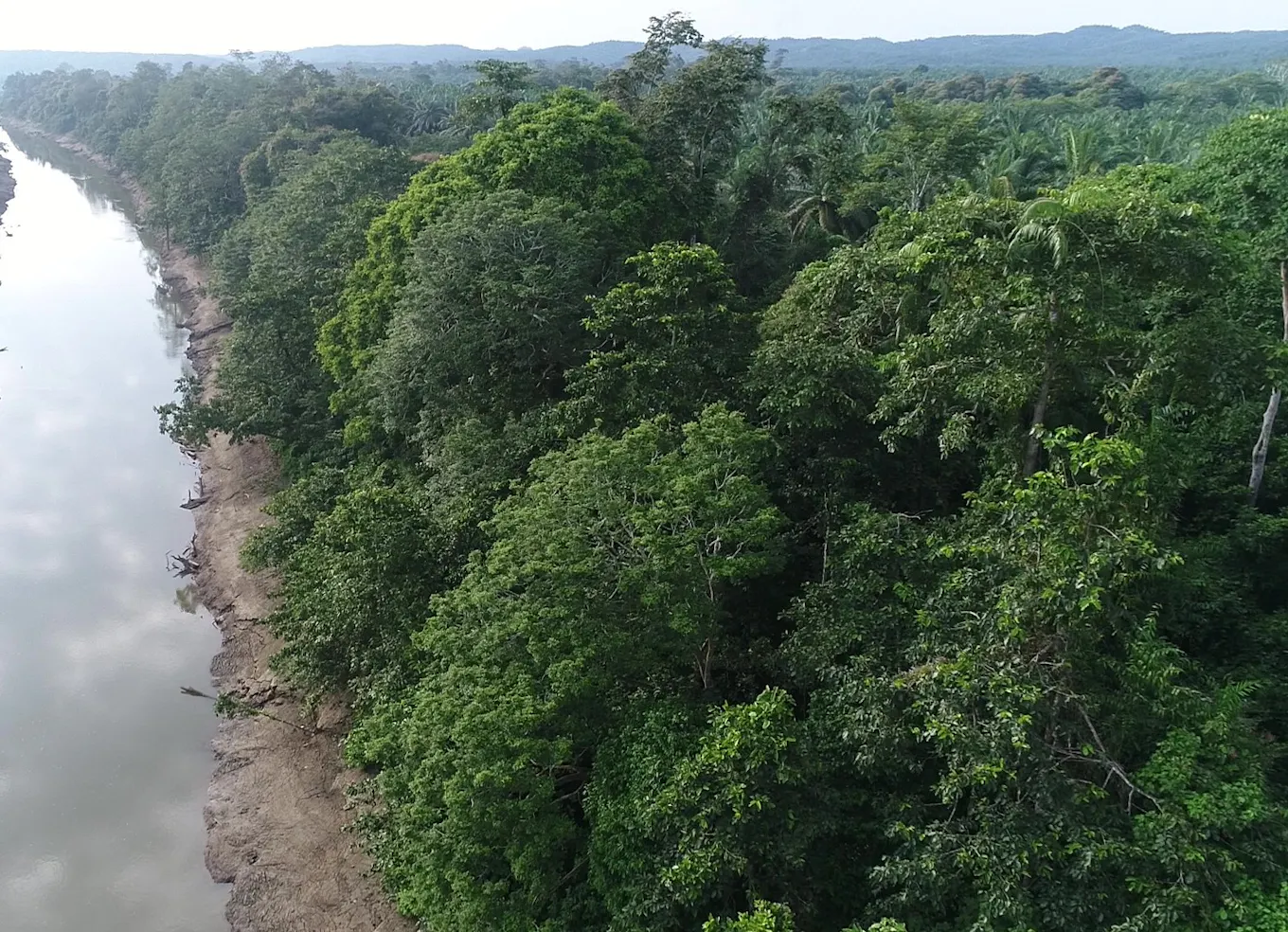
The riparian reserve along a 47-kilometre stretch of the Segama River was expanded from 20 metres to 50 metres in 2009 as part of Wilmar’s conservation efforts. Image: Wilmar International
“By focusing on primates, conservation cannot be treated as an isolated set-aside,” he said. “It must be integrated into estate design through connected riparian buffers, conservation areas and landscape planning.”
Across Wilmar’s managed estates, Singh said approximately 10 per cent of total landbank has been designated for conservation purposes, including riparian reserves and forested areas.
In Sabah, restoration work which covers around 47 kilometres of riparian zone of Segama River has coincided with stabilising or increasing populations of proboscis monkeys, with 25 groups recorded by the end of 2025.
Meanwhile, in West Sumatra, Wilmar’s partnership with the Kalaweit Foundation and Indonesia’s Natural Resources Conservation Agency has successfully rehabilitated and reintroduced 23 rescued siamangs into protected habitats within its concession areas.
One pair, Geri and Kajol, even successfully reproduced after release, demonstrating that the habitat was capable of supporting breeding populations, according to Singh.

23 rescued siamangs have been released into protected areas within Wilmar’s plantations in West Sumatra, Indonesia. Image: Wilmar International
These programmes reflect a broader shift away from viewing conservation as simply protecting isolated forest patches towards creating functional ecological networks embedded within working estates.
Singh added that research partnerships with the Southeast Asia Rainforest Research Partnership (SEARRP), Universiti Malaysia Sabah, Universiti Malaysia Sarawak, Universiti Sains Malaysia and Universitas Andalas now support long-term ecological monitoring, while local communities contribute through wildlife awareness programmes.
Do wildlife corridors work?
Despite their benefits, conservationists caution that the value of these initiatives ultimately depends on whether the corridors are ecologically functional.
Riparian buffers — strips of vegetation maintained alongside rivers — have emerged as one of the most widely adopted conservation measures across certified plantations, as they improve water quality, reduce erosion and provide movement pathways for wildlife, according to Orangutan Land Trust’s Desilets.
She said voluntarily expanding these buffers beyond minimum legal requirements can significantly improve habitat connectivity while simultaneously protecting waterways from agricultural runoff.
Similarly, HCV areas provide important refuges within plantation landscapes, particularly when restoration activities reconnect isolated forest patches.
“Expanding HCV areas through restoration can help provide safe havens for wildlife and contribute to connectivity, even if only as stepping stones,” she said.
Scientific studies increasingly support these observations. Research conducted in Borneo has found that riparian reserves retain substantially higher biodiversity than surrounding oil palm plantations, maintaining many ecological functions lost elsewhere.
However, Desilets noted that studies also show the 20- to 30-metre riparian buffers commonly required under certification schemes like Roundtable on Sustainable Palm Oil (RSPO) are often too narrow to maintain the cooler, more humid microclimates many forest-dependent species require.
“Cutting-edge research using LiDAR and microclimatic monitoring reveals that these standard widths are insufficient for biodiversity protection.”
For example, she said, dung beetle diversity declines significantly in narrow buffers due to edge effects creating warmer, drier conditions at 20 to 30 metre distances.
“Microclimate data shows that approximately 80 to 120 meters of buffer width is needed for temperature and humidity conditions comparable to continuous riparian forest,” she added.
Hutan’s Ancrenaz agrees that the limited width of many riparian corridors remains one of the industry’s biggest shortcomings as they are not fully functional to support biodiversity.
He recommends that if plantation companies are serious about biodiversity conservation, they need to establish much wider corridors and start viewing them as ecological infrastructure rather than compliance measures for certification schemes.
At the same time, he said, the connectivity of such corridors should extend beyond individual plantation boundaries that requires companies to work with neighbouring landowners to allow wildlife to move freely.

Government-accredited wildlife wardens in Sabah help deter illegal hunting and encroachment. Image: Wilmar International
“You need to have a platform where all the different growers, community members, NGOs, and services come together, design, and agree on a plan. This is super complicated to have, but this is needed,” he said, adding however that different commercial priorities by landowners often pose a challenge to such initiatives, ending conservation planning at estate boundaries.
Measuring success and going beyond monoculture
As plantation conservation programmes mature, companies are also broadening how they measure success beyond simply counting animals or hectares restored.
Singh said Wilmar now tracks a range of ecological indicators, including vegetation recovery, canopy closure, riparian width and long-term wildlife monitoring, alongside social indicators such as local participation, enforcement capacity and conservation awareness.
Communities surrounding plantations also play an active role in biodiversity protection through government-appointed honorary wildlife wardens, who help deter poaching while conducting education and outreach programmes to reduce human-wildlife conflict.
”[Our] partnerships have been central to achieving measurable outcomes because conservation cannot be implemented effectively by a single actor,” he said.
For researchers like Ancrenaz, biodiversity monitoring can have a greater impact when the data collected directly informs how plantations are managed.
He said tools such as camera traps, wildlife surveys and sustainability reporting can help companies better understand ecological changes within their estates — but their greatest value comes when findings are incorporated into operational decisions.

Wilmar’s wildlife monitoring team at its Sabahmas plantation. Image: Wilmar International
“If monitoring identifies important wildlife habitat, that should influence where development happens,” he said.
Beyond data collection, Ancrenaz said building long-term conservation capacity within plantation operations is equally important. This requires stronger collaboration between conservation and production teams, ensuring ecological considerations are integrated into everyday plantation management rather than treated as a separate function.
He added that continuity is key to building institutional knowledge and ensuring conservation initiatives remain effective over time.
“You need people who stay [in conservation]. If every few years everyone changes, you never build institutional knowledge,” Ancrenaz said.
While stronger monitoring and management approaches can help plantations reduce their ecological footprint, experts said the broader challenge is also about rethinking how agricultural landscapes are designed.
Certification schemes have helped improve environmental practices across the palm oil industry, but they remain only one part of the solution.
Desilets said Malaysian Sustainable Palm Oil (MSPO) and Indonesian Sustainable Palm Oil (ISPO) certification schemes establish important baseline environmental standards, but RSPO goes considerably further through more robust requirements for HCV and High Carbon Stock assessments, peatland protection and environmental impact assessments.
“National certification schemes raise the floor by establishing minimum requirements, while RSPO raises the bar by requiring stronger safeguards for biodiversity and habitat conservation,” she said.
Even so, Ancrenaz believes certification alone cannot drive meaningful conservation.
He noted that plantation companies often have little incentive to voluntarily set aside additional land for biodiversity because undeveloped concession areas may still incur taxes or, in some cases, risk being reclaimed under existing land allocation frameworks.
“The current legislation in Indonesia and Malaysia is not in favour of creating projects for biodiversity. So, it’s very difficult for the companies to support conservation activities given the policy framework they are operating in,” he said, calling for governments to play an equally important role to amend legislation that rewards estates for undertaking conservation-oriented activities.

The red langur, classified as vulnerable in the IUCN Red List, can also be found in the conservation areas within Wilmar’s Sabahmas plantation. Image: Wilmar International
Researchers are also looking beyond certification and conservation measures within existing plantation models to address biodiversity concerns.
Ancrenaz is among those who argue that while riparian corridors, HCV areas and restoration programmes can help reduce environmental impacts, there may be limits to what such measures can achieve within large-scale monoculture plantations.
One approach he believes warrants further exploration is agroforestry, in which oil palms are integrated with other tree species rather than grown as a single crop. Early field trials suggest that more diverse production systems may offer benefits such as improved soil health, moderated local microclimates and more suitable conditions for wildlife, while potentially maintaining agricultural yields.
He added wider adoption of such systems would require changes to established industry practices, noting that approaches such as agroforestry could become more relevant as climate change places additional pressure on biodiversity and agricultural production.
Meanwhile, Desilets said while there are positive impacts for biodiversity as a result of the efforts of some plantation companies like Wilmar in Southeast Asia, it is not yet at a scale that can allow for a sigh of relief for the future of endangered primates.
”[Conservation] efforts need to be scaled up and become business as usual. National regulations should require it, and buyers should demand it,” she said.
She added that the challenge also extends beyond palm oil to other forest-risk commodities produced across the region, where inadequate safeguards continue to threaten ecosystems.
“They all present a threat, on one scale or another, if best management practices are not applied and efforts are not made to remediate and compensate for the destruction of the past,” she said.
“I believe there is room for some optimism.”