Developing nations should look to secure adaptation funding beyond multilateral climate negotiations at COP, a senior official representing a group of of climate-vulnerable countries has suggested.
To continue reading, subscribe to Eco‑Business.
There's something for everyone. We offer a range of subscription plans.
- Access our stories and receive our Insights Weekly newsletter with the free EB Member plan.
- Unlock unlimited access to our content and archive with EB Circle.
- Publish your content with EB Premium.
Finding new ways to access finance has become more important amid a restrictive global funding environment, said Liz Thompson, who is Sherpa of the Climate Vulnerable Forum and Vulnerable 20 group (CVF-V20), an intergovernmental group focused on climate change and its impacts on vulnerable nations.
“With the inability to access capital and shrinking availability of [climate] finance at the global level, it becomes more important for organisations like CVF-V20 to bring together like-minded nations that have developed homegrown solutions to [climate] challenges and have been able to develop replicable best practices,” said Thompson at an event in Manila on 14 July.
Thompson was appointed by Barbados prime minister Mia Amor Mottley to be her Sherpa, or representaitive, for the CVF-V20. Hurricane-prone Barbados is the current chair of CVF-V20, whose leadership rotates every two years.
Thompson was responding to a question about the need for developing states to band together to reach climate goals in light of dismal outcomes at recent climate negotiations.
The United States’ anti-climate stance over the last seven months has worsened the developing world’s climate finance plight. In January, the super power halted foreign aid and threatened to cancel virtually all international projects, with climate funds identified as a prime target.
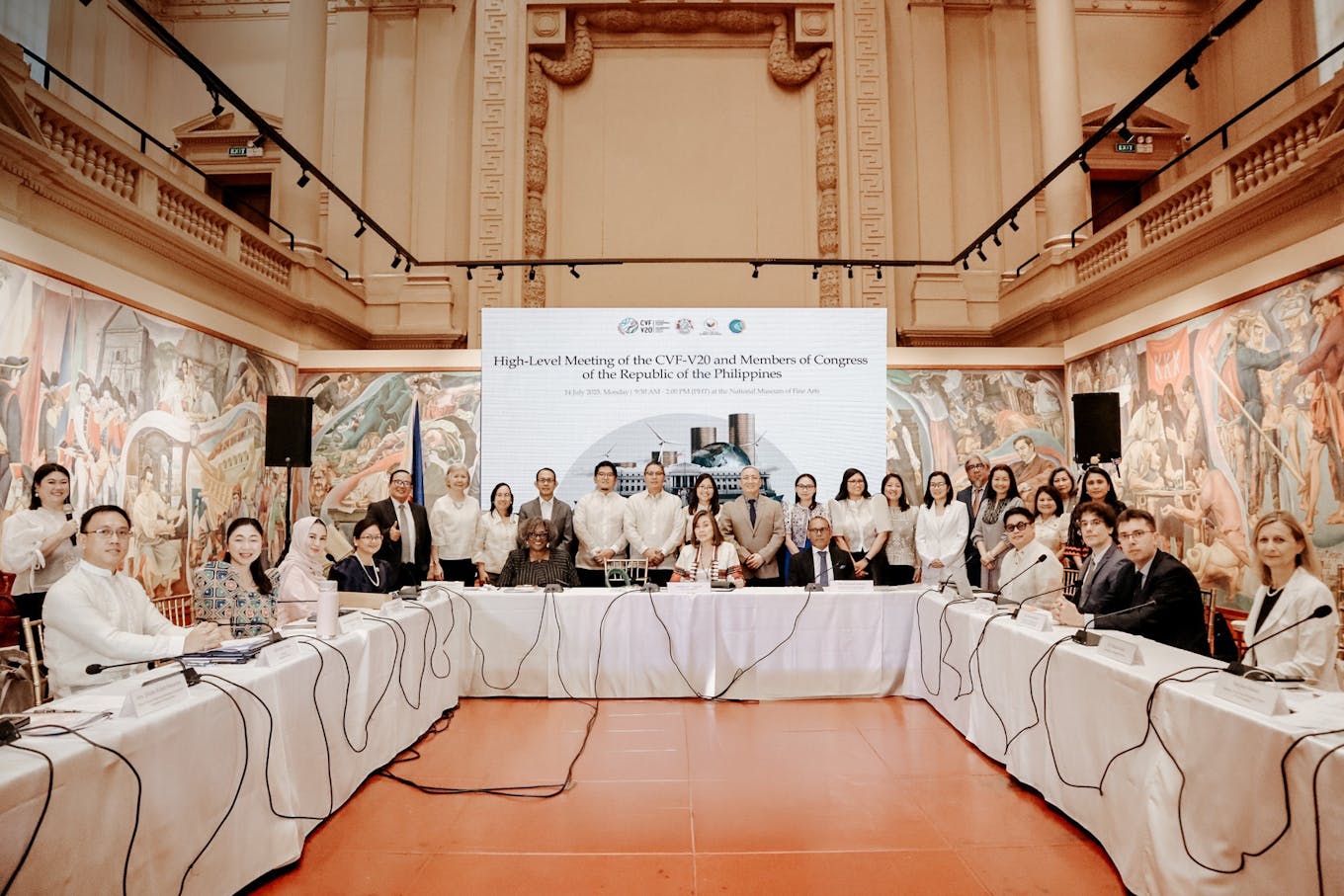
High-level delegates of the CVF-V20 meet with members of the Philippine Congress at the National Museum in Manila, Philippines on 14 July 2025. Seated at the centre from left are Liz Thompson, CVF-V20 presidency Sherpa, Philippine senator Loren Legarda, and Mohamed Nasheed, secretary-general of the CVF-V20 secretariat. Image: CVF-V20
Speaking to delegates from civil society, academe and members of the Philippine congress, Thompson noted how the CVF-V20 group brings “added value” to climate financing by developing projects like the Global Shield against Climate Risks, which is an insurance premium that provides pre-arranged finance to be quickly deployed to member-countries in times of climate disaster.
Since the mechanism’s launch in COP27, it has paid out close to US$2 million to Ghana when it experienced extreme drought in 2024. Other climate-vulnerable countries like Pakistan, Bangladesh, Costa Rica, Fiji, Senegal, and the Philippines will be among the first to receive assistance from the initiative.
“[Such initiatives] can allow access to capital for developing nations on easier terms than the access on the international financial markets. So the CVF has a role to play that is catalysing, collaborative, ensures pressure at the global level, while developing its own mechanisms that are supportive for developing countries,” said Thompson.
The CVF is represented by foreign affairs, climate, and environment ministers from 74 countries of the world’s most at risk to a warming planet. It established V20, composed of finance ministers from countries highly affected by catastrophes amplified by climate change, to focus on economic and financial responses to climate impacts.
Although not a negotiating bloc, the CVF has been regarded as the voice of the vulnerable since the historic 2015 climate summit when the group called for a highly ambitious long-term temperature goal of capping emissions at 1.5°C to avert a climate crisis, which subsequently became the global goal in the Paris Agreement.
Call for ‘rapid disbursement’ in loss and damage fund
At the close of the sixth board meeting held in Cebu, Philippines on Friday, least developed countries demanded that a rapid disbursement of emergency funds for natural disasters was to be included in the loss and damage fund.
Adao Soares Barbosa, board member from Timor Leste, said the draft text of the fund still did not include a procedure for quick release funding in the aftermath of climate disasters, which he cited as a key feature of the mechanism.
“[We would like to] request the Secretariat develops a proposal for a rapid disbursement proposal under the Barbados Implementation Modalities, in response to a funding request from a country and in absence of pre-approved plans,” Barbosa told board members at the meeting.
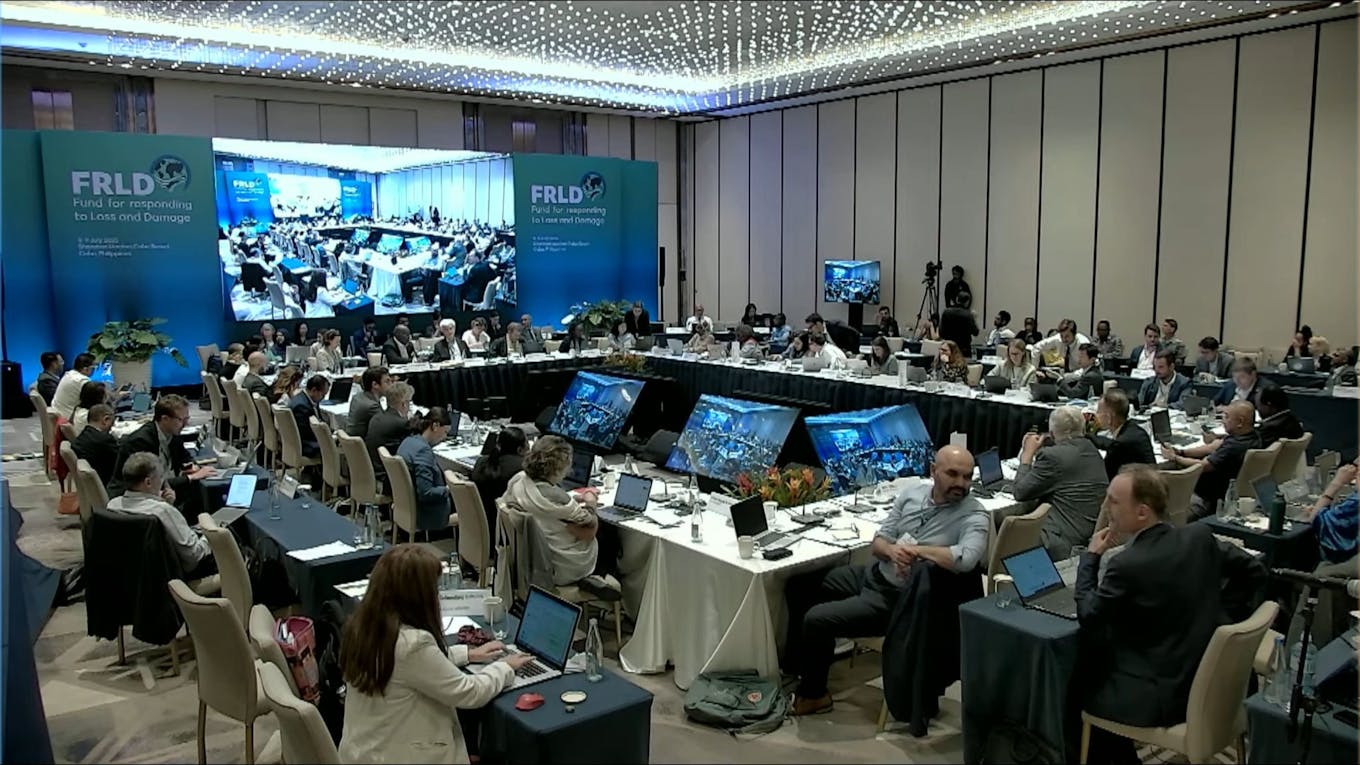
The sixth meeting of the Fund for Responding to Loss and Damage (FRLD) board was held in Cebu, Philippines from 9 to 11 July 2025. Image: Loss and Damage Collaboration
The FRLD currently has US$368 million but at the last meeting in April, board members allocated US$250 million of it for climate vulnerable countries for the Barbados Implementation Modalities (BIM) as the start-up phase of the fund. It will be handed out in 2026, just over three years since the fund was agreed at COP27 in Egypt after years of resistance from rich polluting nations.
This leaves US$100 million for administative costs and just about US$18 million, which will not be enough reserves for a rapid disbursement emergency fund, Philippines board member representative Mark Joven told Eco-Business.
Joven added that rich country board members pushed for a project financing-based mode of disbursement for the loss and damage fund, which would require gradual payment of debt in accordance with the project cycle.
But this was “not appropriate” for the nature of loss and damage, Joven said.
Loss and damage funding would need to go directly into a recipient country’s general budget, rather than into specific projects. It would also require rapid disbursement modalities, which allows for quick access to funds in response to emergencies, he said.
Failure to decide on the criteria before the first disbursement next year will pose a risk for climate-vulnerable developing countries to respond to historical and impending losses and damages, said Cheng Pagulayan, climate justice portfolio manager of nonprofit Oxfam Pilipinas, who was one of the observers at the meeting.
It may also be difficult for the fund to raise more resources to respond to loss and damage if the operationalisation of the BIM is delayed and deemed inefficient due to a very stringent process and selection criteria, he added.
The fund board has had five meetings previously in Manila, Philippines, United Arab Emirates, South Korea and Azerbaijan. The next board meeting will be held in Clark, Pampanga in the Philippines in September.