


A bill its authors say will curb online disinformation while protecting the press has cleared the Philippines’ House of Representatives and is now before the Senate, but artificial intelligence (AI) experts and academics warn it could stifle freedom of expression instead.
House Bill No. 9465, the Digital Media Anti-False Information Act, passed the lower chamber in June by 286 votes to three. Its lead author is House Majority Leader Sandro Marcos, the eldest son of President Ferdinand Marcos, Jr, who in February asked Congress to prioritise a bill against disinformation.
Anyone convicted of knowingly creating, financing, directing, or materially assisting false information intended to cause “verifiable public harm” or a “serious threat to national security” faces six to 12 years in prison and fines of up to P2 million (US$32,575). Undisclosed AI-generated images, video, and audio are also covered.
Lawmakers prioritised the measure amid concerns over coordinated troll farms and bot networks, election-related misinformation, health falsehoods, AI-generated deceptive media and potential foreign influence operations.
Carl Javier, executive director and chief AI ethicist of Data and AI Ethics PH, a nonprofit advocating for responsible, human-centered AI use, said the bill risks creating a “chilling effect” and “prior restraint” because it evaluates the content of individual posts rather than the behaviour driving disinformation at scale.
“
The current bill looks at content. We think the approach should be to look at the behaviour on platforms.
Carl Javier, executive director and chief AI ethicist, Data and AI Ethics PH
“This kind of behaviour could impinge freedom of speech,” Javier told Eco-Business. “The current bill looks at content. We think the approach should be to look at the behaviour on platforms.”
Javier said this kind of approach would “shift accountability” towards platforms that permit content to circulate despite violating their own rules, or whose engagement-driven algorithms amplify misleading material because it performs well.
It would also direct scrutiny at coordinated disinformation operators – the networks that organise, finance and manipulate information operations to spread false narratives – instead of primarily criminalising individual users who post or share content.
Macel Ingles, chairperson of the National Union of Journalists of the Philippines, likewise warned that the measure could threaten press freedom by giving authorities excessive discretion to determine whether online information is false and harmful.
Critics noted that Ferdinand Marcos Jr. was a major beneficiary of coordinated online historical revisionism and disinformation before his 2022 election, making the proposed law especially sensitive in a country where existing legislation have also been used against journalists and government critics.
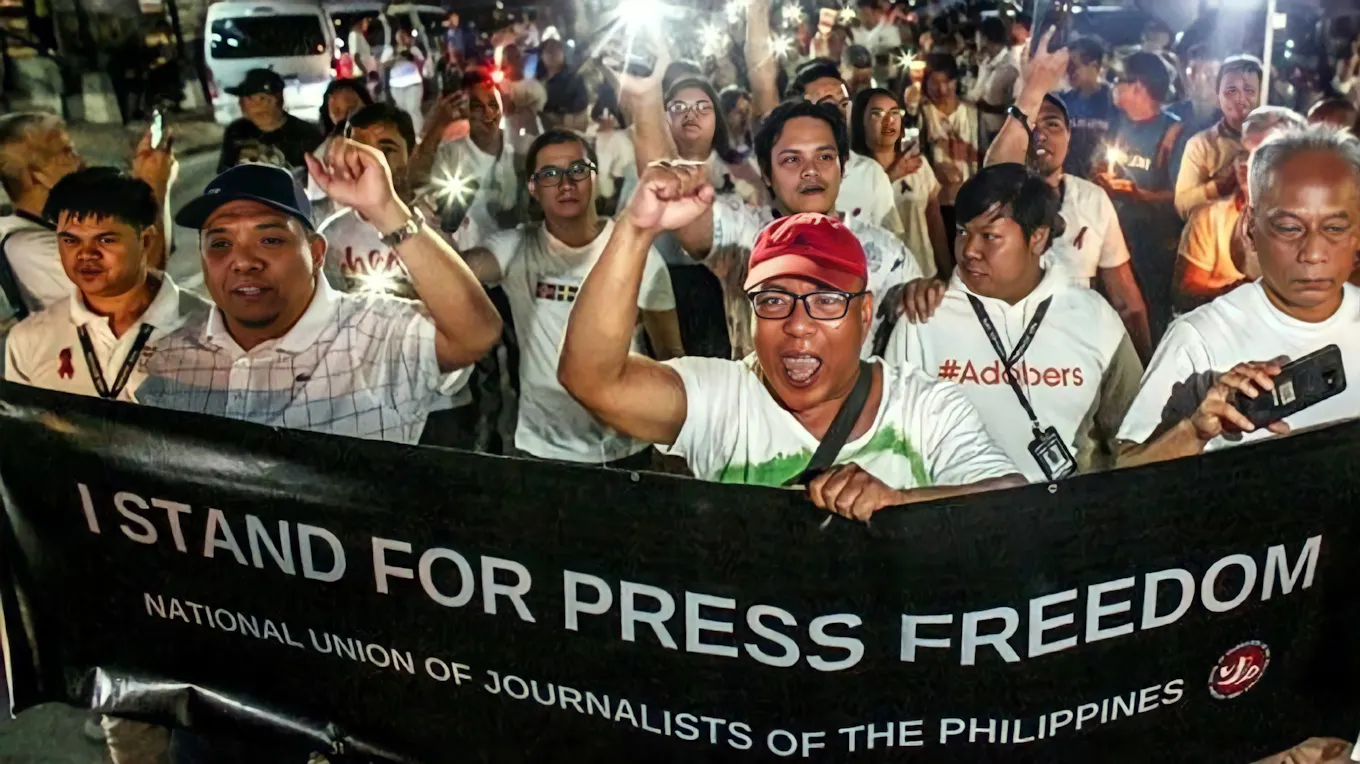
Journalists protest in defence of press freedom during the National Union of Journalists of the Philippines’ 34th anniversary in 2020. Image: NUJP
“Giving the state the power to determine what is true and what is false is authoritarian,” Ingles told Eco-Business. “This power to be the arbiter of truth or falsehood can be used as a weapon by the powers-that-be to muzzle critical reporting and silence dissent.”
She said the measure violates the people’s rights to a free press and free expression, and pointed to previous administration’s use of the Bayanihan to Heal As One Act during the pandemic as a reason for concern. The emergency law contained a provision penalising purportedly false Covid-19 information, which media groups said was invoked against journalists and others critical of the government’s pandemic response.
“Our fears are not unfounded,” Ingles said. “The Bayanihan to Heal As One Act during the administration of [former president] Rodrigo Duterte was used against members of the media, artists and ordinary citizens who were critical of the government’s Covid-19 response. They weaponised the law to go after these critics, accusing them of peddling ‘fake news’ and charging them with violating the Act.”
Need for comprehensive AI governance law first?
Both Ingles and Javier urged the government to prioritise legislation that tackles the underlying conditions enabling disinformation, while strengthening safeguards already in place.
Ingles said HB 9465 moved ahead of House Bill No. 10362, or the AI Governance Act, filed by party-list representative Chel Diokno and fellow lawmakers about two months later. She said the proposed AI law offers a broader framework for governing AI-related harms and the digital systems that fuel information disorder.
“While the disinformation bill does not only cover AI-generated content, a comprehensive law on the governance of AI is necessary to address the structural drivers of information disorder,” she said.
“As it is, without the AI governance law, the responsibility lies on the sources of information and not on the digital infrastructure that allow opaque algorithms, unregulated influence operations and the proliferation of platform structures that make disinformation flourish in the first place.”
Ingles said the AI Governance Act should be treated as an urgent priority, alongside the long-pending Right to Information Act, which would operationalise Filipinos’ constitutional right to access information. The AI bill proposes safeguards on transparency, privacy, discrimination, labour impacts and the environmental footprint of AI systems and facilities.
“
Without the AI governance law, the responsibility lies on the sources of information and not on the digital infrastructure that allow opaque algorithms, unregulated influence operations and the proliferation of platform structures that make disinformation flourish in the first place.
Macel Ingles, chairperson, National Union of Journalists of the Philippines
Javier agreed that lawmakers should address regulatory gaps, but cautioned against treating the proposed laws as mutually exclusive.
“We need to develop patchworks of legislation that reinforce current protections, make space for what should be advanced, and create the needed protections,” he said.
He said that the government should pursue targeted new laws while strengthening existing ones, including the Data Privacy Act of 2012, which regulates how government agencies and private organisations process personal data.