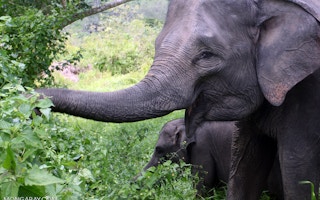

I hold on to every good story about wildlife and sustainability more tightly nowadays, as such stories are becoming increasingly rare. Reading a report about a family of Sumatran tigers thriving in a remote part of the Leuser forest truly made my day. Conversely, acts of cruelty towards wildlife fill me with despair.
Earlier this month, a disturbing event occurred. A 40-year-old male elephant was discovered decaying in a pulpwood plantation in Riau, Sumatra. The elephant’s body was found headless. It is believed he was shot, and then the culprits removed his head and tusks. His body was left in a muddy area surrounded by trees that did not resemble his usual natural forest habitat. A horrible ending that no sentient being would want to experience. Having witnessed many horrors in Indonesian forests, somehow, this particular incident made me question humanity.
The police and the law enforcement team of the Ministry of Forestry acted swiftly. Media exposure and the fact that elephants are one of the President of Indonesia’s favourite animals likely added further pressure. The law enforcement team summoned the board of directors of the pulpwood plantation company as the first step in the investigation into the responsibilities of the plantation’s licence holders for protecting forests and wildlife within their working areas. Pulpwood plantations in Indonesia are mostly massive industrial, monoculture tree farms, primarily growing fast-growing acacia and eucalyptus to feed the pulp and paper industry. These plantations established largely on Sumatra and Kalimantan, cover millions of hectares and were historically created by clearing natural forests and draining peatlands.
“
Just because the forest is gone or replaced, this doesn’t mean that conservation values are erased.
During the investigation, the Ministry also said that its office is examining corporate compliance aspects, including the effectiveness of area security, High Conservation Value management, and the presence and functioning of wildlife corridors within the forest utilisation permit area. According to the Forest Stewardship Council, High Conservation Values encompass environmental and social values considered of outstanding significance or critical importance. The Sumatran elephant (Elephas maximus sumatranus), listed as Critically Endangered by the IUCN, is a High Conservation Value species.
I had my share of similar disturbing experiences in 2011. I received a video of a dying Sumatran tiger, whose leg had been sliced by a snare, supposedly set by locals to hunt wild boars, in a pulpwood plantation in Riau, Sumatra, where I was working. The tiger died. At the time, as the managing director for sustainability at the company, I told the media: “The death of the Sumatran tiger is a tragic situation. Unfortunately, human-tiger conflict has long been a reality in Indonesia.” While my statement was not wrong, it felt somewhat distant and superficial. Growing up as a forester, I understood how pulpwood plantations were developed and their role in the broader landscape, sometimes serving as wildlife corridors. Yet back then, I believed the tiger’s death was beyond my influence. Often, when I visited the company’s plantations and observed the straight rows of trees and shrubs, I thought, “I can’t see any conservation values. Is it me, or are they all gone?”
However, it’s widely reported that 93 per cent of the known elephant habitat in Riau, Sumatra, overlaps with areas where commercial and industrial activities, including pulpwood plantations, are permitted. In 2019, the estimated elephant population ranged from 924 to 1,359, marking a sharp decline of 52-62 per cent since 2007. Additionally, the Indonesian forestry ministry reported that up to 10 Sumatran tigers are killed annually.
After so much loss caused by deforestation, human-wildlife conflict and poaching, what else can be done differently now to better conserve vulnerable species?
I believe that a line should be drawn connecting human-wildlife conflict, wildlife poaching and plantation companies. Indonesia is one of the most biodiverse countries, yet it is continuously threatened by habitat loss. This has made human-wildlife conflict and wildlife poaching critical issues. Yet these two issues are related. Plantation companies can help mitigate the decline in wildlife populations.
From 1991 to 2020, Indonesia lost an estimated 28.4 million hectares of primary forest. By 2020, 7.8 million hectares of forest cleared during this period had been planted with oil palms. Additional large areas were converted into timber or pulpwood plantations, and some for mining. Both pulpwood and oil palm plantations drive significant land-use change. Pulpwood plantations often result in lower but significant biodiversity loss compared with the high-impact conversion of natural forests to oil palm, which severely reduces species richness and ecosystem services.
But one thing is clear: Just because the forest is gone or replaced, this doesn’t mean that conservation values are erased.
Plantation companies have an obligation to protect high conservation values in their concessions, particularly wildlife. There are laws and regulations to support this. For example, Indonesian Law No. 5 of 1990 stipulates that every person, including business entities, must maintain the region’s protective function, including the sustainability of wildlife. In 2022, the Environment and Forestry Ministry issued guidance to forestry companies stating: “Wild animals and other protected wildlife within the concession area are state assets, so it is the obligation of the Forest Utilisation Permit holder to protect and preserve them.”
This means that plantation companies must identify and map High Conservation Value Areas within and around their operations. These maps form the foundation for designating protected zones and integrating the conservation plan to enhance high conservation values within the overall management strategy. Based on my experience, this might include: establishing buffer zones to protect and connect core conservation areas; providing feeding zones and prey; adjusting plantation harvest times to match wildlife movement patterns; conducting wildlife monitoring and patrols; and raising community awareness to protect wildlife.
Security and patrols are important because plantation companies are responsible for securing the access roads they constructed within and around their concessions. For example, the head and tusks of the elephant poached from the pulpwood plantation in Riau earlier this month would have been quite large, and the poachers would presumably have needed a vehicle to transport them along the company’s access road.
The bottom line is unambiguous: plantation companies are accountable when endangered animals are found dead within their concessions.
Human-wildlife conflict arises from rapid habitat loss, deforestation, and the expansion of agricultural plantations. In Indonesia, wildlife poaching is fuelled by a multi-million-dollar illegal trade involving local consumption and extensive networks for the illegal pet trade, traditional medicine, decorations, and food.
Only when companies, local communities, NGOs, law enforcement, and government work together, adopting a landscape approach and fulfilling their roles in safeguarding conservation values, can human-wildlife conflicts be mitigated. Reducing such conflicts in Indonesia not only reduces retaliatory poaching and illegal killings but also promotes a stronger sense of stewardship among law enforcement and communities, which can further reduce wildlife poaching.
Aida Greenbury is a sustainability leader and forestry expert specialising in responsible land use, no-deforestation policies, and sustainable supply chains across Asia.