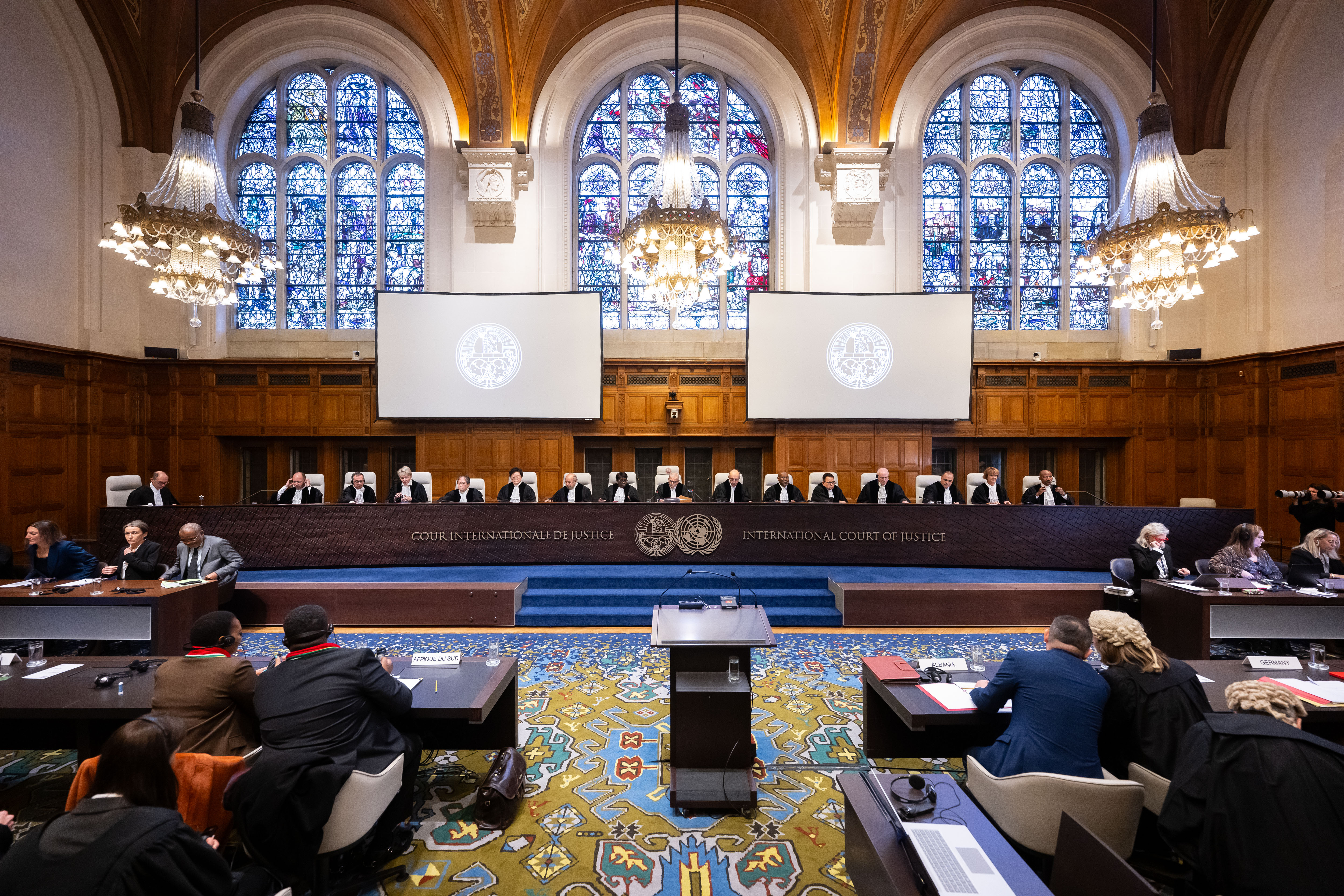
The International Court of Justice (ICJ) is expected to propose that corporate polluters are held legally accountable for climate harms in a new advisory opinion on climate change.
To continue reading, subscribe to Eco‑Business.
There's something for everyone. We offer a range of subscription plans.
- Access our stories and receive our Insights Weekly newsletter with the free EB Member plan.
- Unlock unlimited access to our content and archive with EB Circle.
- Publish your content with EB Premium.
The ICJ in The Hague, the Netherlands, which is often regarded as the world’s highest court, will on 23 July issue a non-binding opinion on countries’ legal obligation to fight climate change, which is expected to address whether large states contributing the most to greenhouse gas emissions should be liable for damage caused to small island nations.
“Even though [issuing an advisory opinion] is a state-focused process, we absolutely expect it to have implications for corporate polluters, private entities and companies…It is the state’s duty to rein in corporate polluters, so we are very much looking out for that,” Joie Chowdhury, senior lawyer for the climate and energy group at the Swiss-based nonprofit Center for International Environmental Law (CIEL), said in a virtual media briefing held on Thursday.
Vishal Prasad, director of Pacific Island Student Fighting Climate Change, a youth-led organisation that campaigns for climate justice for the Pacific Islands, said that the advisory opinion is expected to affirm that “climate inaction, especially by major emitters, is not merely a policy failure, but a breach of international law.”
“This would empower vulnerable nations and communities to demand accountability, strengthen legal arguments and negotiations and litigation and push for policies that prioritise prevention and redress over delay and denial,” Prasad said at the briefing.
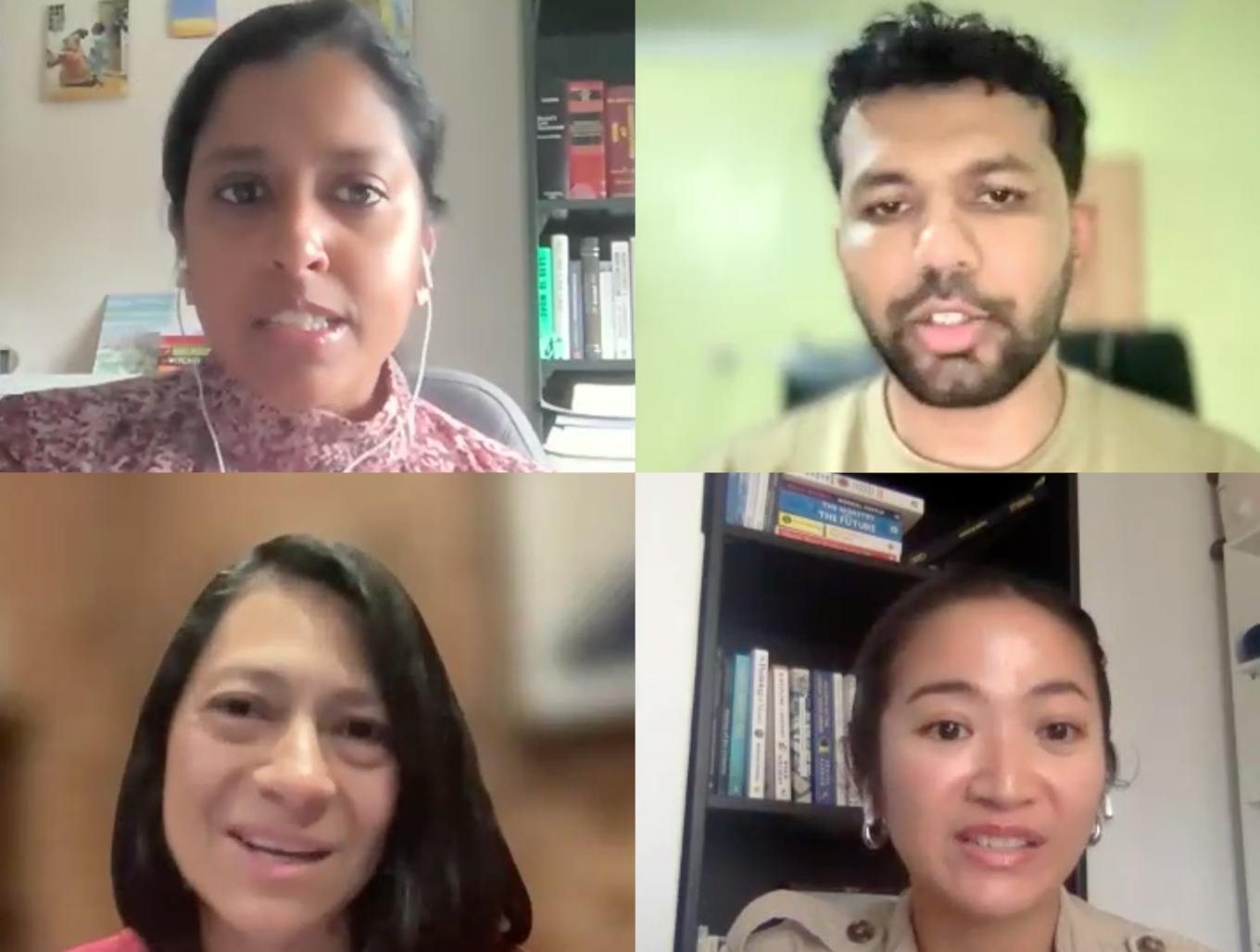
Speakers give their views before the ICJ issues its advisory opinion on climate change on 23 July. Clockwise from left: Joie Chowdhury, senior lawyer at Center for International Environmental Law (CIEL), Vishal Prasad, director of Pacific Island Student Fighting Climate Change, Nicole Ponce, head of advocacy of World Youth for Climate Justice, Astrid Puentes Riaño, UN special rapporteur on the human right to a healthy environment. Image: GSCC Network
Chowdhury noted that some countries, including those from Asia, brought up at the ICJ Court in December that corporates are morally obligated to curb their emissions to prevent transboundary harm and uphold due diligence standards for human rights.
In their oral and written arguments, the Philippines, Bangladesh, Vietnam, along with some Pacific Island states called for corporations and private entities to be regulated according to their climate impact. Such arguments “will absolutely have ripple effects on litigation against corporate actors”, Chowdhury said.
At the same hearing, China, the world’s largest emitter of greenhouse gases followed by the United States, said that the United Nations climate change negotiation mechanism should be the primary channel for global climate governance.
Similarly, the US told the Court that it should rely on the Paris Agreement and not establish further obligations than the ones negotiated by states.
Ninety-eight countries presented statements on what obligations they think states should have in tackling climate change. The series of hearings was the culmination of years of campaigning by a group of students from Pacific nations and a coalition of small island states and vulnerable countries that sought to clarify the legal responsibilities of nation-states in relation to climate change.
Latin America’s Inter-American Court of Human Rights and the International Tribunal for the Law of the Sea previously issued advisory opinions on how countries must monitor corporate activities, especially those that generate greenhouse gases, and the same will be expected for the ICJ, said Chowdhury.
Advisory opinion to fill the “gap” left by COPs
The ICJ’s advisory opinion is as another potential avenue to advance the case for climate reparations, where climate negotiations have failed, suggested the speakers at the online briefing.
The hearings that would lead to the advisory opinion were championed by states because multilateralism, while still important, has not delivered at the scale necessary, said Chowdhury.
“The gap that we’re seeing between countries, policies, laws and what science and climate justice requires is unquestionable,” she said. “States turned to the court because they wanted clarity on what the international legal obligations of states are in relation to climate change. We really hope [the advisory opinion] will help break open some of the issues that have really stalled in negotiations.”
The advisory opinion’s clarification on the consequences for states failing to act on climate change issues will be “the foundation to guide the work forward” beyond COPs, added Prasad.
“The advisory opinion could broaden the scope of environmental law and affirm its status as an integral part of international law,” said Astrid Puentes Riaño, UN special rapporteur on the human right to a healthy environment, who was also present at the briefing.
“It would clarify that environmental obligations are interconnected with all state actions, including economic and development policies. This clarification would enhance global environmental and human rights protection.”