The Indigenous Penan and Kenyah communities of Long Urun in Belaga, Sarawak have escalated their complaints against a palm oil company accused of cutting down natural forests for new plantations, in violation of mandatory Malaysian Sustainable Palm Oil (MSPO) standards.
To continue reading, subscribe to Eco‑Business.
There's something for everyone. We offer a range of subscription plans.
- Access our stories and receive our Insights Weekly newsletter with the free EB Member plan.
- Unlock unlimited access to our content and archive with EB Circle.
- Publish your content with EB Premium.
In a letter to the Premier of Sarawak, Abang Johari Openg, federal Minister of Plantations and Commodities Johari Abdul Ghani and three directors of Sarawak government departments, representatives of the communities called for all land clearing activities by Urun Plantations Sdn Bhd to be stopped immediately, pending an independent investigation.
“This is not just a local issue,” said Celine Lim, director of Sarawak-based non-profit SAVE Rivers, which had made a press statement with fellow non-profit The Borneo Project detailing the concerns of the villagers. “It is a test of Sarawak’s and Malaysia’s credibility on the global stage.”
Urun Plantations, a subsidiary of public-listed company Sin Heng Chan (Malaya) Berhad, has been bulldozing forests on native land in Long Urun since late 2023, according to community members. This has continued despite community actions, including seeking a court injunction, blockades, a petition, and reports to the Human Rights Commission of Malaysia (Suhakam), and a formal complaint to the Malaysian Sustainable Palm Oil (MSPO) Board.
Any deforestation to plant new oil palms since 2019 directly violates the mandatory MSPO standard. Eco-Business was unable to reach MSPO for comment.
The Long Urun communities had filed a complaint to MSPO in May, highlighting their concerns about the lack of free, prior and informed consent (FPIC) and deforestation. They maintained that they had not given their consent to Sarawak’s village development and security authority, known locally as JKKK, to sell their land to the plantations firm.
“MSPO has accepted the complaint, is undertaking an investigation and conducted a field visit last month,” Fiona McAlpine, communications and project manager of The Borneo Project told Eco-Business.
“But no moratorium or stop work order has been put in place, so in the three months it has taken for them to make a decision, a significant amount of forest has been lost. This is why communities are asking the government to intervene at this time,” she said. “They are fed up with waiting and blockading.”

A peaceful blockade by indigenous Penan and Kenyah villagers living in the Long Urun area. The deforested area is visible in the background. Image: The Borneo Project
Legal action underway
In the letter dated 20 August and seen by Eco-Business, the Penan and Kenyah communities said that Urun Plantations had also failed to meet the conditions of the company’s provisional lease issued in 1997 and is clearing forests after the required timeframe has expired. “The provisional lease required clearing within 10 years, yet this is now occurring more than 25 years later,” they said.
On top of that, the community members said that the boundaries of the provisional lease have never been properly demarcated with free, prior, and informed consent. Instead, there have been changes to those boundaries over time that were made without consultation of all villagers.
“Our community’s position has been complicated by differing statements from some leaders over time. After initially agreeing on a united stance, certain leaders later altered their position following closed-door discussions with company representatives, leading to confusion and tension among residents,” they said.
The communities called on the government to recognise and protect native customary rights lands, and to stop all development without free, prior and informed consent. They also requested that the government to publish all provisional lease maps, demarcation records and environmental impact assessments.
As of Friday, McAlpine said that the communities had not yet received a response to their letter.
In the meantime, the indigenous villagers are also seeking legal action to stop deforestation in the Belaga region. On 27 June, the five individuals from the Long Urun communities filed a suit against Urun Plantations in the Bintulu High Court, claiming native customary rights over 54,478 hectares of land in the area. The Sarawak state government and superintendent of the district’s land and survey division were also listed as defendants.
In a company announcement to the stock exchange Bursa Malaysia, Sin Heng Chan said that of the total land area being contested, approximately 10,872 hectares belongs to Urun Plantations.
“Based on the advice of its solicitors and facts of the case, the company is of the view that the claims are likely to be found to be frivolous or vexatious, and without proper basis, and that the company has a good chance of success against the plaintiffs’ claims,” said Sin Heng Chan.
The company is represented by a law firm owned by Baru Bian, a former federal minister and member of the Sarawak state legislative assembly, holding the Ba’kelalan seat. The Indigenous Penan and Kenyah communities are being represented by human rights lawyer Abun Sui Anyit.
Eco-Business has contacted Sin Heng Chan for comment.
‘Irreversible’ environmental loss
In May, Sin Heng Chan told local news outlet Malaysiakini that it had not threatened the villagers, nor had it carried out deforestation activities.
However, satellite data from Global Forest Watch extracted by The Borneo Project showed that deforestation had occurred in the contested area throughout 2024. [see image]
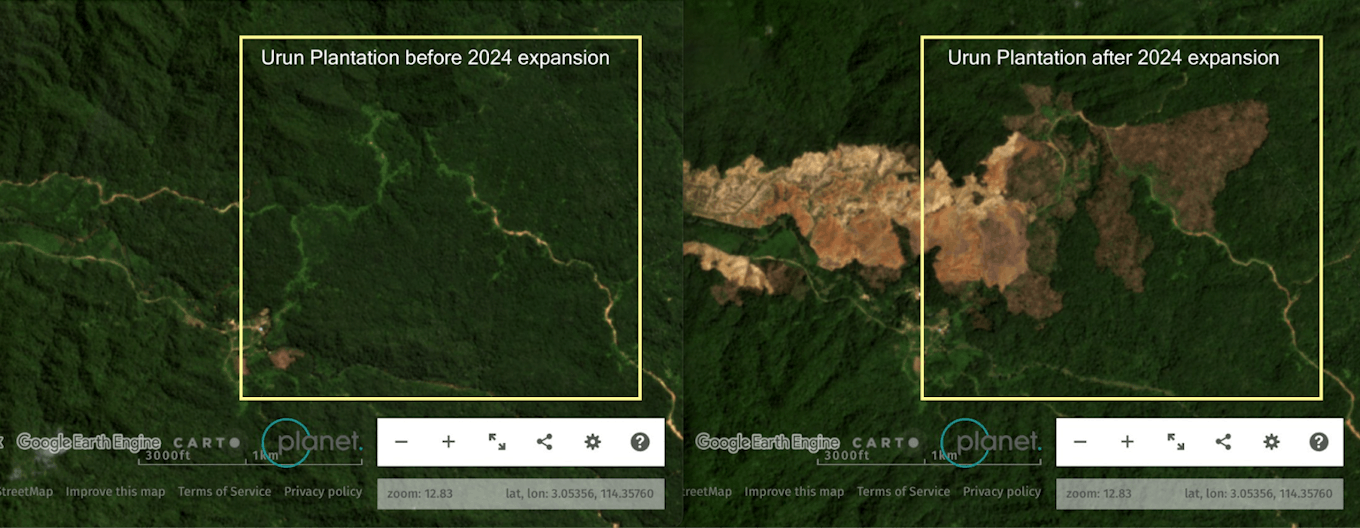
Global Forest Watch data from 2024 shows large-scale encroachment into native forest. Image: The Borneo Project
The villagers have sought to defend the forests using peaceful blockades in recent months, with nine villages represented at the blockade daily. However, they said that the company had used police intimidation and dismantled their blockades twice since December 2024. Five villagers had been arrested.
The Borneo Project highlighted that the community members’ verbal agreements reached during negotiations had not been honoured, with Urun Plantations failing to conduct a joint survey of watershed areas before clearing land, and providing incomplete maps and no publicly accessible shapefiles of plantation boundaries.
In their letter to the Sarawak premier and other government officials, the Long Urun communities urged the state and federal governments to recognise and protect native customary rights lands.
“For generations, these forests have been our source of food, clean water, medicine, cultural identity, and livelihoods,” they said. “We urge [the government] to act quickly, as every day of delay brings irreversible loss to our environment and our culture.”