Jovie Gil Montajes remembers clearly how he was huddled with his wife and two young children in their home in Lapu-Lapu City in the southern province of Cebu on the evening of 16 December in 2021 when Typhoon Rai made landfall in the Philippines.
To continue reading, subscribe to Eco‑Business.
There's something for everyone. We offer a range of subscription plans.
- Access our stories and receive our Insights Weekly newsletter with the free EB Member plan.
- Unlock unlimited access to our content and archive with EB Circle.
- Publish your content with EB Premium.
They were holding hands while listening to the wind howling above them when the roof of their house was blown off. It was a few agonising hours before the rains subsided. Though drenched and cold, they had survived the strongest cyclone of the year.
It was around about this time that Light of Hope Philippines, a grassroots movement Montajes founded that helps families like his own secure affordable and stable access to clean energy, was facing funding setbacks.
Montajes, an electronics engineer by profession, set up a Cebu-based venture in 2017 that uses plastic bottles and the principles of light refraction to create solar-powered night lamps. The invention is known as the Solderless Solar Night Lamp in a Bottle. Since 2020, however, the technology has evolved into the Solar Cloud Grid project, which are portable mini-solar kits composed of a 50-watt solar panel, battery, light bulbs, and USB sockets that can power two LED bulbs and charge four mobile phones in one day.
They are seen as a safer alternative to kerosene lamps and costly diesel generators that communities in remote areas typically use, he says.
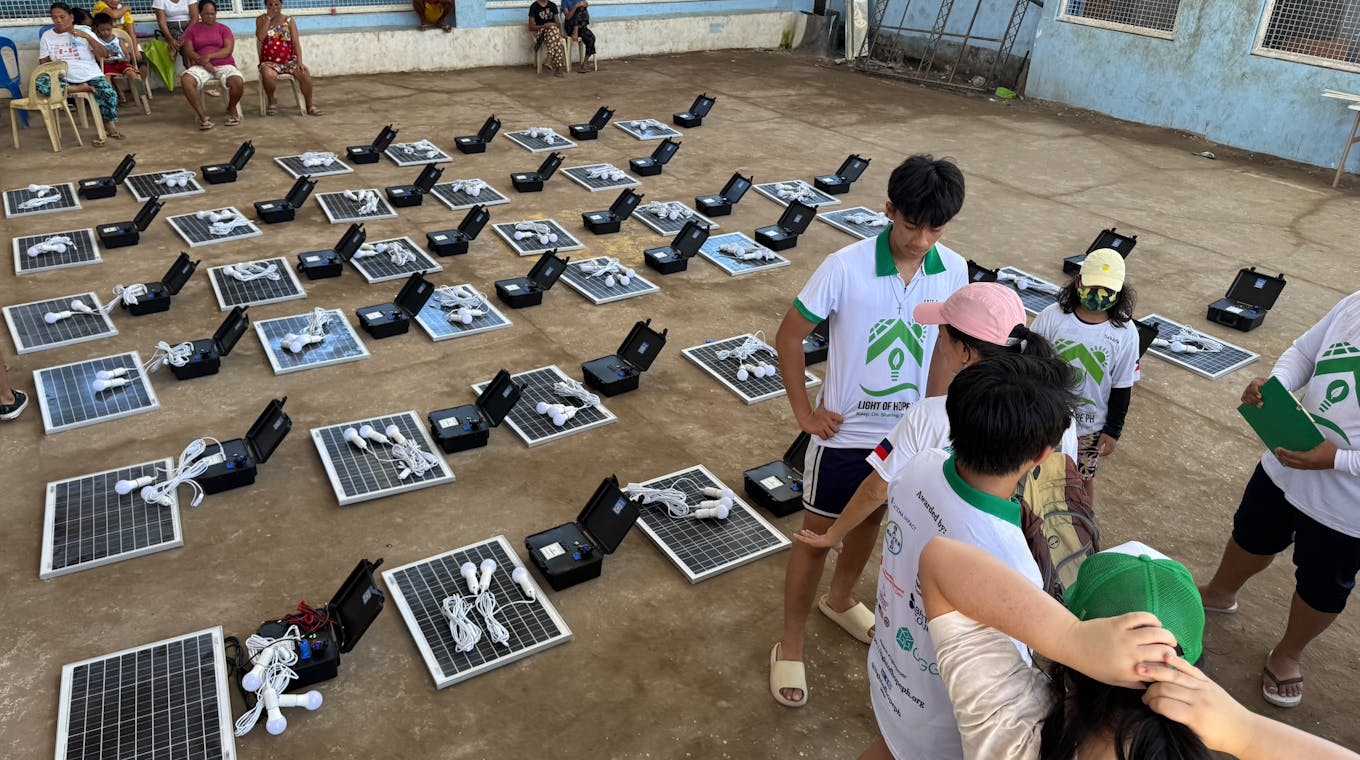
Light of Hope PH distributes solar cloud grid kits to a community in Pangan-an island, Lapu Lapu City in Cebu. Image: Light of Hope PH
Although he was able to facilitate the installation of off-grid solar systems for 55 families in Mindanao, Bohol and Cebu by 2021, it was not enough to sustain the business.
Solar cloud grid recipients paid his business monthly dues to maintain their units, compensate the staff and build more kits if there were excess funds. But the production of the solar grid kits themselves was mostly dependent on grants, which they did not have at that time.
With no funding prospects in sight, and the responsibility of taking care of his own family weighing on him, Montajes was on the verge of folding the venture.
But it was that brush with nature’s fury that strengthened his resolve to carry on. Studies showing that climate change has intensified the storms that hit the Philippines added to his conviction.
“We want to prevent another super typhoon from happening again. Using renewable energy is one way to do it. Since my background is in electronics, I think this will be my contribution to the environment,” Montajes told Eco-Business.
That same year, Light of Hope won a grant of US$5,000 in a competition backed by a nonprofit which supports young people to develop social enterprise solutions. Two years later, the organisation secured its biggest funding to date, of US$250,000. That enabled them to distribute portable solar kits to 1,229 families in the province of Surigao on the island group of Mindanao, the poorest region in the country, while reducing 153 tonnes of carbon dioxide emissions.
By 2030, they are aiming to deploy 5,000 more solar units that could reduce around 650 tonnes of carbon dioxide emissions per year. As of today, Montajes said they have reached 25 per cent of that target.
Transitioning to renewable energy is a crucial step in curbing emissions, slowing ocean warming, and ultimately lessening the intensity and destructiveness of typhoons, according to research.
If Montajes and his team are able to distribute a much larger quantity of units, they will be able to collect sufficent monthly dues, which will reduce their reliance on grants, he added.
In this interview, the 39 year-old social entrepreneur tells Eco-Business how he has used his environmental ingenuity to improve lives in remote communities across the country.
What sparked your advocacy for promoting renewable energy in poor areas in the Philippines?
During my elementary and high school years, there were months when our family did not have electricity because we were not able to pay for it. My sister and I had to study under a shared kerosene lamp and it was difficult. That stuck with me.
When I was already working in a corporate job in Cebu, we had team building activities where we would go to big resorts surrounded by remote communities in mountain areas. I saw that even in a city as prosperous Cebu [Cebu City is the second most populous metropolis in the Philippines, after Manila] there are still areas that do not have access to electricity. So I thought about my situation then and compared it to their situation now. I wondered, why was it that in this age of AI and robotics, which enhance the efficiency and reliability of renewable energy systems, do we still have families who do not have access to electricity?
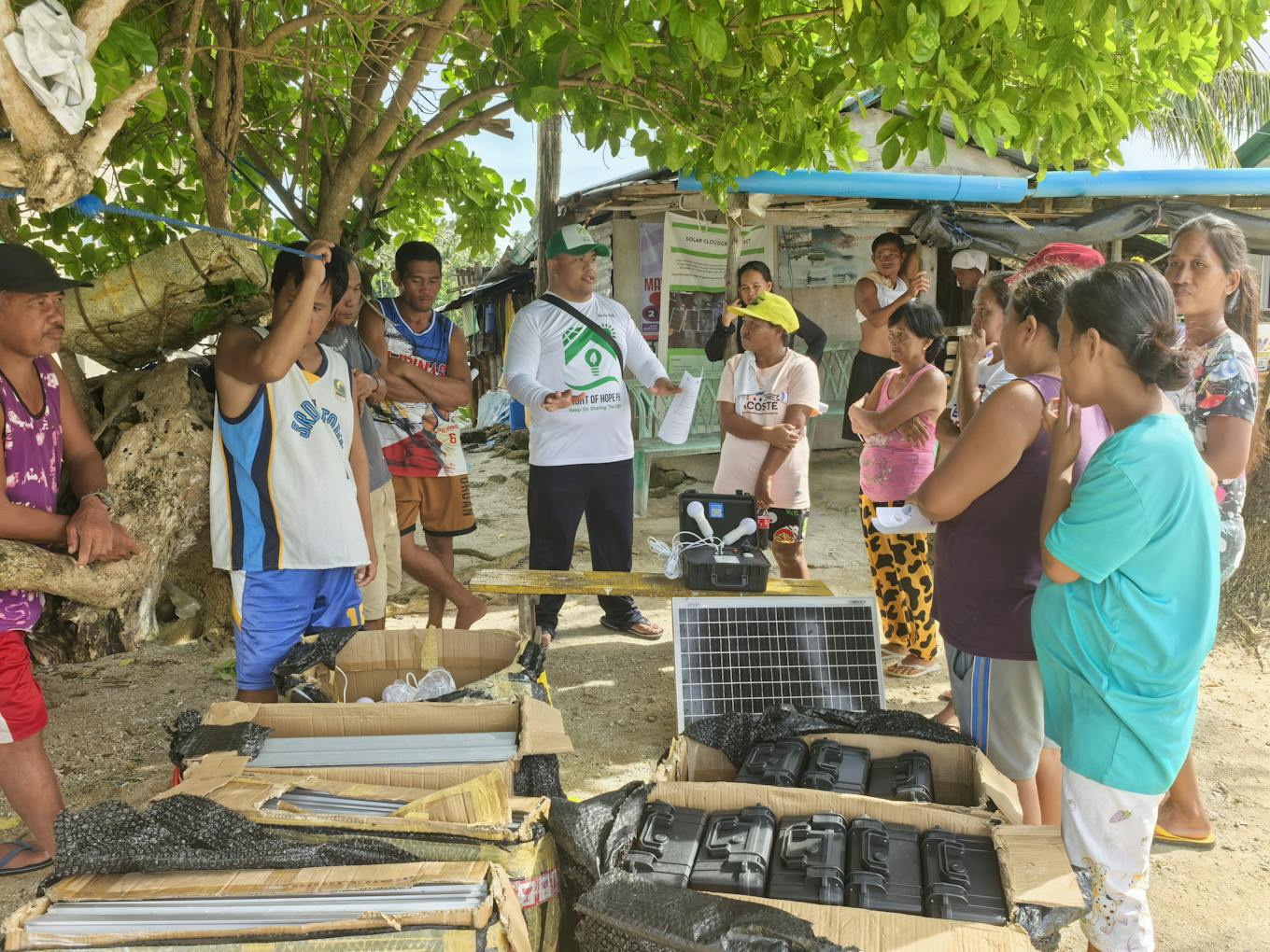
Jovie Gil Montajes explains how the solar cloud grids work to a community in Cab-ilan island, one of the Dinagat Islands in Caraga region in the province of Leyte. Image: Light of Hope PH
How did you transition from being an electronics engineer to founder of Light of Hope?
After finishing my studies as an electronics engineer, I landed a high-paying job at a United States-based company that had an office in Cebu.
I had already set up Light of Hope after working at a corporate for a few years, but I could not decide if I should resign and put all my energies into it or stay in my job.
Then one day when I was going home on my motorcycle, I was so tired and my body was so fatigued that I fell asleep as I got to the Marcelo Fernan bridge. I remember I heard the plastic step board of my motorcycle already grinding on the gutter of the bridge, then I woke up before I approached the downhill section of the bridge. If I didn’t wake up, then I wouldn’t be here today.
I realised that if I did not survive that accident, my company could just replace me in a week, and I would just be forgotten.
I felt that I was given a second chance at life because of the advocacy that we started in 2017. So I took the biggest risk in my career and left that high-paying job to focus on Light of Hope.
In the first year of going full-time with the organisation, I still had savings from my previous corporate job, but in the second year, I had nothing. God guided me where to go. We tried to get funding by joining more than 200 competitions sponsored by developed countries which award grants to social enterprises like ours. We won at least eight of those competitions that financed our initial solar lamp deployments. It was really life changing to put all my resources and energy into this advocacy.
Have you experienced setbacks?
It was hard because I also had a young family to support – milk for the baby is expensive and there were bills to pay.
Apart from my personal responsibilities, we were not winning any more grants that would fund our projects. Those factors almost made me give up the movement.
What boosted my confidence was that we were doing the right thing, and more people were recognising what we were doing, especially those from abroad. There were times when we suddenly received donations from supporters from the United Arab Emirates, Canada, and Europe at times when we needed it most.
Today, we are already paying a salary to seven staff, including myself.
We have local community champions and administrative assistants. We trained a fisherman and a youth who cannot afford to go to school to maintain the units. Once we have funding, we’ll give him a scholarship to go back to school.
Bringing solar energy technology to remote areas is not new in Asia. What makes Light of Hope different from other solar energy social enterprises?
The main difference is that we are looking at the long term sustainability of the project. Not only do we buy the units for the families, but we also maintain the units. We’re confident we can do that because we’re the ones who designed and built them.
We also look at circularity. Since we’re dealing with electronics, we don’t want to leave e-waste in the coastal areas. When we do repairs or maintenance, we take out the defective components, like the bulbs, the USBs, the wires, batteries and panels, and we replace them with new ones.
We bring the e-waste to the recycling centres. So far, we’ve already recovered more than 100 kilograms of e-waste.
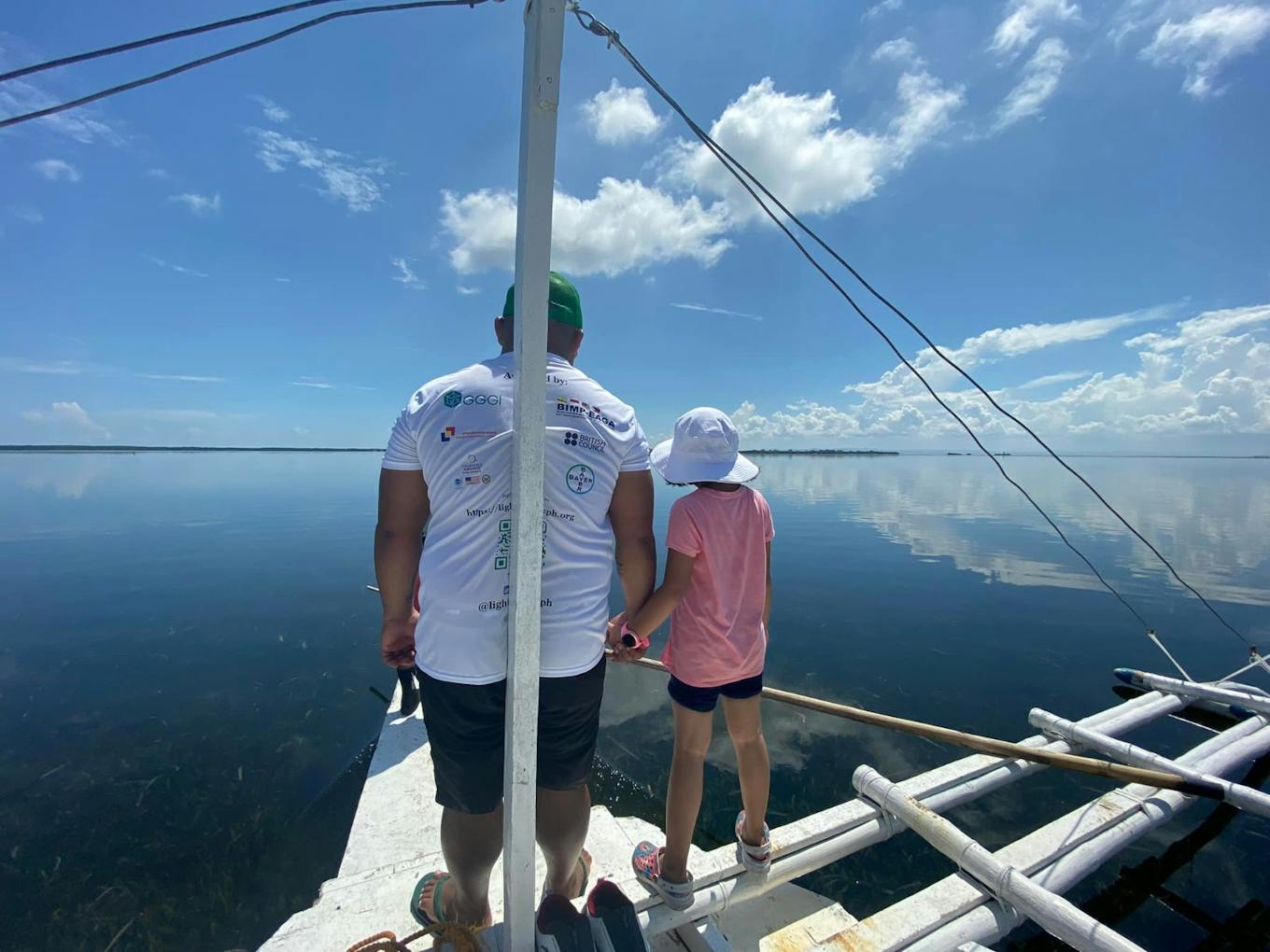
Jovie Montajes with his 8 year-old daughter on the way to Pangan-an island to distribute solar cloud grid units to a community. Image: Light of Hope PH
What is the one thing that inspires you to keep pushing on?
My family was with me through all the struggles since we started. They are still there supporting me and my kids are also going with me to the island communities. It’s a great experience to bond with your kids together with the community.
My kids had the chance to visit Caubian Island and Pangan-an Island in Cebu, as well as Banacon Island in Bohol. During our trips to these island communities, it was heartwarming to see them play with the local children.
What is the hardest aspect of your job?
It would be choosing which community receives the solar lamp units. We have a long waiting list but we don’t have enough units. Every time we deploy, we will always be asked if we have more.
I always ask them to just submit their requirements and hopefully in the next few months, we will have enough funding to build solar lamps to give them.
There was one time there was a pregnant lady who had just transferred to the community we were going to distribute solar units to. Since she was not on the list, we did not have a unit for her. She went on to give birth and she and her newborn had to endure extreme heat, due to a lack of electricity. We were able to serve her only four months after she gave birth.
It’s both heartwarming and heartbreaking. Heartwarming because they see the value of what we are doing, and heartbreaking because we are not able to provide them with what they need right away because we lack units.
The interview has been edited for brevity and clarity. Jovie Gil Montajes was one of the sustainability leaders selected for the Eco-Business Sustainability A-List 2025. Read our stories on other A-List winners here.