
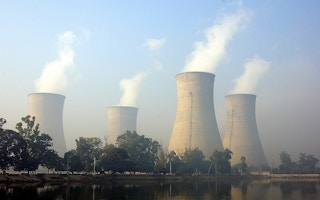
Asian fossil fuel and cement producers were the world’s largest contributors to carbon emissions in 2024, accounting for nearly one-third of global fossil carbon dioxide output, according to the Carbon Majors database produced by non-profit InfluenceMap.
The annual analysis traced 34.7 gigatonnes of carbon dioxide equivalent (GtCO2e) emissions last year to 166 major oil, gas, coal and cement producers worldwide – a 0.8 per cent increase from 2023.
Companies headquartered in Asia alone were responsible for 31.9 per cent of global fossil CO2 emissions, with more than 80 per cent of that total coming from coal. Over half of major Asian companies, or 58 per cent, increased their emissions in 2024 compared to 2023.
Chinese firms dominated a ranking, which was topped by Saudi Arabia’s oil giant Aramco. Thirty-one Chinese companies together accounted for 22.8 per cent of global emissions in 2024, while six Indian producers were linked to a further 5.2 per cent.
The data highlights Asia’s role in driving global emissions growth at a time when the world has just experienced its first calendar year exceeding 1.5°C of warming above pre-industrial levels.
State-owned giants lead emissions
Overall, just 32 companies worldwide were responsible for more than half of global fossil fuel and cement-related CO2 emissions in 2024 – down from 38 five years earlier, reflecting a growing concentration of emissions among the largest producers.
State-owned companies dominated this group, accounting for 54 per cent of global emissions last year. All of the world’s top 10 emitting companies were fully or majority state-owned, and many were based in Asia.
Coal India ranked second globally, linked to 1.51 GtCO2, while China’s CHN Energy ranked third with 1.51 GtCO2. Several Chinese coal and energy conglomerates – including Jinneng Group, Shandong Energy and China National Coal Group – also featured prominently among the top 10 emitters.

Aramco tops the ranking of the world’s major fossil fuel and cement emitters, followed by Coal India, National Iranian Oil Company, Russia’s Gazprom, Jinneng Holding of China, Russian oil and gas company Rosneft, China National Petroleum Corporation, China’s Shandong Energy Group and ChinaCoal. All of these companies are state-owned. Source: Carbon Majors: 2024 Data Update
“Asia’s emissions profile is shaped by a relatively small number of very large, state-controlled producers,” the briefing noted, pointing to the political and policy challenges of aligning climate action with national development strategies.
Emissions still rising
While emissions trends were mixed across the database – with 83 companies reducing emissions year-on-year – Asia stood out both for its scale and its growth. Emissions from Asian companies rose 2.2 per cent from 2023 to 2024, a significant increase given the region’s already high baseline.
More than half of major Asian producers (58 per cent) increased emissions last year, compared with lower proportions in Europe (15.2 per cent) and North America (11.2 per cent). Growth was particularly concentrated among the largest firms: nearly two-thirds of the 32 companies responsible for over half of global emissions increased their output year-on-year.
Coal remains the dominant driver. Seven of the world’s top 20 emitters in 2024 were coal producers, six of them Chinese and one Indian, reflecting the region’s continued reliance on coal for power generation and industrial activity.
The growing concentration of emissions among a small group of companies has sharpened attention on corporate accountability. While most legal action to date has focused on Western oil majors, the data shows that state-owned Asian companies now account for a far larger share of current global emissions.
Historically, state-owned companies globally are responsible for 31 per cent of cumulative fossil CO2 emissions since the Industrial Revolution (1850-1900), compared with 24 per cent from investor-owned firms.

Investor-owned (blue line) versus state-owned (orange line) comany emissions since 1920 [click to enlarge]. Source: Carbon Majors Database / InfluenceMap
In 2024 alone, state-owned companies increased emissions more often than they reduced them, while a majority of investor-owned companies saw declines – evidence that investor and civic society pressure can lead to carbon reductions even among the world’s most powerful companies.
The findings come amid ongoing debate over fossil fuel phase-out pathways in Asia, where energy demand continues to grow and coal remains politically and economically entrenched in countries such as India and Indonesia.
Opposition from major Asian fossil fuel producers including India, China and Saudi Arabia helped block a proposal at the COP30 climate talks to accelerate a global transition away from fossil fuels.
The latest data from Carbon Majors Database also emerged a few weeks after analysis by carbon and air pollution analyst Lauri Myllyvirta showed that coal-fired power generation fell simultaneously in China and India in 2025 for the first time since the 1970s, signalling that record clean energy growth could put both countries on track to peak coal and global emissions.






