
Solar power could help Vietnam avoid US$594 million in coal and gas imports as the war in Iran pushes energy prices higher, sharpening the stakes for the Southeast Asian nation which decided to scrap tariffs on fuel imports as it leans more heavily on global energy markets.
In a report released on 16 March, research group Zero Carbon Analytics estimated that Vietnam’s 25.9 terawatt-hours (TWh) of solar generation could help the country save on fossil fuel imports if current benchmark prices persist for a year. The calculation is based on average Newcastle coal futures and Asian liquified natural gas (LNG) prices in the first week of March, immediately after the outbreak of war in Iran drove up global fuel markets.
The analysis attributed about US$545 million in avoided spending to coal imports and roughly US$49 million to imported gas, assuming coal and gas are used instead of solar, in line with their shares in Vietnam’s power mix.
The findings come days after Vietnam scrapped most tariffs on imported fuels such as gasoline and diesel in a bid to tame inflation and support industry, a policy shift intended to “help stabilise the domestic market and ensure national energy security”, the ministry of finance said in an earlier statement.
Vietnam currently has the highest share of solar and wind generation in Southeast Asia, with 38.7 TWh of solar and wind in 2024 providing about 13 per cent of its power output, far above the under five per cent levels seen in its Southeast Asian peers.
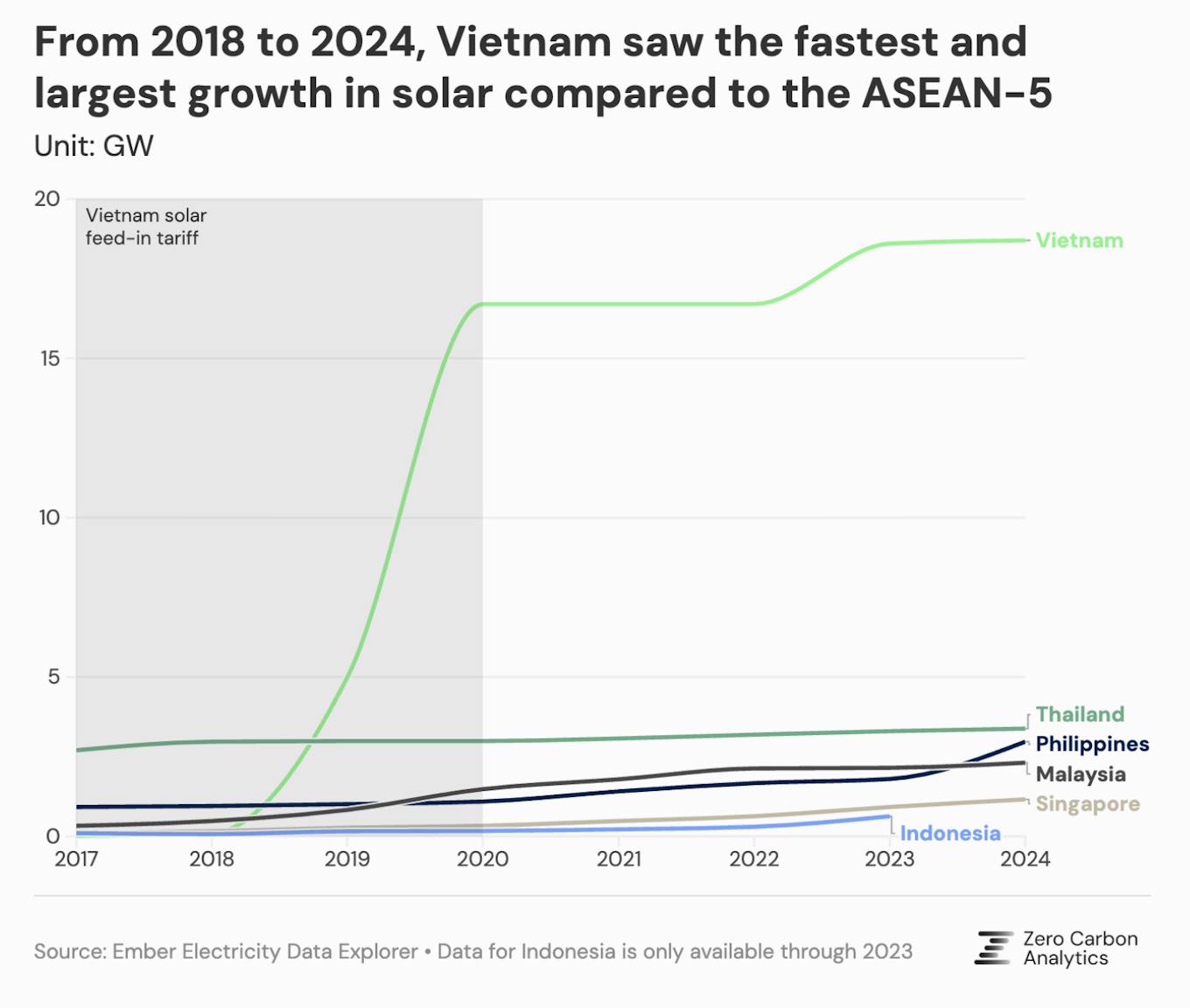
This position stems from an aggressive feed‑in tariff introduced in 2017, which helped solar capacity surge from 28 megawatts (MW) to 16.7 gigawatts (GW) by 2020 before the incentives expired.
“Vietnam’s solar power is already delivering a clear economic benefit by reducing the country’s exposure to volatile fossil fuel markets. When global energy prices spike because of geopolitical conflicts, domestic renewables provide a crucial buffer,” said Amy Kong, energy transition researcher at Zero Carbon Analytics.
Coal is still king
Despite Vietnam’s strong solar growth, relying on the renewable source of energy has faced policy challenges in recent years. The country has been curtailing a significant share of its solar output because the grid and policy framework have not kept pace with the boom in capacity.
Vietnam’s power system still leans heavily on coal and gas, much like the rest of Southeast Asia. In 2024, coal accounted for 50.3 per cent of electricity generation, with about half of that coal imported, and Vietnam has emerged as the region’s fastest‑growing coal importer, reaching a record in 2025.
Under the revised Power Development Plan (PDP8), Vietnam plans to add 22.4 GW of LNG‑fired capacity by 2030, nearly 15 per cent of projected power generation. LNG imports began in 2023, and the country signed its first multi‑year supply deal with Shell earlier this year to help compensate for falling domestic gas output.
Combined coal and LNG imports mean that by 2030, more than one‑third of Vietnam’s electricity could depend on foreign fuels, leaving it highly exposed to global price volatility like today’s spikes, warned Yu Sun Chin, senior Asia regional researcher at Zero Carbon Analytics.
“Expanding domestic clean energy like solar and wind can help provide stable power while reducing reliance on volatile imported fuels. Solar power is already among the cheapest sources of electricity in much of Southeast Asia. Scaling it up, alongside batteries and grid upgrades, can help countries cut energy costs while improving energy security,” she said.