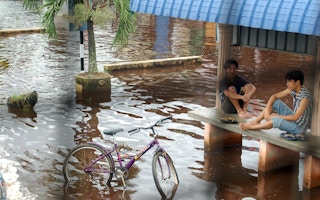
As Southeast Asia struggles with increasingly extreme weather events spurred by climate change, Malaysia’s ability to adapt has come under scrutiny.
To continue reading, subscribe to Eco‑Business.
There's something for everyone. We offer a range of subscription plans.
- Access our stories and receive our Insights Weekly newsletter with the free EB Member plan.
- Unlock unlimited access to our content and archive with EB Circle.
- Publish your content with EB Premium.
A lack of sufficiently detailed and actionable data, which can be translated into action at the local government level, has been a key barrier to improving climate adaptation, said Daniel Lee, executive director of the Selangor Climate Adaptation Centre (SCAC).
“Adaptation work requires localised actions, at the local authority level. We do not have sufficient data that is already downscaled to be operational [to local governments],” he said at the recent launch of the World Bank’s institutional assessment of Malaysia’s readiness to address climate change.
Lee added that although data about Malaysia’s climate-related vulnerabilities is available at a national scale, technical capacity and assistance are needed to help local authorities develop implementable adaptation solutions.
His comments were echoed by Dr Joy Jacqueline Pereira, principal research fellow at the National University of Malaysia’s Southeast Asia Disaster Prevention Research Institute, who also emphasised the importance of integrating disaster risk reduction plans.
Pereira, who is also co-chair of the mitigation working group for the Intergovernmental Panel on Climate Change (IPCC), said that Malaysia as a tropical country is particularly vulnerable to physical risks due to extreme weather events.
“The first step to adaptation for near-term climate risks is actually disaster risk reduction,” she said at the same event. However, national climate action plans are often disconnected from disaster risk responses, which occur at a local level.
“Disaster response and the planning of risk reduction falls under the district offices and local authorities,” she pointed out. “So there is a real need to bridge [federal climate adaptation efforts and disaster responses].”
For instance, Malaysia’s federal government currently oversees a national risk register, which captures climate extremes in English to boost investor confidence, said Pereira. A national disaster risk reduction policy was also launched last year, in Malay.
These policies, she added, would need to be translated to the local level, which is where agencies like SCAC can help.
Climate change law needed
Lee and Pereira’s remarks were consistent with the World Bank’s findings, which determined that Malaysia lacks regional or sector-specific climate data, which is currently focused on national drought and flood forecasts.

Malaysia requires more actionable data and coordination on disaster risk responses to improve local climate adaptation efforts, said Dr Joy Jacqueline Pereira, principal research fellow at the National University of Malaysia’s Southeast Asia Disaster Prevention Research Institute (left) and Daniel Lee, executive director of the Selangor Climate Adaptation Centre (right). Image: World Bank
“Although Malaysia’s climate plans include steps toward a national risk assessment and data hub, as well as to integrate hazard maps, climate projections and risk data from existing systems like the Environmental Impact Assessments, progress has yet to materialise,” the report said.
“Without detailed assessments, adaptation efforts risk being reactive and underfunded, and opportunities to mobilise private investment remain untapped,” said the report. “Better data and targeted studies – especially on vulnerable populations – are essential to develop effective, inclusive, and forward looking adaptation policies.”
An anticipated solution to this is Malaysia’s much-awaited climate change bill, which will include provisions to set up a National Integrated Climate Data Repository, according to a consultation paper published in 2024.
“Hopefully the [upcoming] Climate Change Act’s data repository will help…not just in theory but also, again, to [have] all this integrated data translated into something that can be used at a local level,” said Lee.
According to the consultation paper, the repository is meant to “modernise the way Malaysia will store, analyse, integrate, track, monitor, report and present climate actions and reporting.”
Many expect the bill to be tabled as early as March this year by recently appointed minister of Natural Resources and Environmental Sustainability (NRES) Arthur Joseph Kurup. It had been delayed as the previous acting minister, Johari Abdul Ghani, said more time was needed to secure corporate buy-in for the law.
Eco-Business reported last year that a chapter on climate adaptation has been added to the draft bill. Malaysia is also preparing to publish its first National Adaptation Plan (NAP) this year, which will be submitted to the United Nations’ climate change body.
Business incentives
In the meantime, NRES is also actively studying how it can develop Malaysia’s climate risk and vulnerability assessment, with an aim to integrate it under the climate change bill, shared Muhammad Ridzwan bin Ali, the ministry’s senior assistant secretary for climate policy and negotiation.
He said that Malaysia could look into following the example of the United Kingdom’s Climate Change Act, which requires an update to the country’s climate change risk assessment every five years.
“If we have that, we will definitely have information [on climate risks] to influence policymaking and enhance implementation at the local level,” said Ridzwan.
At a state level, SCAC is currently piloting a project to study Selangor’s climate resilience through the lens of water, energy, food and the environment in the state, said Lee.
Selangor, which is the most populous of Malaysia’s 14 states, is home to over 7 million people and has 12 local councils. Between 2023 and 2024, the state lost RM36.5 million (US$9.4 million) to disasters such as floods, according to data from the state’s disaster management committee.
“We have to look at how climate impacts not only the physical environment but how it affects social and economic development as well within the Selangor river basin,” he said.
Underfinancing is another area of concern for adaptation work, said Lee.
“A lot of our work right now at the state level, and probably even the federal level, is flood mitigation projects based on current and historical floods,” he said. “But we don’t have enough resources to look at future flood risks.”
This is where the private sector could play a crucial role, Lee suggested, as businesses would want to prioritise the long-term sustainability of their operations and should be “willing to invest in some of these adaptation measures.”
“But again, they lack data – there is not sufficient or accessible data so that the private sector can make these kinds of business decisions,” he said. “So we need all kinds of integration, coordination and more importantly, cooperation, especially in terms of financing.”