Solar power could help Southeast Asian nations avoid a costly gamble on imported gas as the Gulf crisis sends shockwaves through global energy markets, a new analysis has found.
Replacing the Association of Southeast Asian Nations (Asean)’s planned gas power expansion with solar could save the region up to US$67 billion at today’s and projected liquefied natural gas (LNG) prices, according to London-based energy think tank Ember.
An earlier Ember study showed that Southeast Asia’s 27 gigawatts (GW) of installed solar is less than 1 per cent of the region’s technical potential of more than 30,000 GW.
Under Asean’s current energy transition scenario, gas capacity is expected to almost double to 200 GW by 2030, from 106 GW today. Ember’s analysis shows that running the region’s gas fleet at current LNG price levels would cost about US$71 billion a year, rising to as much as US$109 billion if prices climb further, while generating the same amount of electricity with solar would cost roughly US$42 billion.
“Oil and gas are far more than just fuels. From fertilisers to high-tech polymers, they are the building blocks of modern life, leaving Asia’s industrial base deeply dependent on them,” said Dr Muyi Yang, senior energy analyst for Asia at Ember.
“Breaking that dependence is not just an energy switch. It is a full economic transformation. Perhaps it is time for Asia to rethink its fossil-intensive growth pathway,” he added.
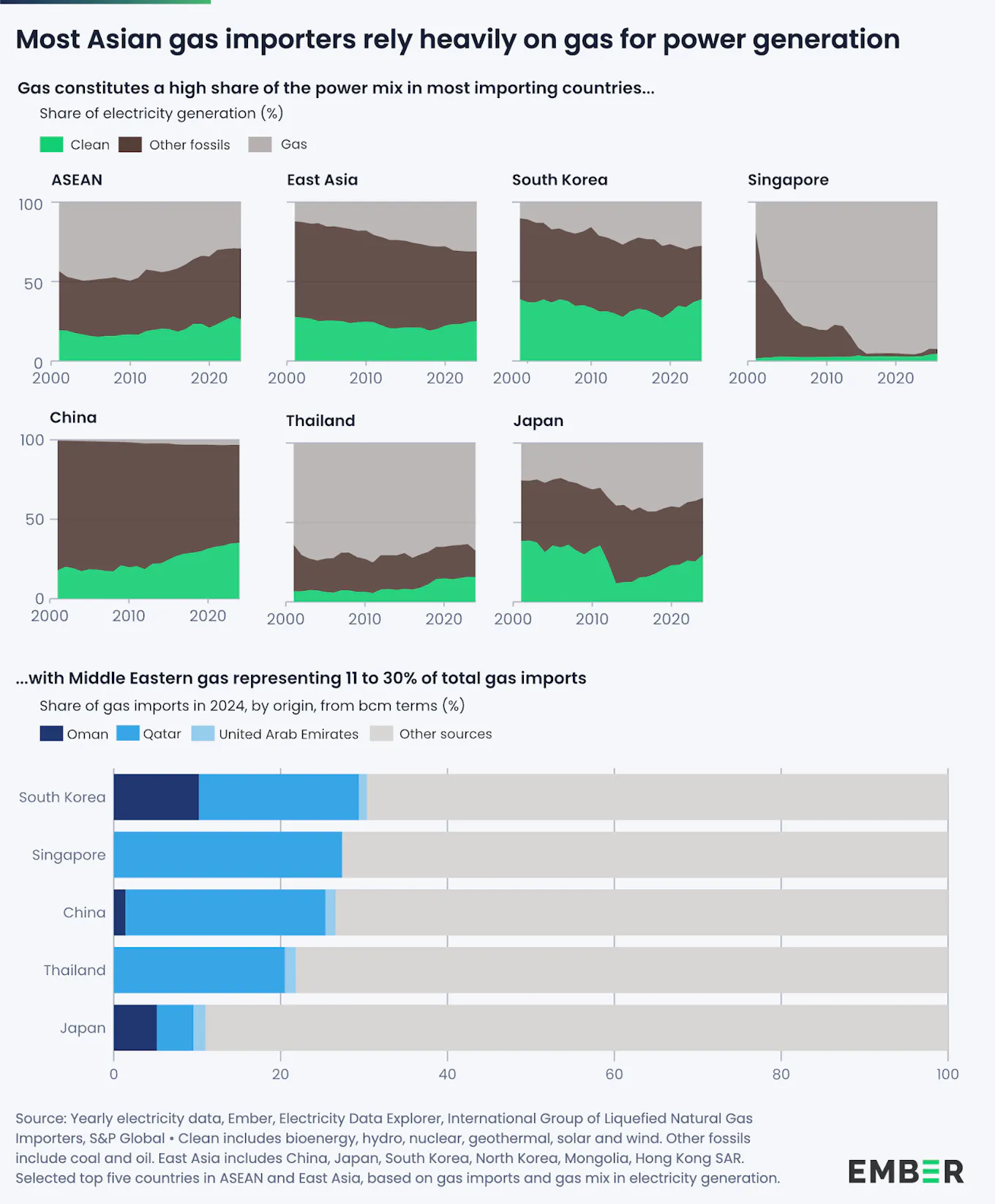
The findings come as the closure of the Strait of Hormuz and a halt in Qatari LNG production roil fuel markets across Southeast and East Asia, tightening supply and driving up prices. Countries with a high dependence on gas-fired power, like Singapore and Thailand face the sharpest effects, as they sourced the largest share of LNG from Qatar last year, at 42 per cent and 27 per cent shares respectively of total imports, said the report.
All countries in the region, except Brunei, are net oil importers, where they bring in more oil from abroad than they sell or ship out to other countries. Indonesia transitioned from being a net oil exporter to a net oil importer in 2004. In East Asia, Japan imports 90 per cent of its crude oil from the Middle East, while South Korea sources around 70 per cent of its crude from there, most of which passes through the Strait of Hormuz.
Costly and risky short-term shift back to coal
Doubling down on fossil fuel use will not solve the region’s energy security woes, according to the report’s authors.
The report took Indonesia as an example, showing how Southeast Asia’s largest coal producer is preparing to adjust its 2026 coal production quota as the Gulf crisis pushes up energy prices.
Coal prices jumped by about 9 per cent to around US$134 per tonne in early March. The government had already cut this year’s production target to about 600 million tonnes, nearly 190 million tonnes less than last year, when around 514 million tonnes, about two‑thirds of output, went to export markets like China, Japan, South Korea, Malaysia, the Philippines and Thailand.
Since last year, Indonesia has used a government‑set coal reference price to guide how much its coal sells for overseas. This gives the government more control in price talks for export contracts and helps shield buyers from sharp swings in global coal prices.
By adjusting the quota upward in response to the Gulf-driven price spike, the government is positioning Indonesia to sell more coal into a tight market, which could make coal more available and attractive to buyers looking for alternatives to expensive gas, local media has noted.
Thailand has also moved to run its coal plants at full capacity, as a temporary measure to manage the electricity crisis. This could add 3.2 million tonnes of carbon dioxide emissions a year, around 5 per cent of its targeted emissions by 2037, said the analysis.
Increasing the capacity utilisation of coal power plants or adding new power plants is “unsustainable” said authors as maximising coal plants capacity would raise coal use.
“Current and past crises have proven that fossil import dependence is risking energy security. Developing and emerging economies in Asia will be at higher risk if energy prices continue to escalate,” said Dr Dinita Setyawati, senior energy analyst for Asia at Ember.
“While energy saving can be an initial short-term solution, the pivot to homegrown renewables can provide more options to buffer future energy shocks.”