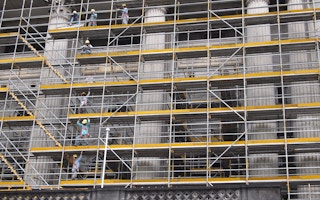
Reusing and upgrading existing buildings instead of replacing them could significantly lower Singapore’s carbon footprint, with retrofits cutting embodied emissions by nearly 70 per cent, a new study by the Singapore University of Technology and Design (SUTD) has shown.
The assessment, which was based on an upgrade of a 1970s office block into a co-living space called Coliwoo Bugis, found that retrofitting an existing building in Singapore can cut embodied emissions by nearly 70 per cent.
Embodied emissions refer to the climate pollution from the full life cycle of construction materials, from extraction to disposal. Embodied emissions account for about 40 per cent of a building’s environmental footprint.
The renovation option from SUTD’s study avoided 2,552 tonnes of carbon dioxide equivalent (CO2e), which is comparable to 4-6 years of the building’s operational emissions. Over a typical 30-year lifespan, this translated into 11–15 per cent lower whole-life emissions.
The biggest reductions came from retaining the structural frame of the building. By avoiding new foundations, columns, beams and slabs, the project achieved a 91.8 per cent cut in concrete-related emissions and a 63.9 per cent reduction in metals, the two most carbon-intensive categories in mid-rise buildings. Interior finishes, partitions and openings also showed reductions as high as 87 per cent.
The report’s authors noted that full redevelopment remain the dominant practice in Singapore’s building sector. Many new buildings are demolished well before their useful life is fully up, with shopping malls such as CapitaLand’s JCube and Frasers Property’s Bedok Point to be torn down after just 11 years.
Studies estimate that the average building lifespan in Singapore to be 33 years – despite most being technically designed for 60-90 years of use.
Peter Ortner, assistant professor at SUTD, told Eco-Business that as a relatively young city, Singapore has primarily grown through new construction, and as such adaptive reuse has remained relatively uncommon – “it simply hasn’t been necessary,” he said.
“But as the existing building stock ages and greenfield sites for development become rarer, adaptive reuse will become more common. If done properly, adaptive reuse provides strong benefits not just for environmental sustainability but for affordability,” he said.
Regulation gap for embodied carbon
SUTD’s study argues that the building industry’s rebuild-first culture persists because embodied carbon is poorly regulated, minimally rewarded and seldom monetised, even though it accounts for a large share of a building’s climate footprint.
The researchers caution that industry-standard carbon estimation tools may be masking the true scale of the problem. According to an assessment of one carbon calculator, embodied carbon was underestimated by nearly 46 per cent.
This calls into question the accuracy of lifecyle assessments currently used to support certification, sustainability disclosures and building approvals, the study warned. Without transparency and higher modelling rigour, Singapore may be underreporting emissions from new construction, it said.
The study highlighted that Singapore’s policy and market frameworks have the potential to more fully unlock climate change mitigation in Singapore’s built environment. Although the city-state has strong standards for operational energy performance in its Green Mark certfiication scheme, it has no equivalent requirements for embodied carbon, it said.
This imbalance means the current Green Mark certification could actually be discouraging retrofit and adaptive reuse by minimising their benefits. developers gain more predictable returns and regulatory clarity by rebuilding, despite the large upfront emissions. Proportionately driving investing into projects that deliver objectively better reductions in operational carbon intensity can also move the market toward the most sustainable solutions for the built environment, the study said.
Ortner argues that Singapore’s current building regime is causing unnecessary increases in material waste and carbon emissions, and recommends three shifts – set embodied carbon intensity thresholds, update the Green Mark sustainability certification criteria to more accurately recognise and reward structural retention, and introduce green finance incentives to prioritise adaptive reuse in lending practices.
Singapore has a goal of greening at least 80 per cent of its buildings by 2030, and had greened 2,590 buildings as of March 2025, which the Building and Construction Authority (BCA) claims has saved the emission equivalent to replanting a forest more than 13 times the size of Singapore.
However, the Green Mark scheme’s emphasis on energy efficiency over minimising embodied emissions will mean that as buildings become more efficient, embodied carbon will represent a more significant fraction of total emissions from the built environment, Ortner noted.