
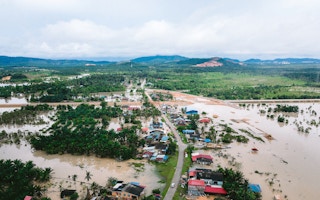
Malaysia’s financial sector has a weather problem. Although the central bank, Bank Negara Malaysia (BNM) has integrated climate risk by mandating disclosures for financial institutions, their exposure to losses caused by extreme weather remains stark.
Experience from climate stress testing elsewhere is instructive. Climate stress tests conducted by the European Central Bank and the Bank of England show that, in their respective banking systems, severe scenarios can raise projected credit losses by roughly 13–30 per cent. Indeed, climate disasters are unfolding at a rate that is pushing against the limits of what the financial system can absorb.
This crisis manifests most visibly in the property market, which underpins 60 per cent of total household debt. BNM noted that about 40 per cent of total bank loans are tied to sectors that are highly vulnerable to physical climate risks, with residential mortgages being a significant component.
The insurance protection myopia
People tend to talk about the insurance protection gap in narrow terms. The General Insurance Association of Malaysia (PIAM) states that over 50 percent of Malaysian households still remain uninsured against fire and natural disasters. But the response by the financial sector has been myopic – the issue is treated as a market failure to be rectified through better product penetration and financial literacy.
In reality, the global reinsurance sector is signalling that a growing tranche of real estate assets faces probability curves that defy traditional underwriting. For five consecutive years, natural catastrophe losses have exceeded , previously the mark of a bad year.
Swiss Re highlights that rapidly rising insured losses are outpacing growth in global GDP and property-insurance premiums. Meanwhile, Munich Re considers the 2024 losses of US$ 320 billion globally as evidence that “our planet’s weather machine is shifting to a higher gear.”
In Malaysia, the pressure is building. The widespread floods of 2021 caused RM6.1 billion (US$1.5 billion) in losses but only RM2 billion in payouts (US$490 million), according to Malaysian Re.
Accordingly, insurers are responding to rising costs with higher premiums and tighter underwriting, say PIAM. With over half of households uninsured, any shock would fall directly on the public and the banks.
The wider economy presents a graver picture, with agriculture operating in a near-total insurance void, despite RM90.6 million (US$22.2 million) in losses during the 2021 floods. Manufacturing and commercial sectors also sustained combined direct losses of RM1.4 billion (US$340 million) in the same disaster, but standard policies rarely cover the financial shock of severed supply chains. This accumulation of risk will ultimately widen the social divide between the resilient and the vulnerable.
Crucially, what many analyses overlook is the durability of the assets serving as the collateral base for the financial system. If the assets securing a significant component of household debt become uninsurable or lose substantial value due to climate risk, the very foundation of credit is compromised as it renders asset recovery meaningless.
Central banks have issued warnings on this: BNM’s Financial Sector Blueprint 2022-2026 explicitly states that physical climate risks will ‘impact investment and collateral values’ where assets are damaged by environmental events. The Bank of England’s 2022 climate stress test warned that banks face projected losses because climate risks will erode the value of homes, commercial real estate and more, making economic recovery difficult.
Physical climate risk is no longer peripheral, but a significant threat to financial stability.
Exhausting government guarantees
For now, the friction between uninsurable physical risk and banking solvency is smoothed by the government backing via moratoriums and public relief. Federal disaster allocations have risen sharply: RM300 million (US$73.6 million) for flood preparedness in Budget 2024, almost RM600 million (US$147.1 million) for the National Disaster Management Agency in Budget 2025, and expanded direct aid flows, including over RM200 million (US$49 million) for flood relief in 2025.
These interventions may subtly distort market dynamics, as they alleviate the pricing pressure on the private insurance and reinsurance markets. Nonetheless, this arrangement will face a hard boundary as the frequency of 1-in-100-year events compresses into annual occurrences. We may approach an inflection point where the cost of capital for the nation itself will surely rise to reflect this unmitigated exposure. The fiscal capacity of the state to act as the insurer of last resort will, at one point, be exhausted.
Positively, our financial reality is beginning to shift. BNM’s Climate Risk Management (CRMSA) and the National Sustainability Reporting Framework (NSRF) now require institutions to quantify flood risks, which is triggering a de-risking trend. Further, BNM’s 2024 Stress Test cycle explicitly forced banks to model capital hits against a catastrophic 1-in-200-year flood event.
Despite these encouraging developments, state government authorities retain the legal power to release land for development, often overriding technical objections. Without statutorily binding the land alienation process with climate data, developers can continue to build in hazardous areas.
The government must heed calls from stakeholders to address this legal framework within the National Adaptation Plan (MyNAP) next year.
Course Correction
We must consider this crisis a signal of the physical limits of our economic model. Yet, it should not be misread as evidence that insurers are failing. Major insurers are withdrawing from wildfire- and flood-prone regions while continuing to report strong profits. This is a strategic course of action to protect their balance sheets, on top of imposing higher premiums and tighter underwriting.
The same pattern is visible in Malaysia. Even as insurers warn of intensifying climate risk and tighten special-perils cover, the local insurance industry has reported robust profits to date.
This divergence matters as it reveals that our dependence on private capital for a social need is unsustainable. As climate risk grows, reliance on private markets becomes structurally untenable, leaving households, banks, and the state to absorb the residual risk when capital withdraws.
Addressing this problem requires moving beyond the current technocratic tinkering. Climate risk cannot just be priced or insured away without reshaping the entire political economy.
Malaysia must seriously consider whether a public banking utility or a state-backed reinsurance pool is required, not to bail out private assets, but to proactively manage a transition where private capital may eventually flee.
Finally, we must look beyond accounting for climate risks in terms of losses. Decarbonisation and adaptation should no longer be considered a green trend or initiative, but the only way forward.
Wan Saefullah is a researcher focusing on climate politics and communication. He holds a PhD in Human Geography from King’s College London.
An earlier version of this article attributed the 13-30 per cent increase in credit losses to BNM’s 2022 Climate Risk Stress Test and cited research on an overlap between property and people exposed to significant flood risk. The author has edited these statements for accuracy.





