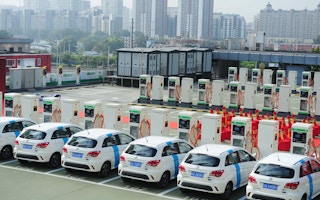
Global manufacturers of electric vehicle (EV) batteries will need to source their energy from cleaner electricity grids to lower the carbon footprint of their products, according to a new report by Greenpeace.
To continue reading, subscribe to Eco‑Business.
There's something for everyone. We offer a range of subscription plans.
- Access our stories and receive our Insights Weekly newsletter with the free EB Member plan.
- Unlock unlimited access to our content and archive with EB Circle.
- Publish your content with EB Premium.
“The manufacturing stage of battery production – responsible for roughly one-third of cradle-to-gate carbon dioxide (CO2) emissions – can be highly electricity-intensive and therefore overwhelmingly dependent on the carbon intensity of the local grid,” the report, published on Thursday, said.
‘Cradle-to-gate’ refers to a product’s lifecycle from resource extraction to the point at which it leaves the factory gate.
The report found that leading EV battery manufacturers Contemporary Amperex Technology Company Limited (CATL), BYD and LG Energy Solution (LGES) operate hundreds of gigawatt-hours of capacity in China and Poland, where the carbon intensity of the national grid exceeds 500 grams of CO2 per kilowatt-hour (kWh). This resulted in manufacturing emissions that are two to four times higher than comparable European facilities.
The report showed that emissions intensity was highest in Poland, followed by Malaysia and China [see chart]. All top 10 EV battery makers analysed in the report operate in China, with only LGES and Panasonic Energy owning manufacturing capacity in Poland.
Meanwhile, the carbon intensity of electricity was lowest in France, where NMC battery cells could achieve as low as 52 kilogrammes of carbon dioxide equivalent per kilowatt hour (kg CO2e/kWh), compared to as much as 126.5 kg CO2e/kWh for the same battery cell in Germany. In China, emissions for such cells range between 99–136 kg CO2e/kWh.
“Shifting production from China to Europe thus yields (emissions) reductions of 32 to 60 per cent, with France attaining the greatest benefit due to its low-carbon grid,” said the report.
“Even within Europe, country-to-country differences bracket savings of 30 to 42 per cent simply by operating in lower-intensity markets,” it said.
The report recommended that policymakers and industry should prioritise siting gigafactories in regions with cleaner grids, or invest in dedicated renewable energy sources for on-site power.
It is worth noting that China’s increase in renewable energy generation caused the country’s emissions to fall for the first time ever in the first quarter of 2025.

The graph shows the production capacity of leading global battery companies by region and the carbon intensity of electricity in those regions. Image: Greenpeace East Asia
Decarbonisation targets needed
Data from the International Energy Agency shows that China produces over three-quarters of batteries sold globally, and has been responsible for more than 70 per cent of all EV batteries ever produced.
According to Greenpeace’s report, CATL accounts for 28.18 per cent of global market share, followed by BYD (16.53 per cent) and LGES (12.02 per cent).
Although all top 10 battery manufacturers studied have established net zero targets to be reached by 2050 or earlier, only CATL, LGES and Panasonic Energy have both committed to 100 per cent renewable electricity for their operations and established carbon reduction targets for their supply chains, said Greenpeace. Three others – Samsung SDI, SK On and Sunwoda – have also set 100 per cent renewable energy targets.
All battery makers should set decarbonisation targets for electricity use and raw material sourcing, urged Greenpeace East Asia campaigner Erin Choi.
“Strong targets for supply chain emission reduction would send a signal to suppliers that they need to take action,” said Choi.
Battery manufacturing was one of two major sources of emissions which significantly contribute to the carbon footprint of lithium-ion batteries, with the second being the production of cathode materials.