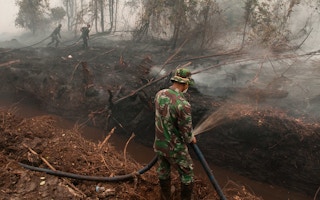


Like clockwork, haze descends over Southeast Asia as wildfires and forest fires, whether natural or human-induced, flare up in the dry season. This year’s transboundary haze is expected to be even worse than usual, supercharged by a “Godzilla” El Niño phenomenon taking hold across the globe. Forecasters warn it could be the strongest in over 70 years and could intensify into early 2027.
In Indonesia, the ongoing battle to extinguish the relentless wildfires and contain toxic haze across six provinces in Borneo and Sumatra has entered a critical phase. The smog has drifted further across the region, blanketing parts of Malaysia, Singapore and the Philippines for weeks. The impact is devastating, affecting roughly 5.5 million people and threatening the health and safety of local communities, livelihoods and wildlife, especially the critically endangered Bornean orangutan.
The palm oil sector has long been at the centre of criticism as one of the main contributors to such fires in its quest to expand plantations. To deny this accusation would be foolhardy. Although the industry has made significant progress in halting large-scale clearing of new frontier forests for agricultural expansion since the late 90s, deforestation linked to industrial oil palm expansion has begun to rise again in parts of Indonesia. Recent satellite analysis shows that Indonesia has seen an uptick in deforestation since its 2021 peak, with 122,000 hectares lost in 2024. In that same year, 67 per cent of Indonesian oil palm companies recorded deforestation.
Despite tightened land-clearing rules limiting burning practices, fire remains the quickest and most cost-effective method to remove dense tropical vegetation and prepare peat or forest land for planting. But the cost has proven too high.
In response to the most intense wildfires in 11 years that the country is battling, Indonesian President Prabowo Subianto has called for stricter regulations and sanctions against slash-and-burn land clearances that he terms as “ecological terrorism”. He also instructed regional governments to immediately abolish exemptions that previously allowed smallholders to clear small plots of land using fire.
With climate change, peatland vulnerability, and intensifying weather phenomena creating a perfect firestorm for fires and severe haze, strict enforcement will be critical for long-term change. This is where rigorous standards and certification parameters, robust ecosystem-readiness, and transparent monitoring and reporting can complement fire and haze management policies at the enforcement level.
Fighting fires: From NDPE to hotspot tracking
When oil palms are grown sustainably and managed responsibly, the industry could actually be a vector for solving the recurring threat of fires and transboundary haze.
Under the Roundtable on Sustainable Palm Oil (RSPO) standards, deforestation has been prohibited since 2018, building on requirements in place since 2005 prohibiting the conversion of primary forests and areas containing High Conservation Values (HCVs). The use of fire for land clearing or preparation, including by smallholders, is strictly prohibited. RSPO certified plantations maintain rigorous fire management protocols and have measures in place to prevent and respond to fire risks and incidents in and around their plantations, while also protecting worker wellbeing when air quality is hazardous.
New planting on peatland, regardless of depth, has been banned since 2018. All existing peatland plantations from before that period are required to strictly manage their concessions and surrounding areas, including keeping peat water tables high enough to resist drying out, and replacing burning with mechanical shredding when land is cleared for replanting.
Through satellite-fed monitoring tools and fire alert systems, teams track “hotspots” – indications of heat points on the ground – in near-real-time, with data made publicly visible for greater transparency and accountability. Where a breach of RSPO standards is identified, strict repercussions apply, including termination of membership or revocation of certification, both of which have adverse business implications in a highly complex regulatory-driven global market.
In 2025, the annual number of hotspots detected within RSPO member concessions in Malaysia and Indonesia decreased from 4,831 in 2024 to 3,550. In August 2026, however, reflecting the seriousness of the ongoing fires and resulting haze, 9,841 hotspots were recorded in RSPO member concessions (2.26 per cent out of a total of 435,507 hotspots) across Malaysia and Indonesia.
While hotspots do not necessarily indicate an active fire, automated alerts enable RSPO members to take timely action to verify the location and respond where fires are confirmed. In 2026, member responses indicated that approximately 65–75 per cent of reported hotspots were associated with actual fires, including fires both within and outside members’ concessions. Whether fires occur inside or outside certified concessions, RSPO members are often at the centre of extensive fire mitigation and rescue efforts, as recently witnessed.
RSPO members rising to the challenge
What the sustainable palm oil sector has shown is that the trajectory can shift. No Deforestation, No Peat, No Exploitation (NDPE) pledges, zero-burning practices, and digital traceability tools, from supply chain tracking systems to GIS-based hotspot monitoring, have made the sector more equipped to respond to fires that can occur for a host of reasons during periods of prolonged dry conditions.
Several RSPO certified members have translated these actions into robust, on-the-ground programmes. Golden Agri Resources (GAR) for example, has trained over 10,000 Emergency Response Team personnel, stationed across its plantations, ready to be deployed at a moment’s notice in the event of a fire, apart from a zero burning policy adopted since 1997 to decouple production from deforestation.
Likewise, PT REA Kaltim Plantations, initiated a coordination meeting in Tabang, Indonesia in September 2026, with the local government, companies and village leaders to coordinate fire response and strengthen community awareness before an emergency occurs.
Because fire does not respect boundaries, certified members also carry out firefighting measures beyond their concessions to include surrounding communities. In the peatland rich province of Pelalawan, Riau, the government had recently declared a Karhutla Emergency Response from 24 August to 6 September. Musim Mas, one of the largest integrated palm oil companies globally, responded by extending its firefighting capacities to mobilise water sources and equipment, conduct coordinated patrols, and engage actively with communities and authorities on the ground.
A call for unified action at scale
It is clear that a single industry, however resolute, cannot fight Southeast Asia’s battle against haze alone.
Fighting wildfires and transboundary haze calls for orchestrated action at scale: with other agricultural sectors adopting similar sustainability standards and cross-border collaboration and knowledge sharing on the data and technology that make early intervention possible.
With the climate crisis and extreme weather now a recurring reality, the urgency for collective action at scale is undeniable. Anything less than unified region-wide action would mean history repeating itself, dry season after dry season. Only when efforts from companies, governments and communities alike can respond in lockstep can the region break the vicious cycle of fires and haze that has impacted so many lives, biodiversity and economies for far too long.
Aryo Gustomo is the Assurance Director at the Roundtable on Sustainable Palm Oil (RSPO).