
Mangrove forests in Peninsula, and Sabah and Sarawak are being rapidly cleared due to the pressures from growing populations in coastal areas.
The ever changing population dynamics has led to changes in land use and over-utilization of resources.
The mangrove depletion is further exacerbated by rapid economic development in the coastal areas apart from unsustainable forest practices, land conversion/reclamation for agriculture, aquaculture, mining, industrial, port expansion, urbanisation, tourism, infrastructure development.
“For instance, many mangrove reserves gazetted during the colonial period have since been de-gazetted and made available for other uses,” said Cheryl Rita Kaur, a senior researcher at the Centre for Coastal and Marine Environment Maritime Institute of Malaysia (MIMA).
And even those mangrove forests that survived the onslaught are being choked by coastal pollution contributed by domestic and industrial wastes.
“Therefore, we need to find a balance between meeting increasing present-day needs on the one hand, and conserving the environmental support system provided by mangroves, on the other,” she said.
Hoe are we to achieve this?
Of course, there are many options before the government to achieve such a goal.
Given their multiple-use potential, she said it is imperative that the management of mangrove based terrestrial and aquatic ecosystems be undertaken within the context of integrated coastal area management planning.
This would essentially require cooperation and commitment between various agencies and stakeholders to ensure the sustainability of mangrove resources, now and in the future.
“For instance the MIMA International Conference on Mangroves a few years back called for a ‘no-net loss’ policy, where the goal was to balance the loss caused by economic development through reclamation, mitigation and restoration efforts - so that the total acreage of mangrove areas in the country does not decrease, but remains constant or, preferably, increases.
“One good example that would relate to this approach would be the Matang mangrove forest in Perak. Through an integrated management approach and strong support from the government, this forest is one of the best managed areas under sustainable forest management system in Malaysia and is also recognised as the best managed mangrove forest in the world,” she said.
The status quo for mangrove in Malaysia
The total mangrove area in Malaysia is estimated to be approximately 575,000 hectares, of which 60 per cent found in Sabah, 23 per cent in Sarawak and the remaining 17 per cent in Peninsula.
Of the total, 85 per cent have been gazetted as forest reserves, wildlife sanctuaries, RAMSAR sites, and as state and national parks. For instance, there are five mangrove-based RAMSAR sites in Malaysia which include Kukup Island, Tanjung Piai, Sungai Pulai, Kuching Wetlands, and Kinabatangan.
However, it is said that mangrove cover in Malaysia has declined by 30 per cent over the past five decades from 800,000 hectares in the 1950s to 575,000 hectares at present.
The lost of mangrove areas are highest in Perlis, Selangor, Johor, Sarawak, Negeri Sembilan and Penang.
The perils of a depleted mangrove eco system
Mangroves are unique especially in terms of their adaptation abilities in response to harsh environments. Mangroves stabilize shorelines and protect coastal communities by acting as a buffer against storm surges and strong winds.
Their function as effective natural barrier againts tsunamis, weather typhoons, cyclones and storm surges as a result of global warming is crucial.
The critical role of the coastal ecosystems including mangroves in maintaining the climate is also being increasingly acknowledged.
“For instance, the term ‘blue carbon’ sinks/storage is used to define this further. Out of all the biological carbon (or green carbon) captured globally, over half (55 per cent) is captured by marine living organisms, not on land, hence, it is called blue carbon. Continuously increasing carbon dioxide (CO2) and other greenhouse gas emissions are contributing to climate change,” she said.
Moreover, in many countries, Cheryl said especially those going through periods of rapid economic growth were increasing their carbon emissions but with the depleting of these mangrove forests that is classified as ‘blue carbon’ sinks/storage, their ability to absorb CO2 is also being reduced.
“And these data, records and various other global initiatives in this regard are largely assisting policy makers to mainstream the mangrove ecosystems into national and international climate change initiatives,” she concluded.
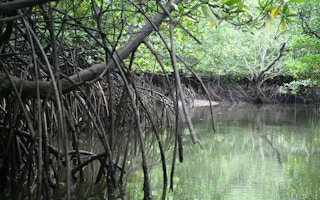
Malaysia’s mangrove forest rapidly depleted and degraded

Terpopuler
-
![Shipping_Harbor_Shanghai_China_Steel]()
Berita / Manufaktur
China’s changing steel sector could leave Australian iron ore behind
Steel slowdown and signals of low-carbon transition in China put Australian ore at a crossroads, as partnerships look … -
![Wildfire_Indonesia_Simulation_Excercise]() Wildfires in West Kalimantan are leaving wildlife struggling to find fresh water as forest pools dry up and …
Wildfires in West Kalimantan are leaving wildlife struggling to find fresh water as forest pools dry up and … -
![AirTrunk]()
Berita / Energi
AI, data centres could make Asean clean energy projects bankable as grid plans advance: experts
Long-term power purchases could unlock investment in renewables and transmission as Asean advances cross-border electricity trade, say energy … -
![Hazy Chinatown in Singapore]()
Berita / Karbon & Iklim
This year’s haze is set to cost Singapore more than 2015’s S$1.83 billion. Who pays for the losses?
Economists suggest the 2026 haze will cost Singapore more than the 2015 episode, while other estimates state that … -
![Construction_Workers_Dam_Bhutan]() Nepal floods bring renewed focus on neighbour Bhutan’s efforts to protect its economically crucial – but debt generating …
Nepal floods bring renewed focus on neighbour Bhutan’s efforts to protect its economically crucial – but debt generating … -
![Car_Show_Display_BYD_China]()
Berita / Manufaktur
China’s EV weight problem
Electric vehicles are getting heavier, making bigger carbon footprints in the factory and on the roads.