
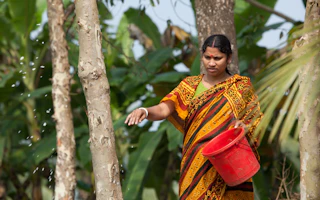

The 8,000 sq km Barind Tract in north-western Bangladesh was once synonymous with paddy cultivation. These days, parts of the region are home to high-value crops that do not form the local staple diet. In some places, crops are being cultivated that were virtually unknown until a decade ago.
The region’s higher, undulated area, the High Barind Tract, incorporates Rajshahi, Chapainawabganj and Naogaon. In parts of these three districts, farmers are switching from paddy cultivation to crops like dragon fruit, sweet orange and mango. They are also increasingly growing crops that require less water, like maize, lentils, tomatoes and chillies.
The tract’s farmers are making this switch in response to a growing water crisis in the region: Barind has been experiencing erratic rainfall, and its groundwater has been gradually reducing.
“Farmers are responding to water stress in real time,” says Mariam Ahmed, a government agriculture officer in Godagari, an upazila (subdistrict) of Rajshahi. “Over the past few years, we have seen a significant expansion of dragon fruit cultivation across three unions in Godagari [Pakri, Matikata and Gogram], particularly in Matikata, where many highlands and even some former paddy fields are now being converted into dragon fruit orchards.”
“
A mango orchard may provide only three months of employment to an agricultural labourer, while paddy cultivation ensures year-round engagement.
Sarwar Jahan, professor, University of Rajshahi
Barind’s transformation is often cited as an example of local climate adaptation. But though the adaptation is rooted in necessity, for some the choice of crop is reflective of economic drivers. “Farmers are shifting from rice to dragon fruit, malta fruit [sweet orange] and mango orchards because they see stable profits and lower water needs,” Ahmed notes. “The driver is economic opportunity as much as climate adaptation.”
This shift is manageable for those with market access, adequate infrastructure to rely upon and capital investment. But landless tenant farmers, as well as resource-poor and marginal communities, remain trapped in traditional systems. They are experiencing shrinking returns and the loss of stable agricultural jobs.
“Those who have land and savings can adapt,” says Mohammad Bulu, a farmer in the Vajanpur Patha Para village of Godagari. “For the poor, it’s impossible.”
A drought-prone region
The Barind Tract is one of the driest zones in the country, with annual rainfall half of that seen in eastern and southern Bangladesh. It is also prone to drought.
Over the past decade, groundwater levels have dropped by nearly 10-15 metres in many upazilas in the region. That is according to Mohammad Abdul Latif Sarkar, an assistant engineer at the Barind Multipurpose Development Authority (BMDA), a government body overseeing the tract’s agricultural development.
This is due to several reasons, one being the region’s thick surface layer of clay. This prevents the percolation of water and thus makes groundwater recharge difficult, notes Chowdhury Sarwar Jahan, a professor at the University of Rajshahi’s Department of Geology and Mining.
“Ten years ago, a BMDA deep tube well could irrigate more than 200 bighas [27 hectares] of land,” says Abu Bakar, a pump operator at the Matikata union council, a local government body within Godagari. “Now, it can barely serve half.” The groundwater level has fallen so low that submersible pumps can no longer do the job.
Across Godagari, irrigation is increasingly difficult. Bakar notes that many tube wells have started to yield less water and, in a few cases, have stopped functioning. Meanwhile, many bodies of surface water in Godagari are already used for aquaculture, which limits alternative irrigation sources in the area.
Saving groundwater
BMDA had historically used deeper tube wells to meet large-scale irrigation needs, and operates around 16,000 deep tube wells in the region. However, aquifer depletion has meant no new installations since 2012.
Since 2024, the BMDA’s pumps in these particular upazilas have been limited to operating for a maximum of 980 hours from mid-February to mid-May, when the boro crops (high-yielding winter rice) reach peak thirst in the Barind Tract. This is down from 1,200-1,400 hours.
Latif notes that the BMDA simultaneously introduced a “rotational irrigation system” in 2024. This entails supplying water to only a third of the area it operates during the boro season, by delivering water from one deep tube well rather than three. Each serves 1-2 hectares of land. “This means farmers who receive irrigation this year will not get it for the next two years,” he clarifies.
Latif adds that field inspections by BMDA officials indicate groundwater levels have increased. Quantified data is not yet available.
The lowered cap and rotational irrigation have rapidly reshaped local cropping decisions. In the union of Pakri in Godagari, total boro rice cultivation shrank from 1,300 hectares in 2024 to around 1,050 last year, notes Mohammad Anisur Rahman. “Vegetables, maize and lentils have replaced many paddy fields because water is no longer available,” says the sub-assistant agricultural officer for Pakri council.
The BMDA’s policy is intended to regulate groundwater extraction, but experts say it may have inadvertently spurred unregulated private pumping. Many farmers are installing their own shallow tube wells, or relying on privately-operated electric pumps.
This often leads to groundwater extraction beyond the reach of government monitoring, notes Jahangir Alam Khan. He directs the DASCOH Foundation (Development Association for Self-reliance, Communication and Health), a local NGO focused on water issues. In upazilas across the region, Khan says “groundwater extraction is effectively going unmonitored, as existing systems of water management are unable to scale and [curb] spread of usage.”
“Restricting state-operated irrigation without strengthening local water governance leads to a parallel, unregulated market,” adds Jahan of the University of Rajshahi. “It undermines the very goal of groundwater sustainability.”
Switching crops: A two-tier adaptation story
With these policy changes, farmers are now faced with new opportunities and challenges shaped by market access and infrastructure.
In Godagari, farmers living near highways and marketplaces, such as those in the union of Matikata and parts of the union of Gogram, are far more likely to switch crops than those in more remote or upland areas, like Pakri, due to their visibility and connection to markets and customers. “Market access is the single biggest enabler,” says Ahmed. “Farmers who can sell fruits directly earn better.”
Hasibul Islam was working in construction in Dhaka, Bangladesh’s capital. After the Covid-19 pandemic hit, he returned home to the village of Gopalpur in Matikata, where he converted his boro paddy fields into a dragon fruit orchard. Islam tells Dialogue Earth that one bigha (0.134 hectares) of paddy yields a net profit of BDT 80,000 (US$655) annually, while dragon fruit earns BDT 500,000-600,000 (US$4,900).
He highlights the benefits of the conversion, and his farm’s location beside the state highway: “Wholesalers come to me. I don’t even go to the market.”
Such transitions are capital-intensive. Establishing one bigha of dragon fruit requires around BDT 250,000 (US$2,045), Islam notes. This is far beyond what marginal farmers can afford. Islam used his savings and obtained a loan from his brother (a migrant worker in Oman) to convert his fields.
For smallholders who lease land, the decision to change crops is often not up to them. “Owners decide what to grow,” says Mohammad Rasid, a tenant farmer in Gorgoria, a village in Pakri. His landlord uses a sharecropping system: land is cultivated on a yearly basis and the harvest typically split equally between the landowner and tenant farmer. Rasid retains a small portion for household consumption and sells the rest.
Rasid notes his smallholding mostly cultivates a thin-grain local variety of kalijira rice, a miniature version of basmati rice. It is traditionally cultivated for personal consumption but has good market value as a premium rice. “If I don’t grow [this variety of] rice, they won’t lease me the land next season,” he adds.
Meanwhile, agricultural labourers, particularly women and marginal communities, are losing work.
Some of the new crops being planted require less labour each year for pruning and orchard management, compared to the more intensive needs of paddy. “A mango orchard may provide only three months of employment to an agricultural labourer, while paddy cultivation ensures year-round engagement,” Jahan explains.
He notes that up to 15 per cent of the Barind Tract’s population is Indigenous and landless communities, who already lack access to land and resources. “With this agricultural transition, many of them have become further marginalised. This shift will inevitably push these communities toward out-migration.”
Shreya Chakraborty, regional researcher at the International Water Management Institute, says Barind farmers’ adaptability and the changes being observed in the region “are evolving unevenly [as] those with resources are progressing, while the poorest remain trapped in uncertainty”.
She adds that a “multi-level holistic approach” is essential for any future adaptation initiatives in the region – “one that connects groundwater governance with inclusive finance, farmer training and fair market systems”.
Chakraborty says: “Without an enabling environment, these transitions will remain isolated success stories, rather than a pathway to long-term resilience for Barind’s water-stressed communities.”
This article was originally published on Dialogue Earth under a Creative Commons licence.