An innovation to turn food waste into nutritious, locally-made fish feed won one of the top prizes at The Sustainability Youth Festival (TSYF) Challenge, with a Singapore youth-led start-up securing new funding to scale its idea into a viable business selling to fish shops and ornamental fish farms.
The challenge, organised as part of the inaugural festival, aims to provide a platform for young people to develop and showcase innovative solutions to sustainability challenges. SusFeed, the winning start-up, pioneered a process to upcycle common food waste items such as surplus vegetables and bread that can be obtained from local supermarkets and retailers into a fish feed that has been tested for use by farms and businesses.
As the champion in the Sustainability Youth Innovator (Senior Division) category at the TSYF Challenge, the start-up, co-founded by two youths in their early 20s, secured S$15,000 (US$11,720) in prize money.
All students from post-secondary educational institutions and young professionals under the age of 35 can compete in the senior division category.
The team said the fresh funding will support it in taking an idea that first emerged from an experiment in the school laboratory to a fully-scalable business that would see it doubling production, acquiring more customers, and increasing the product’s distribution channels. In early trials, the team has already upcycled over 50 kilogrammes of food waste, equivalent to about 385 burgers.
At the challenge, SusFeed’s co-founders Javier Tan and Azad Akim Ahamed shared the thought process behind their product with a judging panel made up of sustainability professionals and leaders, highlighting how they have gotten positive feedback from pilot users. Beyond sustainable production methods, the team focused on enhancing the nutritional value and affordability of the fish feed to appeal to farms and aquarium retailers, especially as fish are often selective about what they eat, they said.
Food waste is a serious problem in Singapore. About 870,000 tonnes of food waste is generated yearly, and more than 80 per cent of it goes to the landfill.
TSYF Challenge is the centrepiece of a new festival that launched in Singapore this month to deepen youths’ understanding of sustainability and nurture a generation of future sustainability leaders across diverse sectors. The full-day event, held at Capitol Theatre, attracted over 1,000 registrations.
Singapore-registered charity EB Impact, which is behind the ground-up initiative, worked in collaboration with the Inter-University Environment Coalition (IUEC), which gathers student leaders from over 10 environmental clubs and green groups of Singapore’s universities. A key objective of the festival is to engage students across educational institutions, including the local primary schools, secondary schools and tertiary education institutions.
Gerald Wong, executive director of EB Impact, said that among youths in Singapore, awareness of sustainability topics has grown in recent years, with a segment of young people deeply engaged in the space. Yet many still lack a deeper understanding of the complexities behind how sustainability considerations interact with other social and economic priorities, he added. “Young people want to know how they can translate their passion into concrete action.”
Wong said EB Impact observed that schoolgoing children, youth and educators also lacked a platform where they can learn about sustainability through experential activities. “Sustainability as a topic can sometimes feel vast and daunting. With the festival, we wanted to make it more relatable and accessible,” he said.
With the challenge, youths are empowered to pursue sustainability-aligned initiatives, which could first take shape in the form of school projects.

From left: Javier Tan and Azad Akim Ahamed, co-founders of start-up SusFeed, which won the top prize under the Sustainability Youth Innovator (Senior Division) category, taking a “wefie” with senior parliamentary secretary for The Ministry of Sustainability and Environment (MSE) Goh Hanyan. Image: EB Impact
The TSYF Challenge is designed as a nationwide sustainability competition for youths under the age of 35. Finalist teams pitched their ideas live on stage and competed for a prize pool of up to S$20,000 (US$15,630).
Other than the Sustainability Youth Innovator challenge, teams from local primary and secondary schools also competed for the Sustainability Youth Changemaker award which showcased ideas focused on behaviour change and awareness in sustainability. Youth for Earth, a team from CHIJ Secondary emerged top. In the junior division – which includes participants from local primary and secondary schools – of the innovator challenge, the champion team was from the School of Science and Technology.

The participating team from Crest Secondary School showing their microgreens and vegetables to judges of the Sustainability Youth Changemaker challenge. The team intends to showcase urban farming techniques to residents and local communities. Image: EB Impact

The “Oh My Batik!” team from Crest Secondary School explaining how traditional batik waste is upcycled and turned into fashionable products like headbands and other accessories. Image: EB Impact
The festival is supported by funding from the government-led SG Eco Fund. Other partners include OCBC, tech multinational Meta, real estate firm City Developments Limited and Eco-Business.

The TSYF Challenge is designed as a nationwide sustainability competition for youths under the age of 35, including students from local educational institutions. The challenge attracted 25 registrations from across Singapore. Image: EB Impact
At the festival, senior parliamentary secretary for the Ministry of Sustainability and Environment (MSE) Goh Hanyan said: “Over the years, we have seen an increase in youth activity across a few areas, including in exploring new technologies and finding ways to tackle climate change.”
She said the TSYF challenge combines these two interests and urged the young to believe that their ability to make an impact on the world is greater than they think.
Working with corporates is key, said Goh, as this can transform ideas into real solutions, with the right resources. There is also a growing need to imbue Singapore’s workforce with new knowledge and fresh ideas on sustainability, which could come from the young, she said.

Senior parliamentary secretary Goh Hanyan (right) stopping at the booth of 1.5degreeNUS, a student-led interest group from the National University of Singapore. The group was at TSYF to engage youths on key concepts such as the importance of understanding our ecological footprint. Image: EB Impact
The festival had also showcased booths from sustainability initiatives such as circular fashion social start-up Cloop and plastic recycling firm Semula.
Another highlight is a conference that gathered expert speakers across academia, industry and civil society.
One panel discussion saw social media content creator Kong Man Jing, better known as Biogirl MJ, share how short-form videos and communication techniques can be used to engage young people on emerging media platforms. The panel also addressed the importance of “localising” global issues and discussed the need to put a spotlight on solutions to inspire collective climate action.

From left: Ethel Lee from IUEC moderating a panel of speakers at the Youth Conference, including Audrey Tan, assistant news editor at Singapore broadsheet The Straits Times, Kong Man Jing, better known as Biogirl MJ, co-founder of Just Keep Thinking, a science and biodiversity channel on social media, and Muhammad Nasry Abdul Nasir, executive director, Singapore Youth Voices for Biodiversity. Image: EB Impact
Participants took part in hands-on workshops and activities at the booths set up outside Capitol Theatre.

Students get creative and design cooling bracelets or “neck coolers” to beat the heat in Singapore at the Eco MakerCart, conceptualised by educational consultant and TSYF knowledge resource partner edm8ker. Image: EB Impact

A young child having fun with beads at the Eco MakerCart. Image: EB Impact
To help students explore how they can pursue sustainability-related careers, a “careers speed dating” session was also organised to allow them to network with industry professionals across diverse sectors.
Darius Ng, co-chair of IUEC, told Eco-Business that the presence of corporate professionals at the festival is a strong pull, especially for young people who are interested in being in a sustainability role when they join the workforce. “A lot of companies are loooking for new talent and people who are passionate about the sustainability cause as well.”
Amid a retreat in environmental, social and governance (ESG) priorities, driven by political polarisation and regulatory uncertainty, Ng observed that there might be cooling of interest from companies in pursuing ambitious sustainability goals, but that there is still a strong youth presence and interest in pursuing sustainability careers among young professionals.
IUEC’s co-chairs of TSYF are Koe Chua and Andres Neo. Through the festival, the coalition also hopes to build stronger relationships with policymakers to share the top concerns and feedback from the youth it engages.

Youths engaging with sustainability professionals across diverse sectors at the career “speed dating” or networking session. Image: EB Impact
EB Impact’s Wong said that the platform is designed to be “approachable” – youths who are interested in future careers in sustainability or who want to launch new community initiatives can be connected with industry professionals and leaders.

Gerald Wong, executive director of EB Impact, said he hopes TSYF 2025 can be a powerful example of what young people can achieve if given the right platform and support. Image: EB Impact
The festival features a Youth Spotlight segment where university student groups had representatives showcase their new initiatives in “Tedx”-like talks.

Chaithanya Laxminarayan, president of Vision of Equality for a Greener Earth (NUS VEGE) takes the stage during the Youth Spotlight segment to champion plant-based living and animal rights. Image: EB Impact

From left: IUEC’s Chai Jie Yi moderates a panel session discussing why pursuing a robust environmental, social and governance (ESG) strategy and sustainability priorities make good business sense. Speakers include Kelyn Tan, head of corporate sustainability, UOB; Tan Szue Hann, head of sustainability, Keppel Land; and Gavin Chua, head of stakeholder engagement, APAC, Meta. Image: EB Impact
A panel discussion saw industry professionals who worked in key sustainability roles sharing insights on how sustainability considerations are integrated into business strategy, as well as the role of financial institutions in supporting sustainable practices.

Students gather around plastic recycling firm Semula’s booth to watch plastic waste get a second life — in just minutes, it’s melted, moulded, and transformed into a handy carabiner they can take home, showing how recycling can be both fun and functional. Image: EB Impact
EB Impact’s Wong said the charity wants TSYF to be the go-to annual gathering where students, youths and educators can learn about sustainability in an engaging way. “Ultimately, we hope TSYF will help build a generation of sustainability-minded leaders who not only understand the challenges we face, but also feel equipped and motivated to drive solutions.”

Kenny Lek, co-founder of Pasarfish, a platform that focuses on outreach and research centered around the fish sold in Singapore’s wet markets and supermarkets, shares his insights on the Youth Spotlight stage. Image: EB Impact
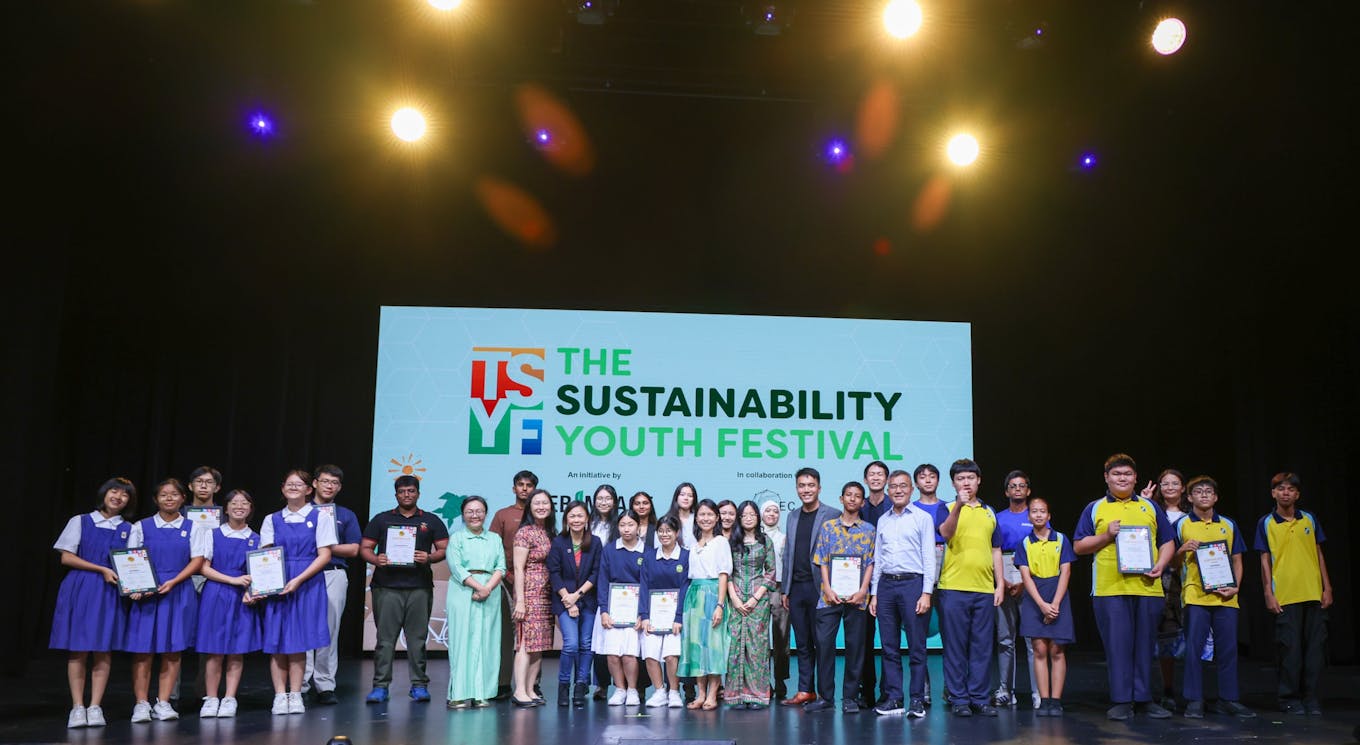
Participants and winners of The TSYF Challenge and TSYF partners gather for a group photo. The inaugural festival attracted over 1,000 participants. Image: EB Impact
Eco-Business is the corporate patron of EB Impact.
Find out more about The Sustainability Youth Festival here. Get involved or partner with EB Impact on the next TSYF edition.