A new tool powered by artificial intelligence (AI) has revealed that rooftop solar installations across the Philippines now total an estimated 1,846.08 megawatts (MW) – the most comprehensive assessment to date of the country’s distributed solar capacity.
Developed by the think tank Institute for Climate and Sustainable Cities (ICSC), the Solar Power Estimation of Capacities and Tracking Using Machine Learning (SPECTRUM) platform uses machine learning algorithms and high-resolution satellite imagery to detect, classify and estimate rooftop solar photovoltaic (PV) systems across the archipelago.
By analysing satellite images and drawing from multi-spectrum data – including infrared and visible light bands – SPECTRUM can automatically identify solar panels and estimate their energy generation potential. The platform fills a long-standing data gap by accounting for both registered and unregistered installations, many of which are not captured under Philippine government initiatives like the net metering programme.
Under the net metering programme, households and businesses can export excess generation – up to 100 kilowatts (kW) – to the grid and receive billing credits, further incentivising solar adoption.

SPECTRUM mapped 1,846.08 MW of rooftop solar nationwide: 1,309.64 MW in Luzon, 472.48 MW in the Visayas and 61.08 MW in Mindanao. Most of the installations were utility-scale. Graph: Institute for Climate and Sustainable Cities
“Through initiatives like SPECTRUM, we turn research into evidence-based policies that guide national planning and empower local governments to adopt climate-smart strategies,” said Angelo Kairos dela Cruz, ICSC executive director.
According to ICSC, SPECTRUM supports a wide range of users – from national energy agencies and local governments, to distribution utilities, developers and researchers. Its insights can inform zoning decisions, improve demand forecasting, guide investments and support compliance with the country’s Renewable Portfolio Standards (RPS).
Solar cities
Initial findings from SPECTRUM’s nationwide scan of 174 cities and municipalities revealed 1,309.64 MW of rooftop solar in Luzon, 472.48 MW in the Visayas, and 61.08 MW in Mindanao. Of the total 1,846.08 MW detected, 1,398.25 MW were utility-scale, 202.03 MW were commercial and 245.8 MW were residential.
SPECTRUM’s AI model is designed for accuracy, claims ICSC, with detection precision rates of 87.6 per cent for residential, 87.1 per cent for commercial, and 98.47 per cent for utility-scale projects.
“
Through initiatives like SPECTRUM, we turn research into evidence-based policies that guide national planning and empower local governments to adopt climate-smart strategies.
Angelo Kairos dela Cruz, executive director, Institute for Climate and Sustainable Cities
Despite the growing attention to solar energy, solar adoption across the Philippines’ major cities remains below 1 per cent of rooftop potential. Data from the SPECTRUM platform show that even in Metro Manila – which has the largest rooftop area at over 19,000 hectares – only 0.47 per cent is currently covered by solar panels.
Other key urban centres such as Metro Cebu (0.48 per cent), Metro Iloilo (0.54 per cent), and Metro Davao (0.16 per cent) similarly fall short of tapping their full solar potential. Bacolod City posts the highest solar coverage at just 0.81 per cent, underscoring the vast opportunity for scaling up distributed solar deployment in the country’s densest urban regions. The ICSC report also highlighted that unregistered solar rooftop capacities are becoming more significant across the country.
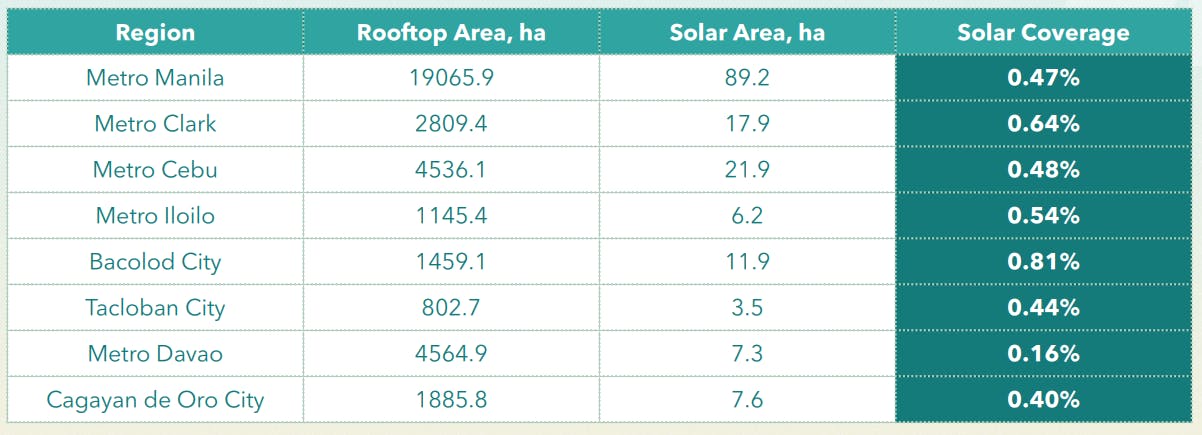
Solar adoption in major Philippine cities remains below 1 per cent of rooftop potential, with Metro Manila at just 0.47 per cent despite having the largest rooftop area. Table: Institute for Climate and Sustainable Cities
“Despite being unregistered, these growing capacities could still contribute significantly to renewable energy generation targets. That’s why we need a clearer, more granular view of what’s already on the ground,” said ICSC chief data scientist Jephraim Manansala.
Department of Energy (DOE) assistant secretary Mylene Capongcol said: “I believe that the ongoing implementation of the SPECTRUM initiative will help us identify potential projects and explore new business models. This also paves the way for the introduction and expansion of innovative and impactful power purchase agreements.”
DOE undersecretary Felix William Fuentebella added: “Metrics are essential – they serve as our compass. By consistently using a spectrum of tools to track these metrics, we can unite people and leaders… around a shared vision.”
The rollout comes at a critical time for Southeast Asia. The recent Renewable Energy Market Review 2025 by insurance company Willis Towers Watson notes that the region must scale up renewable capacity by three to five times by 2035 to meet climate and energy targets. Asia has contributed 72 per cent of global renewable growth over the past decade, led by countries such as China, India, and Asean members.
In the Philippines, government targets under the National Renewable Energy Programme (NREP 2020–2040) call for 35 per cent renewable energy in the power mix by 2030, and 50 per cent by 2040. Meeting the 2040 target will require over 52,800 MW of new capacity, more than half of which – 27,162 MW – is expected to come from solar.
However, the Expanded Rooftop Solar Programme (ERSP) aims to harness residential and commercial participation in the country. With electricity demand from industry also increasing by 6.6 per cent annually, rooftop solar offers a viable way to reduce dependence on the grid and lower consumer costs.
Looking globally, the Philippines may benefit from lessons in countries like China, which installed a record-breaking 60 GW of new solar PV in the first quarter of 2025 alone – 60 per cent of which came from rooftop systems. These installations were driven by new policies encouraging self-consumption and easing grid congestion.
As falling solar costs and new market mechanisms continue to reshape clean energy development, platforms like SPECTRUM are expected to play a central role in accelerating the Philippines’ energy transition. ICSC plans to continuously enhance the tool’s performance by expanding coverage, improving AI precision and tracking solar deployment over time.