
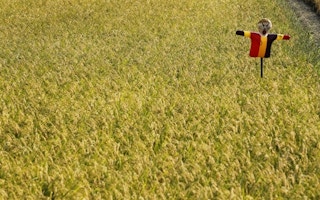
Rice grown in some areas within a 30 km radius of the stricken Fukushima nuclear power plant will be cleared for sale this year, but concerns remain. Some samples have tested positive for radiation well above the permitted level.
So far only test farming of rice in the region was allowed.
Fukushima Prefecture on Wednesday said 44 out of 52 sacks of 30-kg rice harvested in Minamisoma, 20 to 30 km from the power plant, likely exceeded the permissible levels of radioactive materials when tested with a conveyer-belt detector.
The prefecture carried out thorough test of the 44 sacks, and detected 120 becquerels of cesium per kilogram, way over the permissible level of 100 becquerels. “It is possible to sell rice that does not exceed the level,” said a prefecture official.
Meanwhile, another seven tons of highly radioactive water leaked from the desalination pipe for the water used to cool the nuclear reactor in the troubled plant at around 10 a.m. on Wednesday.
Six out of 11 people who were working on the site were drenched in contaminated water. The Tokyo Electric Power Company said a worker’s mistake dislodged a pipe from the desalination device, and radioactive water leaked for about 50 minutes.
The leaked water had beta radiation levels of 34 million becquerels per liter, according to Jiji Press.
Rice grown near Fukushima cleared for sale
Most popular
-
![solar panels my]() Google will also buy renewable energy for its Malaysian data centres from another solar project in the northern …
Google will also buy renewable energy for its Malaysian data centres from another solar project in the northern … -
![Gamcheon Culture Village, Busan, South Korea]() Seoul plans nationwide rollout of village-led projects, targeting 2,500 sites by 2030.
Seoul plans nationwide rollout of village-led projects, targeting 2,500 sites by 2030. -
![Microplastics_Year_End_2025]()
News / Lifestyle
Shocking places where microplastics were found in 2025
New studies reveal plastic particles infiltrating human bodies, food systems and even the planet’s most remote ecosystems. -
![Womens_Health_Rights_Climate_Myanmar]()
News / Policy & Finance
How climate change threatens reproductive health in Asia
A growing body of evidence shows that reproductive health risks rise with climate change in Asia, as experts … -
![Woman_Leather_Worker_Bangladesh]()
News / Manufacturing
Passport for fashion aims to end industry greenwashing
Passport for textiles could verify green claims as global fashion seeks to reduce its environmental footprint. -
![A view of Taipei, Taiwan 5]()
News / Lifestyle
Taiwan parks fall short on plastic reduction as circular economy drive gathers pace
Visitor survey finds continued use of single-use toiletries and plastic bags in protected areas.


