At the recent Bonn Climate Camp, held alongside United Nations climate negotiations in Germany, young Filipino climate activist Ghillean Pranz Fegidero – better known by their drag persona, Celestia – brought both advocacy and artistry into a space where few drag performers have stood before.

Celestia represents Youth for Climate Hope Philippines during the Bonn Climate Camp and United Nations climate negotiations in Germany. Image: Ghillean Pranz Fegider
Wearing heels and carrying a message as bold as her presence, Celestia represented a powerful call for greater inclusion of lesbian, gay, bisexual, transgender, queer, intersex, and asexual [LGBTQIA+] voices in the global climate movement, challenging traditional norms in one of the world’s most high-level policy arenas.
“Bringing my drag into the climate activism space is my love letter to the queer community,” said Celestia, who is part an organisation, Youth for Climate Hope Philippines, that has been protesting to keep Negros Occidental one of the coal-free regions of the country. “With the rising climate crisis, there is an imminent need to reach people outside of our echo chambers and encourage them to join the climate fight. This is where drag and other forms of art [can be instrumental],” they told Eco-Business
Celestia is one of a growing number of queer Filipino voices calling attention to the overlooked intersections of LGBTQIA+ rights and the fight for climate justice.
“When I started doing drag, I made myself a promise that I would make my drag meaningful, purposeful and liberating,” she said. “Drag is a form of protest against oppressive systems. It’s powerful – and we shouldn’t forget that.”
“
We know how to survive, to organise and to care for each other in ways that are deeply rooted in resilience. In many grassroots efforts, LGBTQIA+ people are leading mutual aid, volunteering in relief drives and mobilising networks faster than some formal institutions.
Alvin Toni Gee Fernandez, executive director, Mujer
Climate inequality
That power is desperately needed in the face of rising climate impacts in the Philippines, one of the most disaster-prone countries in the world. A 2024 study noted that climate change has the potential to widen pre-existing health disparities in queer communities. According to Eunille Santos, communications campaigner at Greenpeace Philippines, climate vulnerability in the country is deeply entwined with social exclusion.
“The Philippines consistently ranks among the most climate-vulnerable countries in the world – but vulnerability isn’t just about geography. It’s also about inequality,” said Santos. “LGBTQIA+ communities often exist at the intersections of marginalisation. Some face housing and job insecurity, lack access to legal protections, or are excluded from government services.”
“So when climate disasters hit, these compounded vulnerabilities put LGBTQIA+ individuals at greater risk – whether it’s being denied access to evacuation centres, being misgendered in shelters, or losing access to essential medication and support systems.”
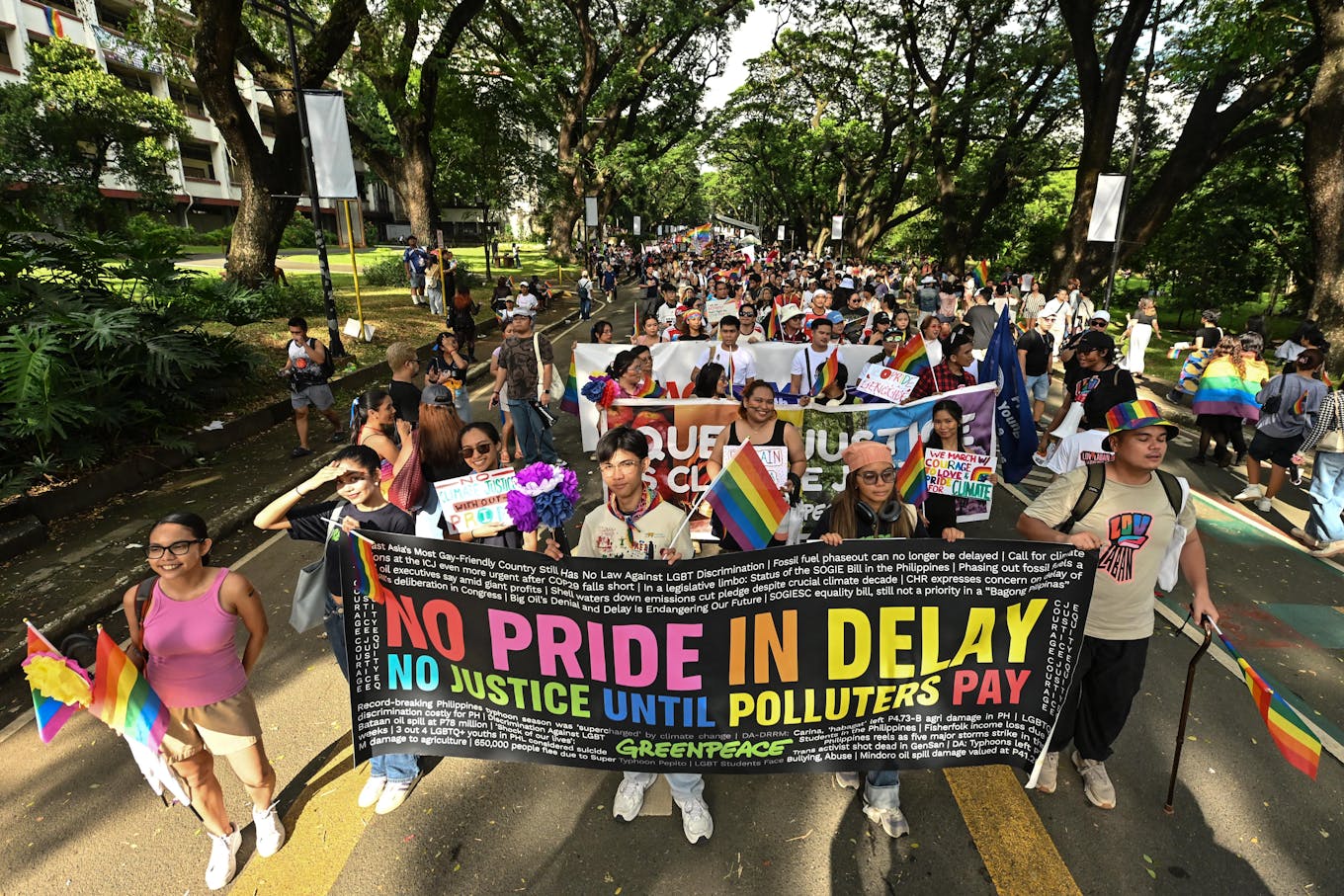
The long-delayed passage of the SOGIE Equality Bill - which would prohibit discrimination based on sexual orientation, gender identity and expression - remains a critical gap in the country’s human rights framework. Image: Noel Celis / Greenpeace
This structural neglect has real, life-threatening consequences. After super typhoon Odette (known internationally as tropical cyclone Rai) struck the Visayas and Mindanao in 2021, Santos recalled that people living with human immunodeficiency virus (HIV) in Southern Leyte couldn’t access antiretroviral therapy for weeks.
“Access to gender-affirming care or HIV medication is essential healthcare. Yet it’s often treated as non-essential or overlooked entirely in emergency planning,” he said.
Compounding this crisis, earlier this year, the Trump administration’s cuts to USAID – including to the President’s Emergency Plan for AIDS Relief (PEPFAR) – put HIV prevention and treatment efforts in the Philippines at serious risk. With the country facing one of the world’s fastest-growing HIV epidemics, groups like LoveYourself have had to start charging for services like pre-exposure prophylaxis – medicine that reduces a patient’s chance of getting HIV – and self-testing kits. UNAIDS (the Joint United Nations Programme on HIV/AIDS) warns that over 550,000 vulnerable people could lose access to essential care if new funding isn’t found.
Still, Santos insisted that LGBTQIA+ people are not merely victims of the climate crisis – they are leaders in confronting it. “LGBTQIA+ individuals have always been powerful agents of care, creativity, and resistance. From disaster response to community kitchens, we’ve turned survival into solidarity for generations.”
Survive and organise
That spirit of care runs deep in grassroots organising. Alvin Toni Gee Fernandez, executive director of the Zamboanga-based LGBTQIA+ group Mujer in the Philippines’ Mindanao region, pointed out that queer communities are often among the first to respond when state support is delayed or absent.
“We know how to survive, to organise, and to care for each other in ways that are deeply rooted in resilience,” Fernandez said. “In many grassroots efforts, LGBTQIA+ people are leading mutual aid, volunteering in relief drives, documenting gaps in services and mobilising networks faster than some formal institutions.”
Fernandez’s understanding of climate vulnerability is shaped not just by typhoons or floods, but by the overlapping crises experienced in their hometown. “Here in Zamboanga, we have faced storms, flooding, and even armed conflict,” she said. “I’ve seen how disasters hit people who are already struggling harder – like the LGBTQIA+ community, women, and those living in poverty.”
These experiences, Fernandez said, deepened their commitment to fighting for inclusive solutions. “Climate change is not just about the weather – it’s about people, survival, and justice.”
But despite their role on the frontlines, Fernandez said queer Filipinos are still routinely excluded from policy discussions. “Honestly, LGBTQ+ voices are still not meaningfully included in climate policy and environmental decision-making – especially here in the Philippines. We are rarely seen as stakeholders, even though we are directly impacted.”
This lack of meaningful inclusion reflects a broader failure of the state to legally protect queer communities. The long-delayed passage of the SOGIE Equality Bill – which would prohibit discrimination based on sexual orientation, gender identity and expression – remains a critical gap in the country’s human rights framework. Without such legal safeguards, Fernandez noted, “we’re left out of planning – so when disasters happen, our specific needs aren’t even considered.”
This exclusion also puts LGBTQIA+ individuals at risk of targeted violence. The Commission on Human Rights recently raised alarm over a “disturbing pattern of trans femicide” following the killings of two transgender women in June. Ali Jejhon Macalintal, a trans rights activist and radio commentator, was shot multiple times by a gunman at an acupuncture clinic she owned in southern Mindanao’s General Santos City. Days later, 18-year-old trans student Gian “Kierra” Molina was also found lifeless in a river in northern Luzon’s Cagayan.
These threats underscore the urgency of tools like Justice with Pride: LGBTQIA+ Community Legal Guidebook in the Philippines, launched in June by Mujer in partnership with TrustLaw, the Thomson Reuters Foundation’s global pro bono legal network, and legal firm SyCip Salazar Hernandez & Gatmaitan. The guidebook outlines existing legal protections, actionable steps against discrimination or “red-tagging” – the labelling of activists or organisations as communists or subversives – and best practices for safe advocacy.
Fernandez said it can empower queer climate defenders and communities to stand their ground. “Knowing your rights is the first step [in empowerment].”
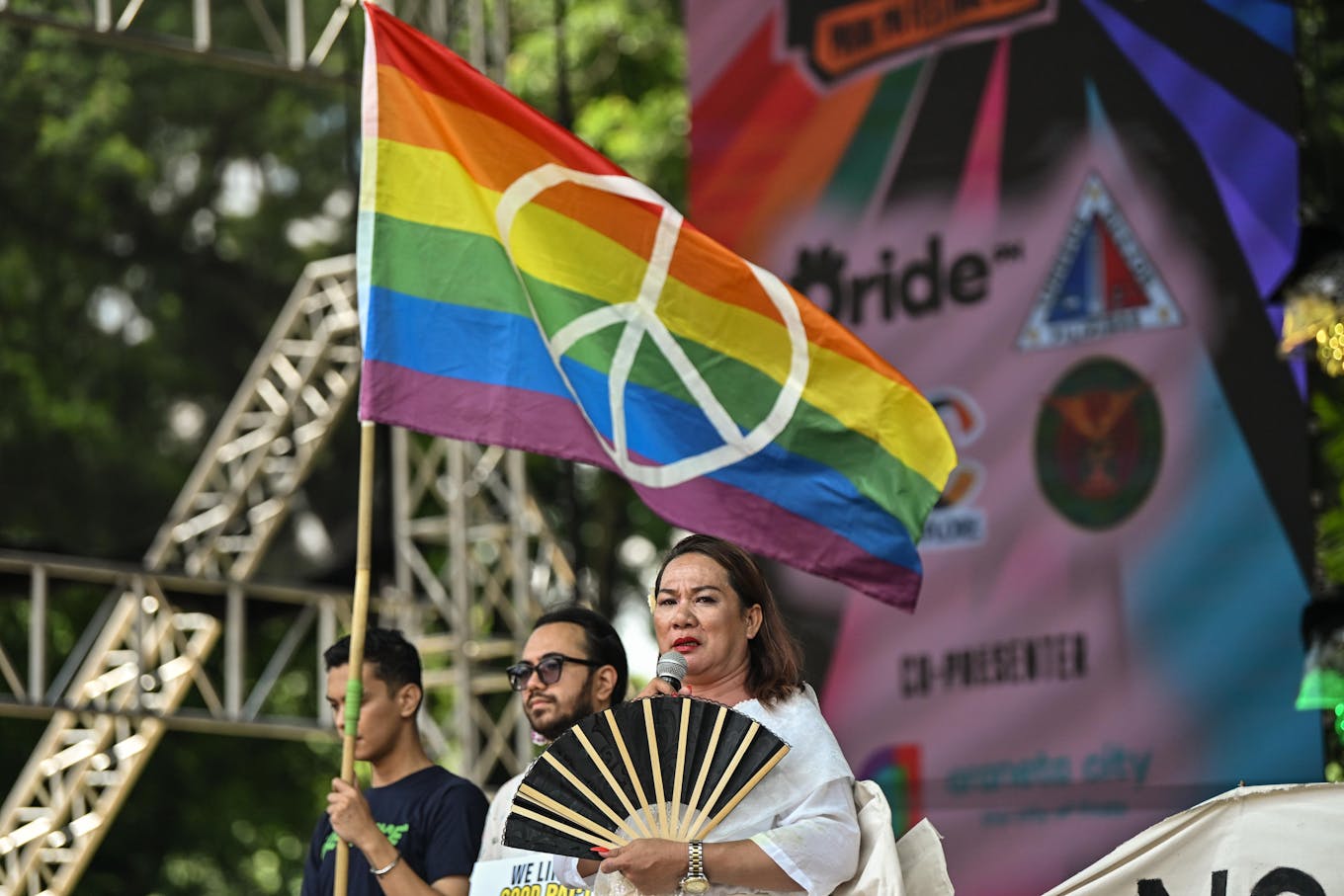
Arthur “Jean” Golong speaks during the LoveLaban Pride Festival at the UP Diliman Campus in Quezon City in late June. Image: Noel Celis / Greenpeace
Unequal access
Survivor stories like Arthur “Jean” Golong’s illustrate just how far that invisibility can go. Golong, now a trans community leader in Tacloban, survived super typhoon Yolanda (known internationally as Haiyan) in 2013 – one of the deadliest storms in Philippine history.
“Before Yolanda, I already had a parlour, a sari-sari store, I bought appliances like a washing machine and refrigerator. I had 50,000 pesos saved. Those savings only lasted for a month because of the typhoon,” they recalled.
When typhoon warnings came, Golong stayed behind to guard what she had worked for. “I couldn’t leave the house because of all the things I had saved up for. I watched the storm tear through everything – walls collapsing, rooftops exploding. It was like something out of a movie.”
She and 13 of their neighbours survived by clinging to a felled banana tree. “Even rats and snakes were swimming with us. They were panicking too.”
After the storm surge, Golong returned to find only the concrete pillars of their home standing. “The floor was gone. Everything was gone.”
In the aftermath, they became a de facto community leader, organising lists of affected families, advocating for relief, and distributing aid. “The support didn’t come to us. I had to go out and ask for it. I carried around a list of 178 families. Eventually, NGOs (non-governmental organisations) started coming because they saw I was doing something.”
LGBTQIA+ individuals are often denied access to welfare and relief aid due to a lack of legal documentation, Fernandez noted, with some losing access for months. “It’s not just a health issue – it becomes a human rights issue,” she said, adding that those without identification or living with chosen families are frequently excluded from welfare.
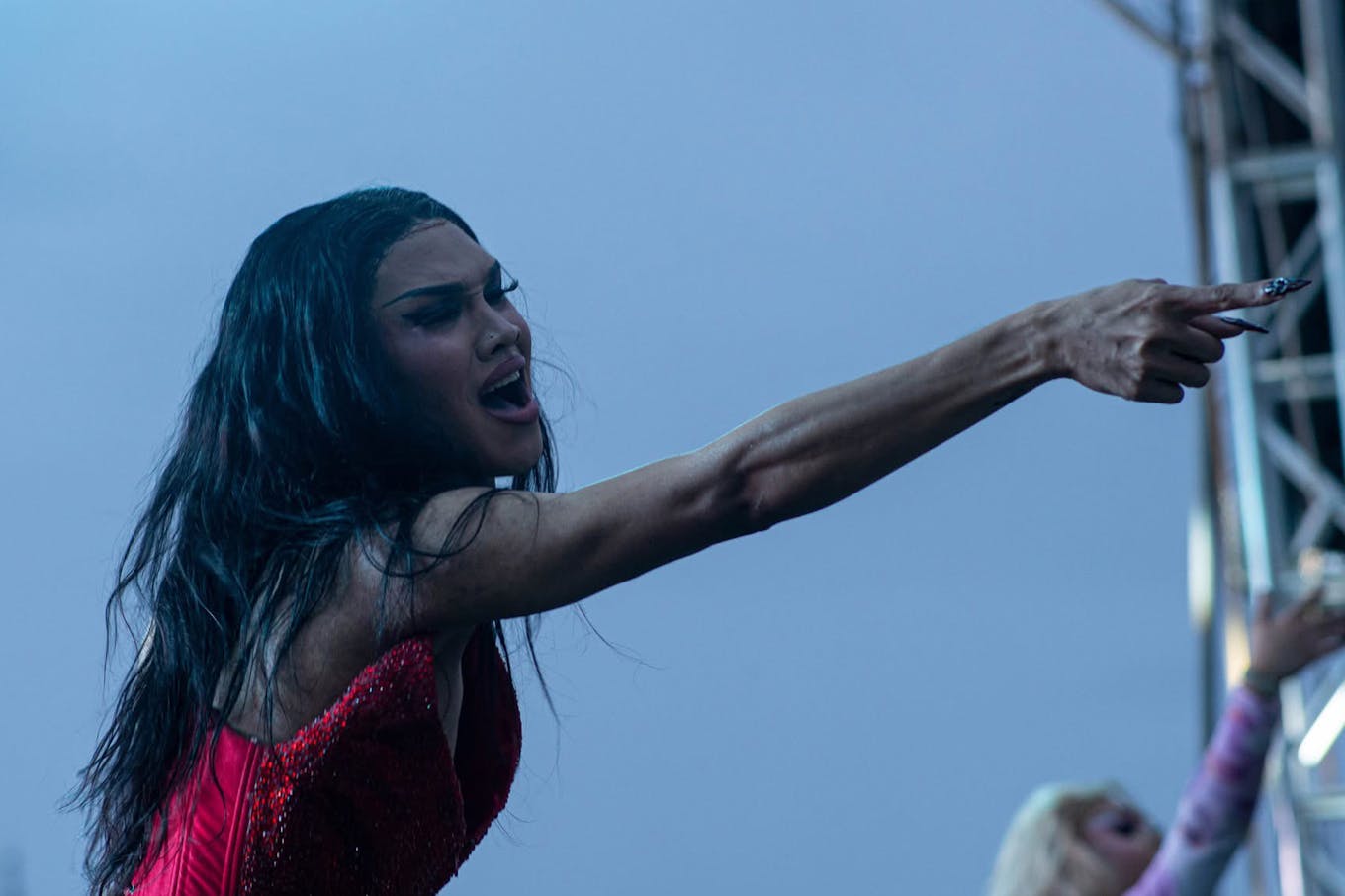
Filipino climate activist Celestia hopes that her drag artistry can encourage more people to join the climate fight. Image:Ghillean Pranz Fegider
For Celestia, these experiences show that there’s more than one way to fight for climate justice – and more than one way to be seen.
“With the rising effects of the climate crisis, there is an imminent need to reach people outside of our [silos],” she said. “Some people may be overwhelmed by [direct climate communication], this is where drag and other forms of art [can help draw attention and spread awareness]. It’s proof that there’s no one way to resist.”
Celestia’s island home of Negros has long faced threats from fossil-fuel projects. “I have seen how different communities have been affected – how greedy corporations continuously exploit our island. I fight not only because it’s right, but because it’s the most humane thing anyone can do.”
Her activism is also rooted in intergenerational memory. “Celestia would not be who she is if it weren’t for the women and the queer [people] who fought before her. My fight is a continuation of their resistance.”
“I want my fellow queer Filipinos to remember that despite society’s attempts to erase our identities and belittle our capacities, we still hold so much power,” said Celestia. “Our community deserves to live – not just survive.”