The creation of a global partnership to help ensure that the world’s fish supplies can keep pace with booming demand has received a green light from FAO’s Sub-Committee on Aquaculture.
Over 50 countries endorsed the Global Aquaculture Advancement Partnership (GAAP) programme, which will bring together governments, UN agencies, non-governmental organizations and the private sector to find sustainable solutions to meeting the need for fish products.
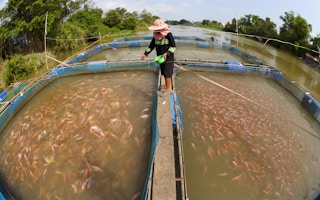
Aquaculture already supplies nearly 50 percent – or nearly 63 million tonnes – of fish consumed globally, and with production from wild fish stocks levelling off, it will fall to fish farmers to supply the estimated 50 million additional tonnes required to feed the rising world population by 2030.
But while aquaculture is one of the fastest expanding food sectors in the world with a current growth rate of around 6.1 percent a year, recent trends predict a gradual decline which might see the sector fall short of bridging the gap between projected supply and demand.
“This is an alarming situation and urgent concerted efforts to build a strong private-public partnership are imperative to maintain the current rate of growth of aquaculture over the coming years,” said Árni M. Mathiesen, FAO Assistant Director-General for Fisheries and Aquaculture.
The partnership will be tasked with overcoming obstacles to the expansion of the sector, which include the increasing scarcity of land and water for the development of inland fisheries and the need to step up aquaculture activities in the world’s seas and oceans.
This in turn will require strict governance to safeguard aquatic animal health and conserve biodiversity.
“GAAP will also help tap the huge potential of aquaculture to help reduce poverty, unemployment and socio-economic inequalities through proper planning and development,” Mathiesen said, recalling that around 80 percent of fish farmers are small-scale.
Some 55 million people are directly employed by the fisheries and aquaculture sector, of whom 85 percent live in Asia.
The initiative will now go for approval to the Committee on Fisheries when it meets at FAO headquarters in Rome in June 2014.
Certification benchmarking
A tool to help countries assess whether public and private aquaculture certification schemes are in line with FAO’s global guidelines for certification has also received a nod from the sub-committee, which is the only global intergovernmental forum discussing aquaculture development.
Covering animal health, food safety, the environment and worker welfare issues, the FAO aquaculture guidelines were approved in 2011 after four years of consultation among governments, producers, processors and traders.
“It is overwhelmingly positive that consumers want to see a label on a product showing that it is sustainably produced. The challenge is to ensure certification provides adequate incentives to small producers and eventually contributes to overall sustainability of the sector,” said FAO Senior Aquaculture Officer Rohana Subasinghe.
“Many schemes claim they are within the FAO guidelines, but this new evaluation framework will allow them to self-assess whether that’s true,” he said.
The evaluation framework will also now pass to the Committee on Fisheries for approval in June next year.
Coordinated efforts in aquaculture needed to meet global demand

Paling popular
-
![UCFS SG Jeffrey Siow]() Speaking at Unlocking Capital for Sustainability Singapore 2026, Minister for Transport and Second Minister for Finance Jeffrey Siow …
Speaking at Unlocking Capital for Sustainability Singapore 2026, Minister for Transport and Second Minister for Finance Jeffrey Siow … -
![Al Gore at IMPACT WEEK]()
Berita / Karbon & Cuaca
Al Gore: Southeast Asia should put its own interests ahead of US-China rivalry
Southeast Asian governments should focus on the interests of their own people, rather than on how Washington or … -
![Fisherfolk_River_Boat_Laos]() Laos’ dams and transmission lines are powering the region’s shift to lower-carbon energy. But its neighbours are also …
Laos’ dams and transmission lines are powering the region’s shift to lower-carbon energy. But its neighbours are also … -
![Orangutan_Wildfire_Indonesia_]()
Berita / Karbon & Cuaca
Rescuers race to protect orangutans from El Niño fires in Borneo
A strengthening El Niño threatens to fuel major fires across Indonesia’s peatlands and mineral soils during this year’s … -
![Malaysia power station]() As Malaysia targets greater renewable energy penetration and data centres drive up electricity demand, experts say the country …
As Malaysia targets greater renewable energy penetration and data centres drive up electricity demand, experts say the country … -
![UCFS_Singapore_TLC_Panel]()
Berita / Karbon & Cuaca
‘We need solutions’: Southeast Asia’s climate risks sharpen case for ocean investment
As Southeast Asia’s climate risks intensify, The Liveability Challenge is backing ocean-based innovations to help close the region’s …