Technology’s race to build more chips and data centres is colliding with a finite resource: water.
The global semiconductor industry now uses roughly 210 trillion litres of water a year – that’s 84 quintillion Olympic-sized swimming pools – and almost half of that is consumed in regions already facing above‑average water scarcity.
At the same time, around 45 per cent of the world’s data centres sit in river basins with a high risk of water‑availability disruptions, many clustered in the same stressed watersheds as chip “fabs”.
A new case study by the Taskforce on Nature‑related Financial Disclosures (TNFD) warns that this dependence on water is no longer just an environmental issue but a mounting financial risk for the technology sector and the investors bankrolling its growth.
The report released on Friday finds that water stress, pollution and climate‑driven extremes could disrupt semiconductor and data centre industries that underpin everything from smartphones and cars to cloud services and artificial intelligence (AI).
It follows TNFD’s recent release of the draft sector guidance for the technology and communications sector, which is currently open for consultation until 10 April.
Water‑hungry fabs and the cloud
Microchips are made in highly specialised fabrication plants, or fabs, where silicon wafers are repeatedly washed with ultrapure water (UPW) to strip away microscopic impurities. Fabrication is by far the most water‑intensive step in chipmaking, and demand for more powerful chips is pushing that footprint higher.
Between 2012 and 2022, water use across the sector doubled, driven by rising output and more advanced products.
A single fab can consume around 14 billion litres of UPW per year. As every unit of UPW requires 1.4 to 1.6 units of municipal water, the upstream draw on freshwater sources is even larger. Globally, the industry’s total intake is comparable to supplying a city like Hong Kong of 7.5 million people.
Data centres, which keep the digital economy – and increasingly prevalent artificial intelligence (AI) services – running, are similarly thirsty.
Typical facilities can use between 25 million and 770 million litres of water a year, depending on size, while hyperscale sites can exceed 2 billion litres annually to cool servers and control humidity. In the United States alone, data centres used an estimated 66 billion litres of water in 2023, roughly equal to the annual domestic consumption of the city of Santa Barbara.
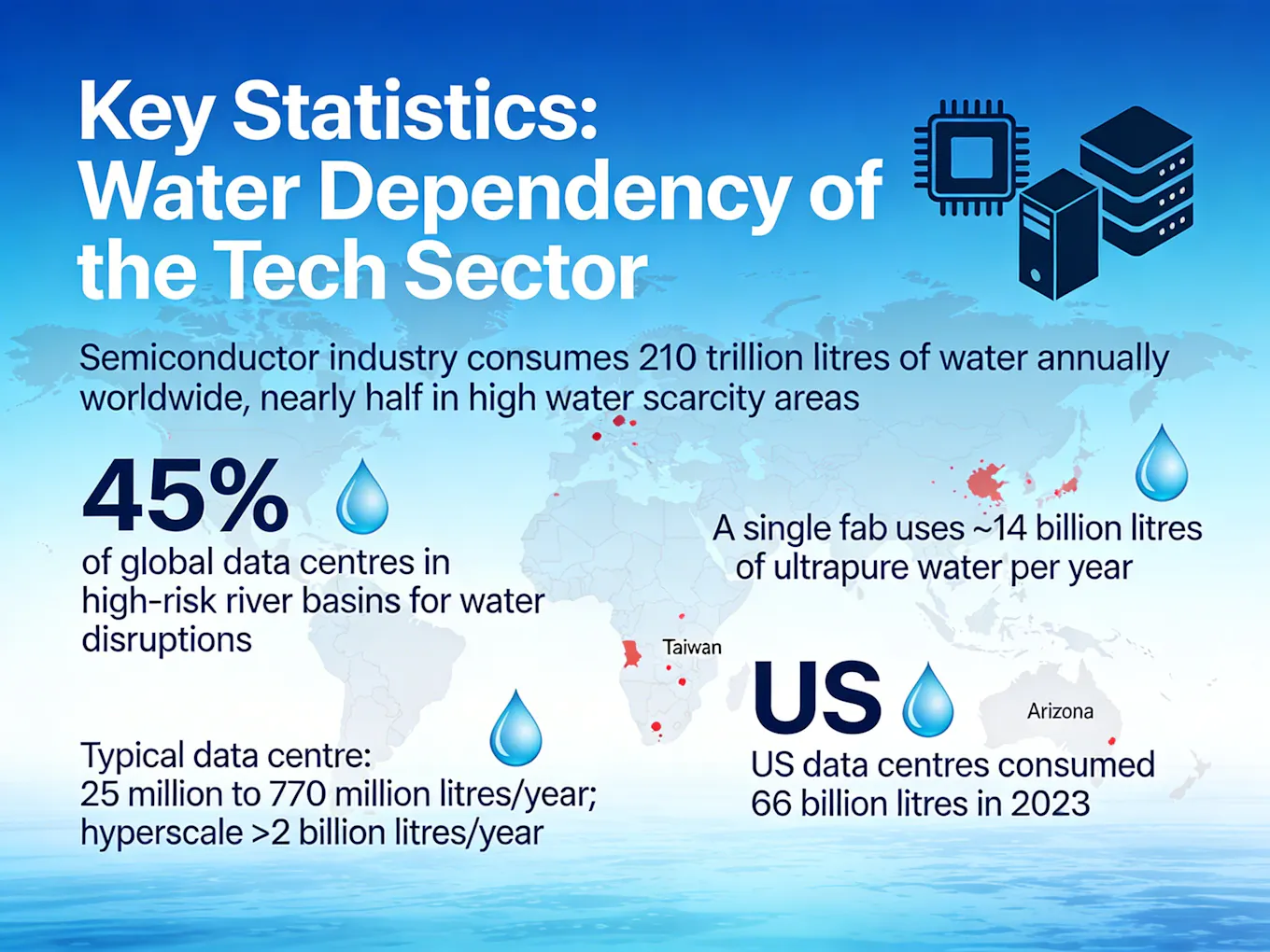 TNFD has released a new case study examining the water-related financial risk facing investors in the telecommunications and semiconductor industry. Image: Generated by Gemini 3-Pro-2026 / Eco-Business
 Water stress hotspots
The TNFD analysis shows that 40 per cent of existing fabs, and more than 40 per cent of new fabs announced since 2021, are located in basins projected to face high or extremely high water stress by 2030.
When adjusted for scarcity, northeast Asia and the western United States emerge as the regions with the highest semiconductor‑related water demand.
In Taiwan, chip giant TSMC commands over 60 per cent of global fabrication revenue and 90 per cent of revenues for advanced chips, supplying major customers such as Apple and Nvidia.
The island relies on typhoon seasons for about 70 per cent of its rainfall, but during 2020 to 2021 no typhoon made landfall, triggering the worst drought since 1964 and pushing some reservoirs below 5 per cent capacity. As water authorities imposed a 15 per cent reduction in supply, TSMC earmarked NT$800 million (US$28.6 million) to truck in water, a 60 per cent increase in its emergency budget.
While agriculture bore the brunt – irrigation was cut off to about 74,000 hectares of rice fields – chipmakers were largely shielded, fuelling concern that water for food is being sacrificed for water for chips.
Mainland China has poured more than US$63 billion into 73 fabs since 2019, backed by state subsidies. Many of these plants sit in eastern and northern industrial regions already grappling with scarcity and pollution, conditions that restrict the use of groundwater for an industry that accounts for about 27 per cent of total manufacturing water use in the country.
Xi’an, a key semiconductor hub, faces growing shortages driven by rising demand, upstream withdrawals and contamination – pressures that could force parts of the sector to migrate south in search of more reliable supplies.
In South Korea, microchips are the country’s largest export, and leading producer Samsung uses around 344,000 tonnes of water per day. The company has acknowledged that water stress is a material risk, while the nation’s dependence on a small number of river basins leaves industry vulnerable to drought.
On the other side of the Pacific, the United States is racing to onshore chip production. Its share of global manufacturing is expected to triple between 2022 and 2032, with major new fabs under construction in Arizona, Idaho, Ohio and Texas. Yet Intel’s Ohio facility is the only announced site not located in a watershed with high or extremely high projected water stress.
Arizona, in long‑running drought, has become a magnet for chip and data centre investment. TSMC is building its first advanced fab outside Taiwan there and has committed about US$165 billion towards additional plants, joining existing facilities operated by NXP, Microchip and Intel.
In 2023, dwindling flows forced Arizona to cut its take from the Colorado River by 730 billion litres – about 21 per cent of the river’s water and 9 per cent of the state’s total use – prompting concerns over how new industrial demand will be balanced with the needs of households and farmers.
From risk to response
As the global chip supply chain is highly concentrated – a handful of firms and regions dominate advanced fabrication – water disruptions in one hotspot can ripple across multiple industries.
The Covid‑19 era chip shortage offered a stark preview: in 2021, the automotive sector, which can require thousands of chips per vehicle, saw production decline by 26 per cent, with supply instability among the contributing factors; Apple alone is estimated to have lost US$6 billion in sales due to chip supply issues.
Communities are also pushing back. In France, activists under the banner StopMicro have staged protests targeting chipmakers STMicroelectronics and Soitec over water extraction. In Spain, the group Tu Nube Seca Mi Río (“Your cloud dries my river”) is calling for a moratorium on new data centres in water‑scarce areas, while in the US the coalition CHIPS Communities United has raised the alarm about the industry’s water footprint, energy consumption and pollution.
In Malaysia this week, protesters gathered at a data centre construction site in the southern state of Johor, demanding an end to dust pollution and compensation for negative impacts on their health.
Protestors also expressed concern the facility will impact their water supply, with Johor having stopped approving certain data centres due to their high water usage.
Regulators are starting to tighten the screws. In Taiwan, new rules that came fully into force in 2025 require high‑volume industrial users to pay an additional NT$3 (US$0.09) per cubic metre during the dry season, eroding the advantage of historically low water prices for fabs.
South Korea has strengthened its Water Environment Conservation Act and Sewage Act to clamp down on pollutants including PFAS “forever chemicals”, prompting operational changes such as PFAS removal and real‑time pollution monitoring at Samsung’s Pyeongtaek site.
Under pressure from regulators, communities and financiers, leading chipmakers and cloud giants are starting to rework how they use water, both within their operations and at the basin scale.
Norges Bank Investment Management has set expectations for water‑intensive sectors to assess, govern and disclose water risk and support collective action, while other asset managers are mapping where their semiconductor exposure overlaps with high water demand and pollution.
The TNFD case study points to solutions already emerging – from closed‑loop cooling and high‑rate recycling at fabs, to wastewater reclamation schemes like Singapore’s NEWater and landscape‑scale restoration projects funded by firms such as Intel – but stresses that avoiding and reducing use at source must come before offsetting.
Without credible, basin‑level stewardship, nature‑related risks in the tech sector could cascade through global value chains and portfolios; with it, says the TNFD report, the industry has a chance to turn a major vulnerability into resilience for both business and the communities that share their watersheds.