


Water experts and policymakers are urging data centre developers to shift construction to less water-stressed areas, as a surge in water-intensive facilities near Southeast Asia’s cities causes shortages and public protests.
To continue reading, subscribe to Eco‑Business.
Access all our exclusive content and archive — with a 7-day free trial. Then just US$5/month. Cancel anytime.
- Exclusive access to training across business and policy topics
- Direct access to industry leaders at Eco-Business events
- A seat among the decision makers shaping the region's sustainable development
Data centres use high volumes of potable water – which is safe for human consumption – for cooling purposes. Research by the Taskforce on Nature-related Financial Disclosures showed that a typical facility can consume between 25 million and 770 million litres of water per year, with hyperscale sites requiring over 2 billion litres.
“It is good to plan early to locate data centres in water-rich areas. That means you will not have the issue of depriving or disrupting normal water supply to the people,” said Teo Yen Hua, former chief executive officer of Malaysia’s National Water Services Commission (SPAN), speaking on a panel at the Asiawater conference in Kuala Lumpur last Wednesday.
In Indonesia, improved siting could mean planning new data centres closer to the country’s new capital city Nusantara, which is being developed in East Kalimantan, Borneo, said T. Subekti, executive director of the Indonesia Water Supply Association (Perpamsi), who also spoke at the conference.
Subekti added that there were opportunities to invest in new data centres that were located closer to Samarinda, an East Kalimantan city. The city sits along the Mahakam river, a large source of raw water that will also support the water needs of Nusantara.
“That is a very big river [but] it is 90 kilometres from the new capital,” he said. “The distance is the challenge, so we need investors. But given it is near the new capital, I think it is a good investment opportunity.”
Subekti told Eco-Business that Borneo’s geological stability, relative to Java and other Indonesian islands, is another good reason to site data centres there.
The majority of Indonesia’s 185 data centres are currently concentrated near capital city Jakarta, according to Data Center Map. A high concentration of data centres are also located on the island of Batam, which neighbours Singapore and which already experiences chronic water shortages, according to an investigation by Indonesian news outlet Katadata.

Image: Samantha Ho/ Eco-Business
“[For] data centres, you need to ensure that there is sustainable water supply – definitely, if you put up [a new data centre] in a greenfield, it’ll be easier than brownfield, provided you have sufficient energy resources (and) digital infrastructure,” said Teo.
In Malaysia, where residents in Johor staged the region’s first protest against data centres in February, this could mean building new data centres in states such as Perak and Pahang instead, where water resources are richer, he added.
“I think the [water authorities can] look at how to tap on these potential areas where we can have more data centres set up, instead of just concentrating in Johor, Selangor, Penang or Negeri Sembilan,” Teo said.
Not like electricity
The construction of new data centres in Asia Pacific have mushroomed near urban areas for several reasons. For one, there are more subsea cables connecting coastal cities such as Singapore. There is also the question of latency, which is the time it takes for data to travel from servers to users and is most valuable to international financial hubs such as Singapore.
Stable and reliable energy connections are another deciding factor for locating data centres. However, it is important to recognise that building infrastructure for water is not the same as that of energy and telecommunications systems, said Teo.
“We’re all looking at the Asean Power Grid and how you can easily transfer electricity to other neighbouring countries – but not (for) water. Water is so bulky,” he said. “To pump one metre cube or one tonne of water…water tariffs must be revised to reflect the actual cost.”
“It is not practical to have a water grid across Asean because the pumping costs will kill you,” Teo added. “But [for] neighbouring islands and areas, it is feasible to look at [connectivity].”
This is a solution that some water districts in the Philippines must also explore, according to Salvador M. Royeca, general manager of Baguio Water District.
“We need to invest in raw water [infrastructure] development,” he said on the same panel, adding that piping systems must be upgraded to transport water from other regions or neighbouring towns to meet data centre demand.
Royeca also highlighted how the demand profile of data centres differs from typical residential, commercial or even industrial users. “Data centres need 24/7 water supply… they use high volumes of water but have low tolerance for interruptions because it will affect their operations.”
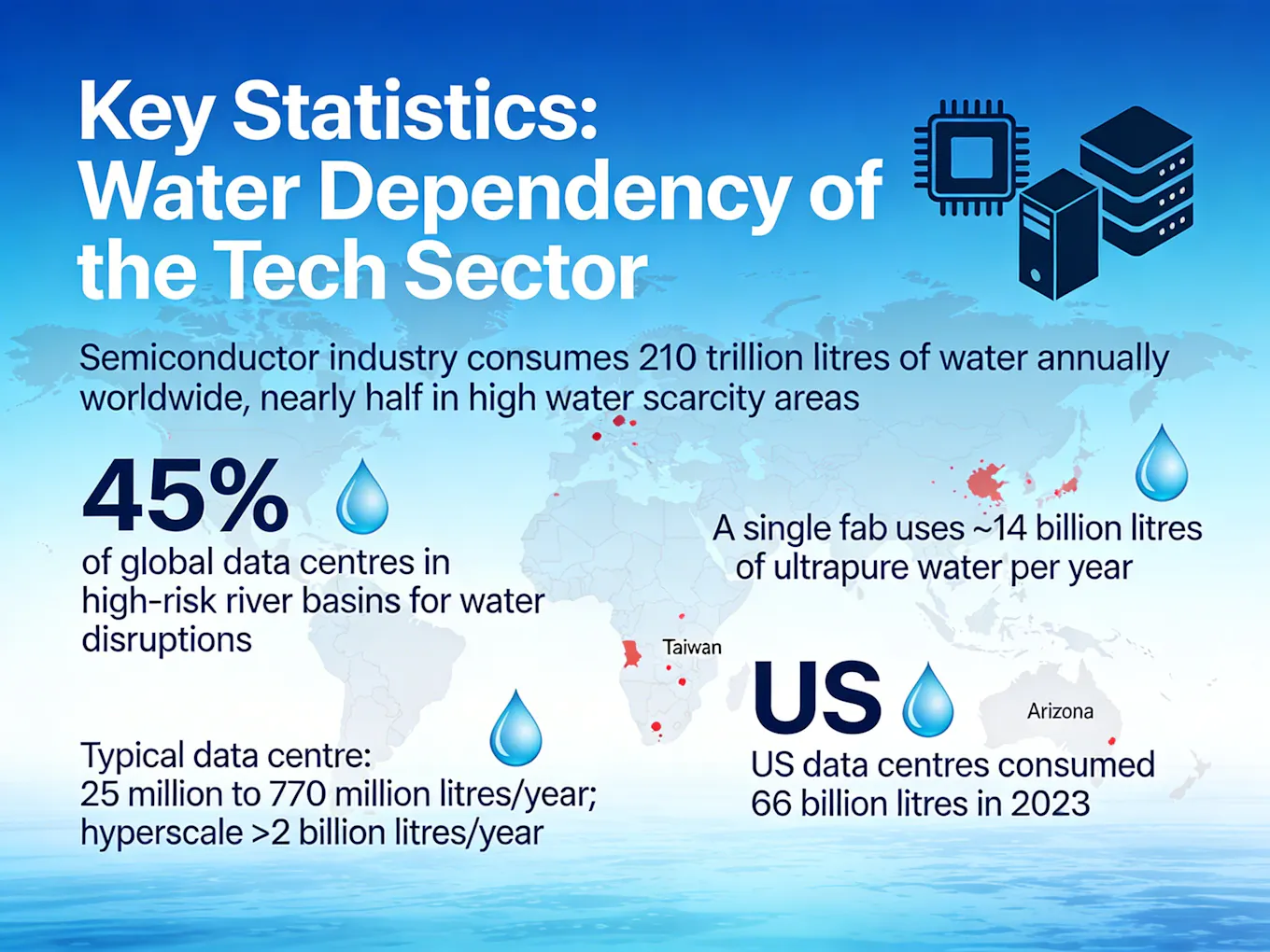
TNFD has released a new case study examining the water-related financial risk facing investors in the telecommunications and semiconductor industry. Infographic: Generated by Perplexity-2025 / Eco-Business.
However, existing water systems are designed for conventional demand and “not industrial-scale, continuous cooling loads,” he said. “This is the challenge. We need to adapt our strategies.”
Tariff revisions
Malaysia’s Teo said that tariffs also need to be restructured to reflect the true cost of water for data centre operators, adding that higher tariffs are unlikely to deter operators if service providers can deliver on stable, reliable supplies.
“We know that what [the industry] actually wants is…consistent water quality and consistent supply, without interruption,” he said. “Those are the critical factors which convince them whether Malaysia is the right place to build data centres, not so much the tariffs.”
Higher tariffs be one of several ways to help Thailand’s water industry cope with surging demand, as country’s water authority has increasingly relied on private service providers to secure water supplies. Increasing water stress has been felt especially in the country’s Eastern Economic Corridor, where data centre construction is booming.
Sumetee Charoenwongmit, assistant governor for the strategic planning at Thailand’s Provincial Waterworks Authority and a member of the Thai Waterworks Association told Eco-Business that the country may need to consider imposing separate, higher water tariffs on data centre operators.
The water authority is currently buying water from private operators to cope with higher demand, but Sumetee said that this is not a viable long-term solution. At most, such an arrange can only go on for another five to ten years, he said on the sidelines of the Asiaworks conference.
“In the medium term, we have to think about [improving] wastewater management,” he said, echoing a need raised by Malaysia’s and the Philippines’ Royeca. Companies such as Bridge Data Centres have already begun using treated wastewater for their facilities in Johor.
In other water-stressed data centre hubs such as Batam, desalination is being considered as a another source of water, said Subekti. He told Eco-Business that lessons can be learnt from Saudi Arabia, where the cost of desalination has been reduced to as low as US$0.30 per tonne.
“I think that this is a good opportunity for (new supplies of) raw water,” he said. The majority of Batam’s raw water currently comes from surface water, which includes rainwater and reservoirs.