Scientists around the world are racing to find a solution to a deadly disease that is spreading through shrimp farms in South-east Asia, killing shrimp en masse.
Earlier this year, the Global Aquaculture Alliance estimated that Early Mortality Syndrome (EMS), which emerged in China in 2009 and reached Thailand this year, is causing annual losses of more than US$1 billion (S$1.3 billion) across China, Vietnam, Malaysia and Thailand.
Thailand, the largest shrimp exporter in the world with last year’s exports worth 95.3 million baht (S$3.8 million), is being increasingly hit by a virus-triggered toxin which kills the shrimp.
“We are at a very early stage and there are different opinions,” said Dr Simon Funge-Smith, an aquaculture expert at the Food and Agriculture Organisation in Bangkok. “It is not clear yet how the virus is arriving in the ponds.”
The worst-affected countries are China, Vietnam, Malaysia and Thailand, which together account for 70 per cent of global shrimp exports. Losses caused by EMS are ruining some shrimp farmers across the region and driving up prices in importing countries.
Thailand’s shrimp production this year is expected to fall to 350,000 to 400,000 tonnes from around 500,000 tonnes last year, estimated Ms Karnda Kraikajornkitti, an executive at the Thai Shrimp Association.
There are around 30,000 to 40,000 shrimp farms in Thailand, most of them small-scale, Ms Karnda said. An average of 25 per cent to 30 per cent of farms in any given area are affected by EMS, she said.
The worst-hit area was eastern Thailand, but EMS recently affected farms in the south as well.
The association was hopeful that the situation would return to normal next year, she said.
The disease is caused by a virus that affects bacteria naturally present in the gut of the shrimp. The bacteria then create a toxin that kills the shrimp.
Outbreaks typically occur within the first 30 days after stocking a newly prepared shrimp pond, and mortality can exceed 70 per cent.
“One laboratory in the US claims to have replicated the effect of the virus,” Dr Funge-Smith said. “Right now other labs are trying to do the same. It is only when labs are able to recreate this that you understand the mechanism of the disease and can then take steps to manage it. Until then, it is shooting in the dark.”
The vulnerability of shrimp farms is linked to the fact that they are usually open-air systems with water flowing in and out.
Converting them to closed systems using mostly recycled water is expensive. And with profit margins low, few shrimp farmers can afford the systems.
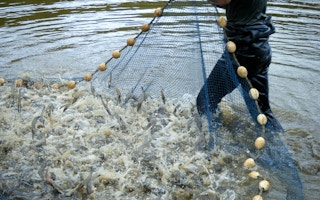
Race on to fight deadly shrimp disease
Paling popular
-
![A Sojao outlet in Singapore]()
Berita / Tanggugjwab Sosial Korporat
Singapore SMEs are struggling with sustainability, but for some it’s a competitive edge
Rising costs, consumer apathy and slowing climate action are holding Singapore’s SMEs back on sustainability – but for … -
![Ambassador Ravi Menon and Minister Grace Fu]()
Berita / Polisi & Kewangan
Singapore launches new C3T council to drive competitive climate shift beyond compliance
Singapore has launched a new public-private platform to help companies stay competitive as climate risks intensify and the … -
![Climate_Villains_Nickel_Mining]()
Pendapat / Tenaga
The energy transition has its own Strait of Hormuz
A system built on renewables introduces new risks, as critical bottlenecks shift to refining, processing, and mineral-supply chains. -
![Offshore wind]()
Audio / Tenaga
De-risking offshore wind could put Philippines ahead in clean energy race: GWEC’s Ann Francisco
Government must call on development finance institutions to tap on risk management tools to make the capital-intensive technology … -
![Vehicles on a road in Phnom Penh]()
Berita / Pengangkutan & Logistik
Cambodia scraps EV import taxes, citing fuel price pressure
Duties have also been lowered for goods such as electric rice cookers, solar lamps and batteries as the … -
![China skyline_EB stockpress]()
Berita / Polisi & Kewangan
Asia Pacific a bright spot for sustainable finance in 2026: ING
Financial institutions and corporations drove strong growth in green bonds and loans in 2025, the banking group said, …