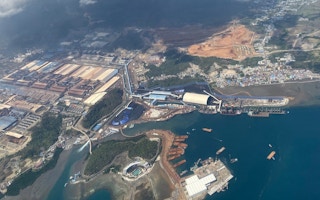
Indonesia’s rapid expansion of captive coal plants to power its nickel boom is placing the country’s climate goals, public health and economic future at risk, according to analysis by the Centre for Research on Energy and Clean Air (CREA) and Global Energy Monitor (GEM).
Operational and planned captive coal capacity – which are coal plants that power industrial facilities and are not connected to the national grid – has reached 31 gigawatts (GW). This figure triples Indonesia’s 2023 captive coal base capacity, exceeds the size of Australia’s entire coal power fleet and is close to matching Germany’s total coal capacity.
Of the 31GW, 19.3GW is already operational, 3.6GW is under construction, and a further 8.16GW is in the pipeline. The scale of expansion contrasts sharply with official transition assessments. A November report on captive coal by Just Energy Transition Partnership (JETP), a national scheme to move the country away from fossil fuels, cited just 3.1GW of planned capacity in its text, while tabulating 4.45GW elsewhere and omitting all announced projects, the analysis found.
In a recent statement, researchers said this discrepancy highlights a broader lack of transparency and oversight in Indonesia’s coal transition planning.
“Indonesia’s energy landscape is undergoing a radical split, where a stagnant national grid is being eclipsed by an explosive, nickel-driven captive coal surge,” said Katherine Hasan, an analyst at CREA. “Explicitly integrating captive coal units into national 2040 phase-out targets and establishing a public monitoring framework are essential to enforcing the 35 per cent emissions reduction mandate.”
Captive coal projects also benefit from regulatory loopholes under Presidential Regulation No. 112 of 2022, which grants exemptions for national strategic projects. While the regulation requires captive units to reduce emissions intensity by 35 per cent, there is currently no public monitoring framework or evidence to verify compliance.
“The omission of large volumes of captive coal capacity from official assessments, combined with weak regulatory oversight, risks locking Indonesia into a high-emissions pathway and creating stranded assets that could undermine national competitiveness for decades,” CREA and GEM said in a statement.
Between GEM’s July 2024 and July 2025 coal plant database updates, captive coal accounted for around 80 per cent of all new coal capacity added in Indonesia, pushing operational captive capacity to 19.3GW.
Much of this growth is concentrated in nickel processing hubs in Central Sulawesi and North Maluku, where captive coal capacity has multiplied by 2.25 times since 2023 as a result of the burgeoning nickel processing industry.
Indonesia’s nickel is critical for electric vehicle batteries and the transition to a cleaner energy future. However, nickel smelters are being powered by coal power plants that emit toxic pollution.
CREA’s modelling of Indonesia’s coal transition pathways shows that excluding captive coal from national retirement targets would carry severe human and economic costs. The organisation estimates that this approach could lead to 27,000 additional air pollution-related deaths and impose a cumulative economic burden of US$20 billion before the coal fleet is fully decommissioned.
A separate CREA study focused on nickel processing regions found that while industrial output peaks around the fifth year of development, environmental degradation begins to sharply erode economic gains by the eighth year. By 2030, air pollution in these hubs alone is projected to cause 5,000 deaths annually and cost the economy US$3.42 billion each year. Environmental damage is also expected to result in US$235 million in losses for local farmers and fishers over the next 15 years.
As global markets increasingly demand green-certified minerals, analysts warn that Indonesia’s heavy reliance on coal-powered industrial growth could weaken its position in international supply chains. Failure to decarbonise its industrial base may expose the country to carbon-based trade measures and exclusion from key markets such as the European Union, which this month introduced a carbon border tax.
“If the government wants to achieve its Golden Indonesia 2045 vision [Indonesia aims to be a developed country by 2045], it must recognise the profound economic and environmental benefits of an ambitious early retirement schedule for both on-grid and captive coal fleets,” Hasan added.
Lucy Hummer, senior researcher at GEM, said transparency is a prerequisite for a credible energy transition. “Data transparency is a fundamental first step towards a just and accountable energy transition,” she said. “It is impossible to plan the replacement of coal plants with renewable alternatives without understanding the full landscape of existing and planned coal capacity – especially for captive coal, which has grown rapidly and largely unchecked in recent years.”
“Knowing where these plants are, how large they are and what industries they serve is critical to fully incorporating captive coal into long-term transition planning and effectively phasing out coal power in Indonesia – not just on the state grid, but across the entire economy.”