
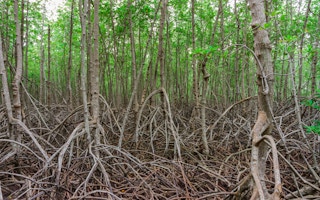
Indonesia`s mangrove swamp is the largest in the world, covering some 3.2 million hectares, or 22 percent of the total area of mangroves in the world, with a high level of biodiversity.
Despite their many benefits, these coastal trees are in a vulnerable state. Over the last 20 years, the area has been reduced by 1.1 million hectares, mostly due to conversion to other land uses.
In the 1980s alone, mangroves covered 4.2 million hectares of land in Indonesia, but by the end of the 1990s, more than half of that coverage had been lost to agricultural expansion.
Indonesia, a sprawling archipelago of 17,504 islands with a total coastline of 95,181 kilometers, is extremely vulnerable to a rise in sea levels, storm surges, or intense tropical storms linked to global warming.
Most of its population lives along the coast and in the downstream areas of watersheds, which empty into the main ocean.
In his speech to mark the opening of the seminar on 25 years of Mangrove Forest Management, held by PT Bintuni Utama Murni Wood Industries (BUMWI) in Bogor recently, Dr Harry Santoso, senior expert for the Ministry of Forestry for the Development of Watershed Management, remarked that the economic potential of coastal areas is generally quite high.
However, from time to time, due to the pressure of rapid development, both directly and indirectly, as well as increasing demand for the conversion of mangrove forests along the coast, it is often difficult to avoid conversions that would benefit the poor. Pockets of poverty caused by the loss of livelihoods for those living along the coast among the mangroves are now widespread.
At the seminar, drawing on the Bogor Agricultural University`s (IPB) 50 years of experience, Santoso noted that people living in coastal zones continue to face certain challenges.
First, according to data issued by the Central Bureau of Statistics (BPS), some 7.87 million people, or 25.14 percent of the total population under the poverty line, live along the coast of Indonesia.
Second, the rampant coastal environment destruction due to the conversion of land for intensive aquaculture (fish and shrimp pond) programs, settlement, tourism, fisheries programs, agricultural expansion, mining, reclamation efforts, and excessive harvesting of mangroves for firewood, among other things, has caused the continuous depletion of critical ecosystems in coastal areas, including the protected mangrove forests and coral reefs.
Third, deforestation and changes in land use affecting mangrove forests will contribute to greenhouse gas emissions (GHG) by destabilizing the climate and ecosystem, lowering the productivity of people living in rural areas, especially in the pockets of poverty in coastal areas that are prone to food insecurity.
Fourth, national security and defence concerns are still being resolved, such as illegal logging, fishing, and mining activities and human trafficking in the coastal areas and small islands off the beaten track.
“The management of the mangrove ecosystem, as a renewable resource, should be an integral part of the spatial planning of provinces, districts, and cities and the management of watersheds from upstream to downstream,” Santoso said.
“This is necessary because mangrove forests form a bridge between terrestrial and marine ecosystems and, thus, have a specific function; its existence depends on the dynamic relationship between terrestrial and marine ecosystems,” he added.
According to Santoso, the existence of the mangrove forest, as a wetland resource in coastal areas, is influenced by watershed ecosystems.
PT BUMWI has established itself as a pioneer in opening up the eastern part of Indonesia. The company was launched through order SK-HPH No. 174/Kpts-IV/1988 on March 21, 1988. The 82,120 hectare concession area covers a large part of the Bintuni Bay mangrove forest. Through order SK No. 213/Menhut-II/2007, registered on May 28, the company`s right to use the land was further extended to the year 2052.
To date, the company exports a total of 2.7 million green tons of wood chips, employs an average of 800 workers per year and contributes to the protection of the mangroves and its ecosystem.
By hosting the seminar and inviting experts to address the attendees, Raflis, president director of PT BUMWI, pointed out that he would like to provide transparent information on the company`s activities in managing its concession area.
He recognized that hectares of mangroves in some parts of Indonesia have been cut or damaged through harvesting or for other reasons, but most of the deforestation was due to conversion of the land to other land uses.
“For the last 25 years, the company has contributed significantly to the local economy as well as to that of the entire country,” Raflis said.
“Surely we all hope that the work and best practices of sound management of the mangrove forests, which has been implemented by PT BUMWI in the Gulf of Bintuni, Papua, for 25 years, should be replicated in other regions of Indonesia and even abroad,” Santoso asserted.
Other countries and companies can especially learn from the company`s ability to source basic data and information for publication, create pilot and reference materials for sustainable mangrove management, develop learning management systems, develop science and technology, manage institutional and human resources, plan the location of education, implement training, handle extensions, and conduct research and development.
Lessons learnt on managing mangroves sustainably

Paling popular
-
![Shipping_Harbor_Shanghai_China_Steel]()
Berita / Pembuatan
China’s changing steel sector could leave Australian iron ore behind
Steel slowdown and signals of low-carbon transition in China put Australian ore at a crossroads, as partnerships look … -
![Hazy Chinatown in Singapore]()
Berita / Karbon & Cuaca
This year’s haze is set to cost Singapore more than 2015’s S$1.83 billion. Who pays for the losses?
Economists suggest the 2026 haze will cost Singapore more than the 2015 episode, while other estimates state that … -
![Wildfire_Indonesia_Simulation_Excercise]() Wildfires in West Kalimantan are leaving wildlife struggling to find fresh water as forest pools dry up and …
Wildfires in West Kalimantan are leaving wildlife struggling to find fresh water as forest pools dry up and … -
![AirTrunk]()
Berita / Tenaga
AI, data centres could make Asean clean energy projects bankable as grid plans advance: experts
Long-term power purchases could unlock investment in renewables and transmission as Asean advances cross-border electricity trade, say energy … -
![Construction_Workers_Dam_Bhutan]() Nepal floods bring renewed focus on neighbour Bhutan’s efforts to protect its economically crucial – but debt generating …
Nepal floods bring renewed focus on neighbour Bhutan’s efforts to protect its economically crucial – but debt generating … -
![Car_Show_Display_BYD_China]()
Berita / Pembuatan
China’s EV weight problem
Electric vehicles are getting heavier, making bigger carbon footprints in the factory and on the roads.