Asia Pacific‘s leading platform for sustainable development
Myanmar Berita

The region accounts for nearly half of global GDP represented by economies adopting ISSB standards, but ACCA warns that businesses must move beyond compliance to address climate risks, resource pressures and emerging challenges.

Tenaga
Latest Asean energy outlook ditches carbon neutrality pathway, projects higher emissions by 2050
Asean’s official energy outlook, endorsed by its energy ministers on 8 October, reveals a gap between the region’s energy plans and its members’ net-zero pledges, and allows new coal plants to be built even in its lowest-emissions scenario.

Bandar-bandar
Global mangroves rebound after decades of loss
Globally, mangrove cover has grown by 477 square kilometres (184 square miles) between 1985 and 2025, marking a turnaround from the losses that have predominated for years, but gains are uneven.

SMEs form the backbone of Asia’s supply chains and labour force across Asia’s emerging markets, yet many struggle to access the finance and insurance needed to withstand climate shocks. Eco-Business speaks to UNDP’s Tom Beloe in Hong Kong, who explains what it will take to reach them.
Bandar-bandar
Rohingya camps in Bangladesh face growing landslide risk
Polisi & Kewangan
Climate adaptation and resilience need its own investment language: MAS
Polisi & Kewangan
Chinese transition mineral abuses surge 190% overseas, says new study
Myanmar Pendapat

Karbon & Cuaca
Regional haze casts a pall on Asean’s influence
The return of smoke haze underscores a sobering reality: while Asean has policies designed to combat it, the problem continues to occur.

Polisi & Kewangan
For Southeast Asia, the AI race is about access, not supremacy
The region’s stake in AI is not simply which great power builds the most capable model. The key is to ensure that AI remains affordable, locally relevant, continuously available and politically accessible.

Karbon & Cuaca
Rethinking flood protection through a ‘no-regret’ lens
Governments in our region and beyond must plan today for tomorrow's floods, in a warming world. Regret can be minimised, if not eliminated.

Workers’ suffering is an integral part of the fisheries system, say four experts.
Polisi & Kewangan
Southeast Asia’s high-income aspirants should focus on quality of growth
Makanan & Pertanian
How Asean can reduce its heavy dependence on imported agricultural inputs
Makanan & Pertanian
Securing Asean’s food resilience amid the Middle East conflict
Makanan & Pertanian
Women farmers are the first defenders of a warming Southeast Asia
Myanmar Video

Southeast Asian nations are racing to bring clean, affordable power to their people, but one country is outrunning them all. How can states make their renewable energy transition a success?
Studio EB
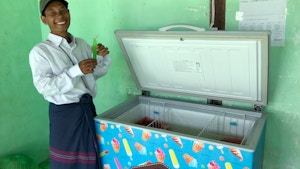
In line with the Sustainable Development Goals' aim to eradicate poverty, a Japanese multinational electronics firm is providing power supply stations, solar storage and products to countries with little or no access to electricity.

Makanan & Pertanian
Water-saving tech, veg gardens grow hope in Myanmar’s Dry Zone
In parched lands, families grow food in gardens using drip irrigation, hydroponics and soil moisture sensors to cut down on over-irrigation and save water.

Bandar-bandar
Rockefeller renews call to help cities become stronger
The Rockefeller Foundation is looking for more cities willing to build economic, social and physical resilience amid a rapidly urbanising world. Submission of applications for the 100 Resilient Cities Challenge ends on September 10.
Myanmar Siaran Akhbar

UNICEF (United Nations Children's Fund)
Acute food insecurity, malnutrition remain alarmingly high as crises deepen: report

United Nations Development Programme (UNDP)
Satellite imagery guides faster recovery in crisis zones

United Nations Development Programme (UNDP)
Myanmar’s youth 'on hold' as education and employment crisis deepens

United Nations Development Programme (UNDP)
Urgent removal of at least 2.5 million tonnes of debris needed in Myanmar following earthquake: UNDP


Myanmar Penyelidikan

Eco-Business
Ecosperity 2026 Impact Report

BirdLife International
State of the World's Birds 2018—taking the pulse of the planet




Receive the latest insights daily or weekly.
Organisasi Strategik