
Air pollution is a silent killer that claims millions of lives globally. The World Health Organisation reported that 1.7 million children under the age of five die each year from polluted environments.
To continue reading, subscribe to Eco‑Business.
Access all our exclusive content and archive — with a 7-day free trial. Then just US$5/month. Cancel anytime.
- Exclusive access to training across business and policy topics
- Direct access to industry leaders at Eco-Business events
- A seat among the decision makers shaping the region's sustainable development
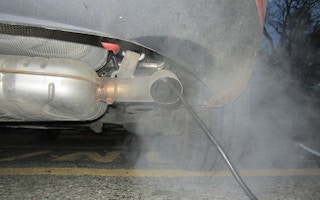
In highly urbanised cities, tailpipe emissions are a major source of air pollution. Particularly notorious are particulate matter 10 and particulate matter 2.5, or PM10 and PM2.5, so-called for their size being 10 and 2.5 micrometres or less in diametre, respectively.
Because of its size, PM2.5 cannot be filtered by ordinary masks, and thus, can lodge directly in the lungs, causing inflammation and a variety of respiratory infections.
The European Union (EU) ranks third in the world for global CO2 emissions from road transport, according to a European Commission report that cited 2015 International Energy Agency (IEA) data. China tops this chart, followed by the United States.
To curb the environmental and health risks from exhaust emissions, the EU introduced the European Emission Standards. First rolled out in 1993 with Euro 1, the standards define the acceptable limits of exhaust emissions of new vehicles sold in EU and European Economic Area (EEA) member countries. In September 2015, the EU introduced its latest standard, Euro 6.
What is Euro 6? How can it help make exhaust emissions cleaner and safer? What pollutant does Euro 6 aim to reduce? This infographic demonstrates the evolution of the European Standards over the years, and how Euro 6 promises cleaner air for all.
.jpg?auto=format&dpr=2&fit=max&ixlib=django-1.2.0&q=45&w=680)
Facts About Euro 6. Image: Northgate Vehicle Hire